
与遵循标准美式饮食的女性相比,遵循营养丰富、富含植物性食物饮食的女性表观遗传衰老速度较慢,炎症指标较低。
Slower Pace of Epigenetic Aging and Lower Inflammatory Indicators in Females Following a Nutrient-Dense, Plant-Rich Diet Than Those in Females Following the Standard American Diet.
作者信息
Ferreri Deana M, Sutliffe Jay T, Lopez Nanette V, Sutliffe Chloe A, Smith Ryan, Carreras-Gallo Natalia, Dwaraka Varun B, Prestrud Ann Alexis, Fuhrman Joel H
机构信息
Nutritional Research Foundation, Flemington, NJ, United States.
Department of Health Sciences and the PRANDIAL Lab, Northern Arizona University, Flagstaff, AZ, United States.
出版信息
Curr Dev Nutr. 2024 Oct 28;8(12):104497. doi: 10.1016/j.cdnut.2024.104497. eCollection 2024 Dec.
BACKGROUND
Plant-based diets are associated with lower inflammatory biomarkers and reduced risk of age-related chronic diseases. Epigenetic biomarkers of aging are DNA methylation-based tools that estimate biological age and rate of aging, providing insights into age-related health risks. Healthy diet and lifestyle indicators correlate with slower epigenetic aging.
OBJECTIVES
Neither inflammatory biomarkers nor epigenetic aging has yet been studied in the nutrient-dense, plant-rich (Nutritarian) diet, a plant-based diet that emphasizes specific plant foods, such as cruciferous vegetables, beans and other legumes, onions and garlic, mushrooms, berries, nuts, and seeds. We aimed to compare inflammatory status and epigenetic age acceleration in females following a Nutritarian diet with those of females following a standard American diet (SAD).
METHODS
We investigated dietary inflammatory potential, epigenetic age acceleration using first, second, and third-generation clocks, and additional health-related epigenetic biomarkers in this retrospective cohort study of 48 females who habitually (≥5 y) follow a Nutritarian diet and 49 females without obesity who habitually (≥5 y) follow a SAD. Participants completed a series of online questionnaires and provided a blood sample.
RESULTS
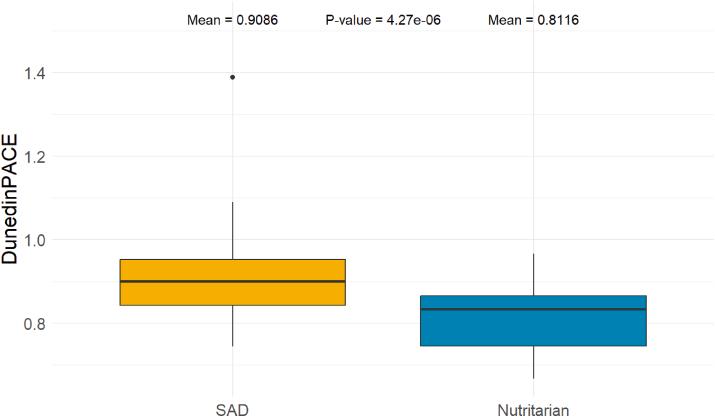
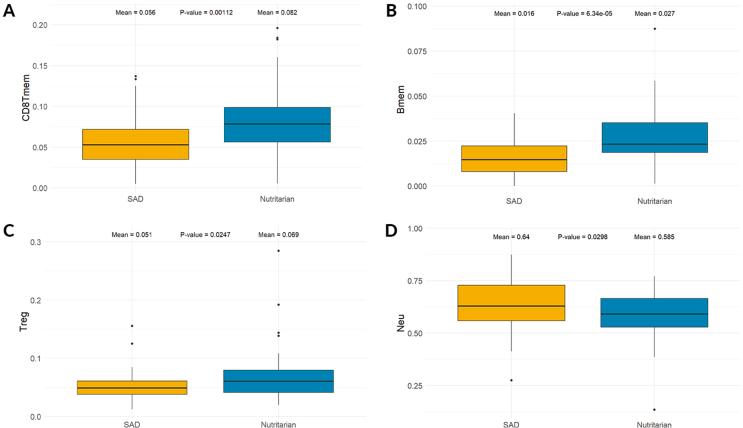
Epigenetic age acceleration, indicated by the third-generation clock DunedinPACE, was significantly slower in the Nutritarian group than that in the SAD group ( = 4.26 × 10). The Nutritarian diet group showed lower dietary inflammatory potential, as indicated by Empirical Dietary Inflammatory Pattern and Dietary Inflammatory Index. We observed differences in methylation-predicted immune cell subsets (lower neutrophils and higher T regulatory cells) and a lower epigenetic biomarker proxy for C-reactive protein, both of which suggested a lower inflammatory status in the Nutritarian group. Epigenetic biomarker proxies for LDL cholesterol, body mass index (BMI), insulin-like growth factor binding protein 5, and blood glucose were also lower in the Nutritarian group.
CONCLUSIONS
Our findings suggest the Nutritarian diet could help reduce chronic inflammation and slow epigenetic aging.
背景
以植物为基础的饮食与较低的炎症生物标志物以及与年龄相关的慢性疾病风险降低有关。衰老的表观遗传生物标志物是以DNA甲基化为基础的工具,可估计生物年龄和衰老速度,从而深入了解与年龄相关的健康风险。健康的饮食和生活方式指标与表观遗传衰老速度较慢相关。
目的
在营养丰富、富含植物的(纯素食)饮食中,尚未对炎症生物标志物和表观遗传衰老进行研究。这种以植物为基础的饮食强调特定的植物性食物,如十字花科蔬菜、豆类和其他豆类、洋葱和大蒜、蘑菇、浆果、坚果和种子。我们旨在比较遵循纯素食饮食的女性与遵循标准美国饮食(SAD)的女性的炎症状态和表观遗传年龄加速情况。
方法
在这项回顾性队列研究中,我们调查了48名习惯性(≥5年)遵循纯素食饮食的女性和49名无肥胖症且习惯性(≥5年)遵循SAD的女性的饮食炎症潜力、使用第一代、第二代和第三代时钟的表观遗传年龄加速情况,以及其他与健康相关的表观遗传生物标志物。参与者完成了一系列在线问卷并提供了血液样本。
结果
第三代时钟达尼丁PACE显示,纯素食组的表观遗传年龄加速明显慢于SAD组( = 4.26 × 10)。经验性饮食炎症模式和饮食炎症指数表明,纯素食饮食组的饮食炎症潜力较低。我们观察到甲基化预测的免疫细胞亚群存在差异(中性粒细胞较低,调节性T细胞较高),以及C反应蛋白的表观遗传生物标志物代理较低,这两者都表明纯素食组的炎症状态较低。纯素食组中低密度脂蛋白胆固醇、体重指数(BMI)、胰岛素样生长因子结合蛋白5和血糖的表观遗传生物标志物代理也较低。
结论
我们的研究结果表明,纯素食饮食有助于减少慢性炎症并减缓表观遗传衰老。

 Zotero 插件