
IV期非小细胞肺癌患者接受抗PD-1抗体治疗时,基线血浆D-二聚体和血小板与无进展生存期的关联
Association of baseline plasma D-dimer and platelets with progression-free survival in patients with stage IV non-small cell lung cancer treated with anti-PD-1 antibody.
作者信息
Pang Boyue, Wang Jing, Wang Jing, Zhang Jiali, Ren Xiubao, Han Ying
机构信息
Tianjin Medical University Cancer Institute & Hospital, National Clinical Research Center for Cancer, Tianjin's Clinical Research Center for Cancer, Key Laboratory of Cancer Immunology and Biotherapy, Tianjin, China.
Tianjin Key Laboratory of Lung Cancer Metastasis and Tumor Microenvironment, Tianjin Medical University General Hospital, Tianjin, China.
出版信息
Transl Lung Cancer Res. 2024 Nov 30;13(11):3106-3121. doi: 10.21037/tlcr-24-763. Epub 2024 Nov 28.
BACKGROUND
In past studies, peripheral blood D-dimer and platelets have shown predictive value in the treatment of non-small cell lung cancer (NSCLC). However, it remains unclear whether pretreatment D-dimer and platelets can serve as biomarkers for predicting efficacy and prognosis in stage IV NSCLC patients without driver gene mutations receiving programmed cell death protein 1 (PD-1) antibody. Therefore, this study aims to investigate the correlation between baseline D-dimer and platelet levels and the efficacy and prognosis in the study population, aiding in determining the significance of baseline D-dimer and platelet levels as biomarkers.
METHODS
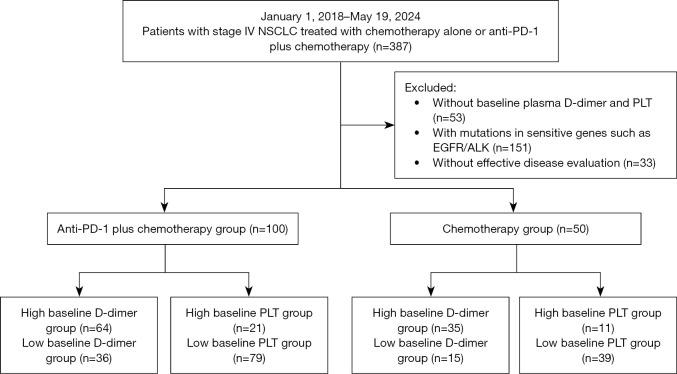
This study included 150 patients who were newly diagnosed with stage IV NSCLC without driver gene mutations and conducted a retrospective analysis. Among them, 100 patients received first-line treatment with anti-PD-1 plus chemotherapy, while 50 patients received chemotherapy alone (2:1). Basic and clinical information for all patients was collected before treatment. Firstly, the differences in progression-free survival (PFS) and objective response rate (ORR) between the two treatment regimens were compared. Subsequently, the anti-PD-1 plus chemotherapy group and chemotherapy-alone group were analyzed separately, dividing patients into pretreatment high and low D-dimer group, as well as pretreatment high and low platelet group. Kaplan-Meier analysis and Cox proportional hazards models were used to analyze PFS data. Chi-squared tests and logistic regression analysis were employed to evaluate treatment efficacy, specifically ORR differences. All patients were followed up through electronic medical records and telephone, and disease assessment was conducted via imaging examinations, with the follow-up deadline being May 19, 2024.
RESULTS
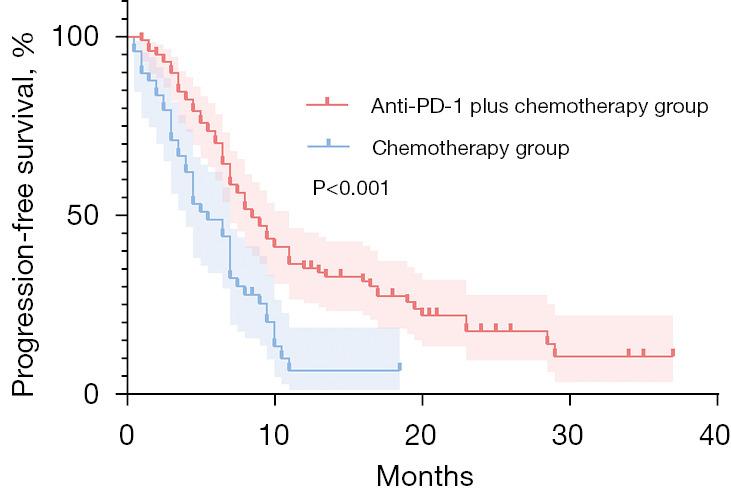
Kaplan-Meier analysis demonstrated that patients receiving anti-PD-1 plus chemotherapy had longer PFS compared to those receiving chemotherapy alone (median, 8.5 versus 5.5 months; P<0.001). Multivariate Cox regression analysis revealed that first-line chemotherapy (P<0.001), high baseline D-dimer level (P=0.002) and platelet count (P=0.04) were independent risk factors for shorter PFS. Pearson's Chi-squared test showed that the ORR was 46.00% for the anti-PD-1 plus chemotherapy group and 14.00% for the chemotherapy group (P<0.001). In the anti-PD-1 plus chemotherapy group, patients with low baseline D-dimer levels had longer PFS compared to those with high D-dimer level (median, 13.0 versus 8.0 months; P=0.005). Similar results were observed for baseline platelet count (median, 9.5 versus 6.5 months; P=0.005). In this group, no statistically significant differences were found in ORR between high and low D-dimer subgroups or high and low platelet subgroups (P=0.51 for D-dimer subgroups, P=0.87 for platelet subgroups). In the chemotherapy group, no correlation was observed between baseline D-dimer or platelet levels and PFS or ORR.
CONCLUSIONS
Pretreatment plasma D-dimer and platelet levels could serve as convenient prognostic biomarkers for stage IV NSCLC patients without driver gene mutations receiving anti-PD-1 antibody. Patients with higher baseline D-dimer and platelet levels might have poor PFS.
背景
在过去的研究中,外周血D-二聚体和血小板在非小细胞肺癌(NSCLC)的治疗中显示出预测价值。然而,对于无驱动基因突变的IV期NSCLC患者接受程序性细胞死亡蛋白1(PD-1)抗体治疗时,治疗前D-二聚体和血小板是否可作为预测疗效和预后的生物标志物仍不清楚。因此,本研究旨在探讨研究人群中基线D-二聚体和血小板水平与疗效及预后之间的相关性,以确定基线D-二聚体和血小板水平作为生物标志物的意义。
方法
本研究纳入150例新诊断的无驱动基因突变的IV期NSCLC患者并进行回顾性分析。其中,100例患者接受抗PD-1联合化疗一线治疗,50例患者仅接受化疗(2:1)。在治疗前收集所有患者的基础和临床信息。首先,比较两种治疗方案之间的无进展生存期(PFS)和客观缓解率(ORR)差异。随后,分别对抗PD-1联合化疗组和单纯化疗组进行分析,将患者分为治疗前高、低D-二聚体组以及治疗前高、低血小板组。采用Kaplan-Meier分析和Cox比例风险模型分析PFS数据。采用卡方检验和逻辑回归分析评估治疗疗效,即ORR差异。通过电子病历和电话对所有患者进行随访,并通过影像学检查进行疾病评估,随访截止日期为2024年5月19日。
结果
Kaplan-Meier分析表明,接受抗PD-1联合化疗的患者PFS较单纯化疗患者更长(中位数,8.5个月对5.5个月;P<0.001)。多因素Cox回归分析显示,一线化疗(P<0.001)、高基线D-二聚体水平(P=0.002)和血小板计数(P=0.04)是PFS缩短的独立危险因素。Pearson卡方检验显示,抗PD-1联合化疗组的ORR为46.00%,化疗组为14.00%(P<0.001)。在抗PD-1联合化疗组中,基线D-二聚体水平低的患者PFS较D-二聚体水平高的患者更长(中位数,13.0个月对8.0个月;P=0.005)。基线血小板计数也观察到类似结果(中位数,9.5个月对6.5个月;P=0.005)。在该组中,高、低D-二聚体亚组或高、低血小板亚组之间的ORR无统计学显著差异(D-二聚体亚组P=0.51,血小板亚组P=0.87)。在化疗组中,未观察到基线D-二聚体或血小板水平与PFS或ORR之间的相关性。
结论
治疗前血浆D-二聚体和血小板水平可作为无驱动基因突变的IV期NSCLC患者接受抗PD-1抗体治疗的便捷预后生物标志物。基线D-二聚体和血小板水平较高的患者PFS可能较差。



 Zotero 插件