
影响新冠后相关症状病程的因素:德国健康与福利服务行业员工的双向队列研究
Factors influencing the course of post-COVID-19-related symptoms: A bidirectional cohort study among employees in health and welfare services in Germany.
作者信息
Steinke Lara, Peters Claudia, Nienhaus Albert, Bethge Matthias, Koch Peter
机构信息
University of Lübeck, Lübeck, Germany.
Competence Center for Epidemiology and Health Services Research for Healthcare Professionals (CVcare), Institute for Health Services Research in Dermatology and Nursing (IVDP), University Medical Center Hamburg-Eppendorf (UKE), Hamburg, Germany.
出版信息
GMS Hyg Infect Control. 2024 Nov 5;19:Doc61. doi: 10.3205/dgkh000516. eCollection 2024.
OBJECTIVE
The aim of this study was to determine the prevalence and trajectory of persistent symptoms following COVID-19 and to investigate factors influencing these among employees in the health and welfare services in Germany.
METHODS
This exploratory, mixed retro- and prospective cohort study using paper-and-pencil questionnaires was conducted among insured persons of the German Social Accident Insurance Institution for the health and welfare services with a SARS-CoV-2 infection in 2020. The baseline survey in February 2021 was succeeded by two follow-up surveys after 8 and 13 months. Demographic data, information on the acute illness and persistent symptoms were collected. Kaplan-Meier curves were created to visualize the course of recovery. Factors influencing the time to recovery were analyzed using multivariate Cox regressions.
RESULTS
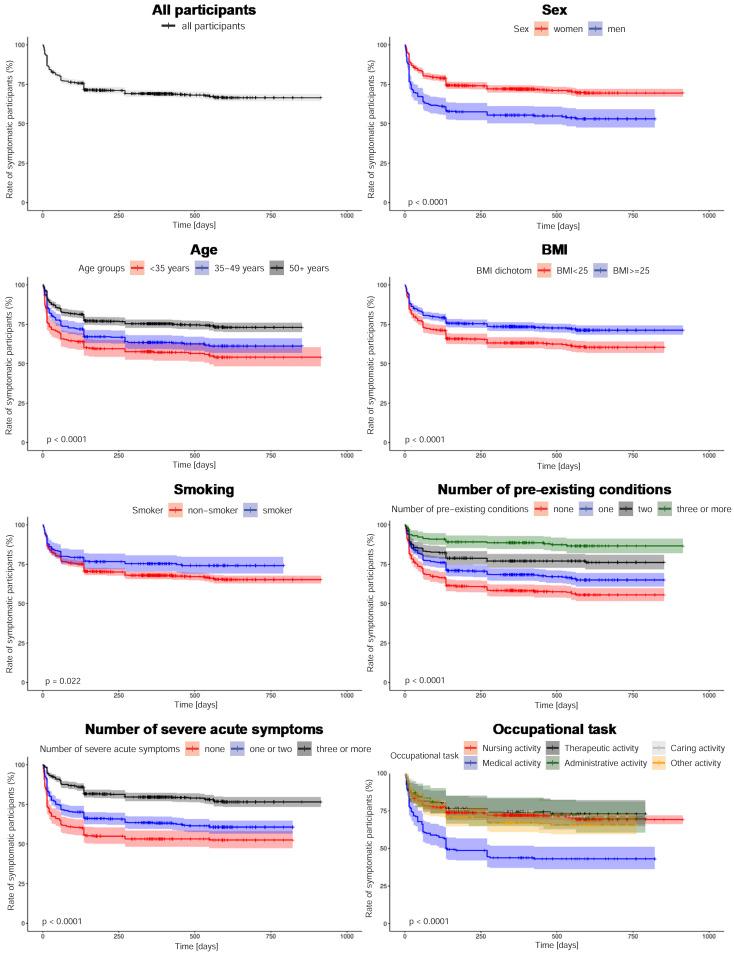
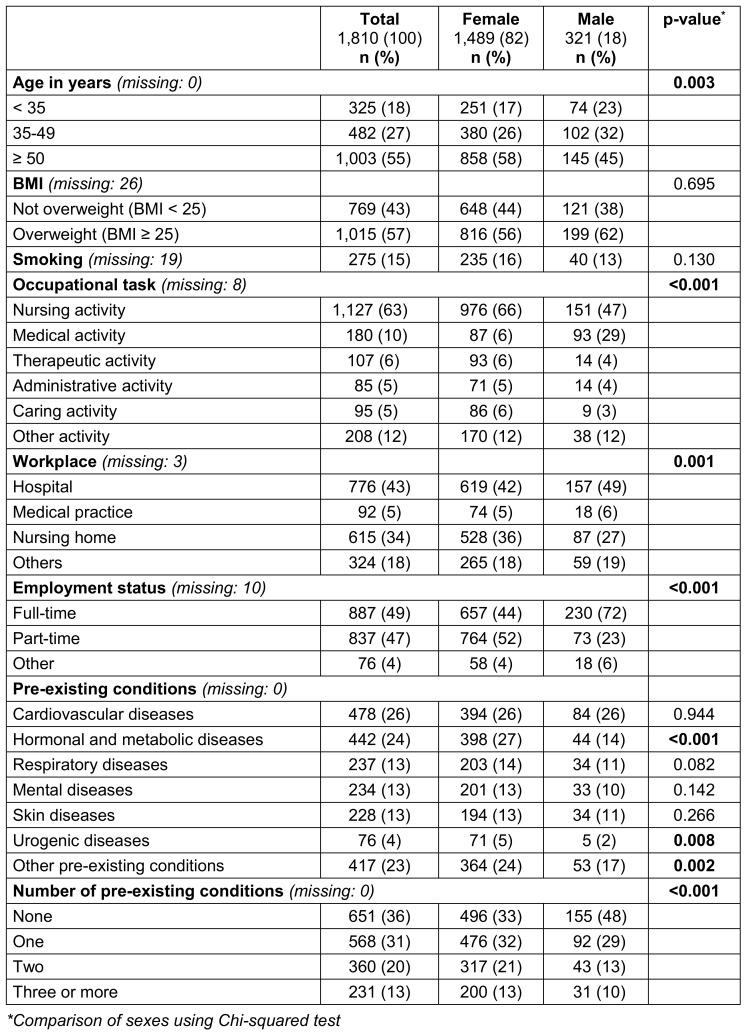
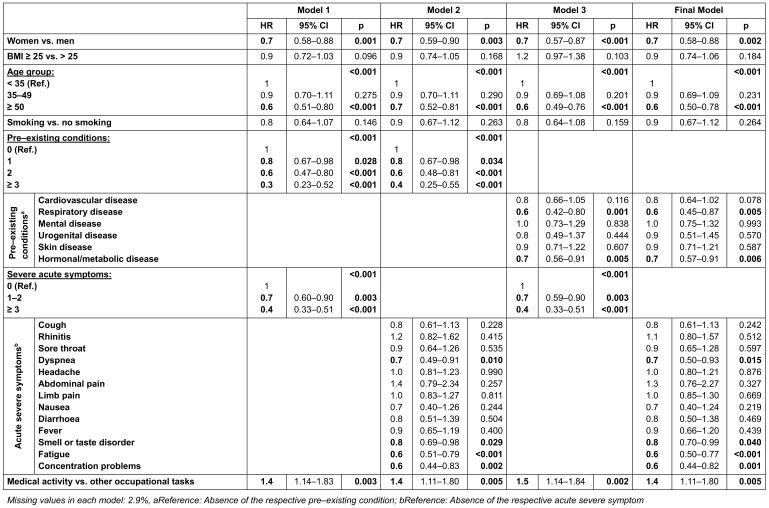
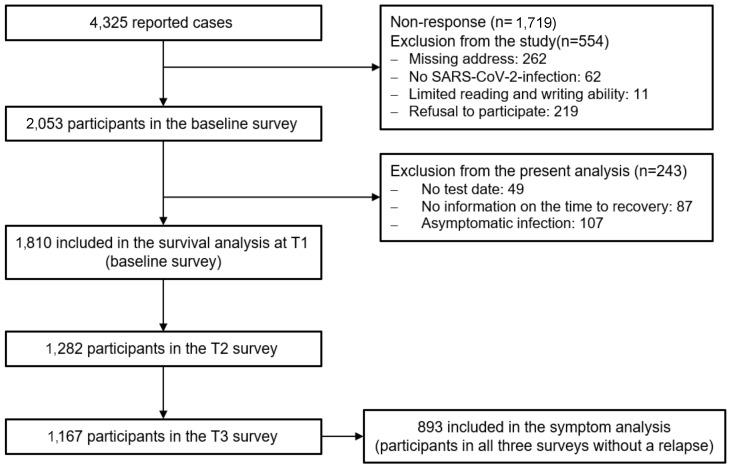
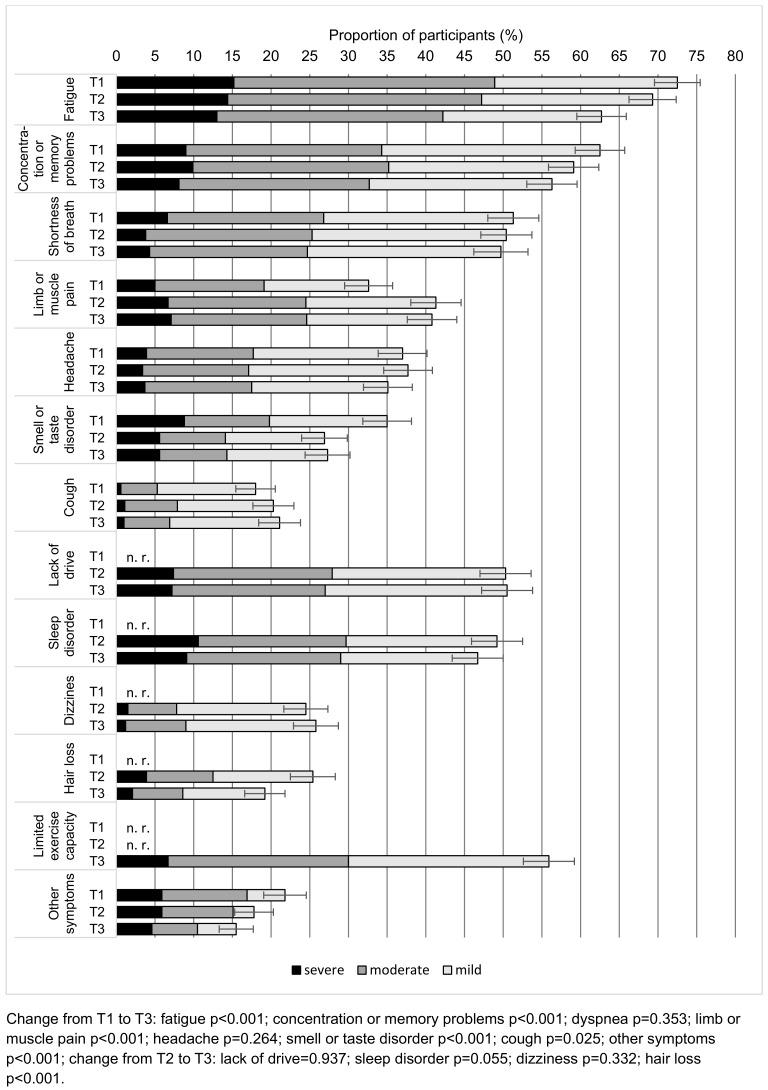
Of the 4,325 people contacted, 2,053 took part in the survey (response rate: 47%). 1,810 people were included in the analysis. The most common persistent symptoms at all three survey time points were fatigue, concentration and memory problems, and dyspnea. After three months, 76.2% (95% CI: 74.2-78.2%) of participants still reported symptoms, after 18 months this dropped to 67.2% (95% CI: 65.0-69.4%). Significant risk factors for persistent symptoms were female sex (HR: 0.72; 95% CI: 0.58-0.88), age over 50 years (HR: 0.63; 95% CI: 0.50-0.78), a higher number of pre-existing illnesses and a higher number of severe acute symptoms. Respiratory and hormone-metabolic pre-existing conditions as well as severe dyspnea, smell or taste disorders, fatigue and memory or concentration problems during the acute COVID-19 illness also reduced the probability of complete recovery. Compared to other professions, working as a doctor had a protective effect (HR: 1.42; 95% CI: 1.11-1.80).
CONCLUSION
More than a year after a COVID-19 illness, two-thirds of the healthcare staff surveyed reported persistent symptoms. This high number emphasizes the importance of long-term consequences of the COVID-19 pandemic for public health and the need for suitable therapy and rehabilitation concepts, especially for healthcare staff with post-COVID syndrome.
目的
本研究旨在确定新型冠状病毒肺炎(COVID-19)后持续症状的患病率和发展轨迹,并调查德国健康与福利服务行业员工中影响这些症状的因素。
方法
本探索性、回顾性与前瞻性混合队列研究采用纸笔问卷,对2020年感染严重急性呼吸综合征冠状病毒2(SARS-CoV-2)的德国社会事故保险机构健康与福利服务参保人员进行调查。2021年2月进行基线调查,之后在8个月和13个月进行两次随访调查。收集人口统计学数据、急性疾病信息和持续症状信息。绘制Kaplan-Meier曲线以直观呈现恢复过程。使用多变量Cox回归分析影响恢复时间的因素。
结果
在联系的4325人中,2053人参与了调查(应答率:47%)。1810人纳入分析。在所有三个调查时间点,最常见的持续症状是疲劳、注意力和记忆力问题以及呼吸困难。三个月后,76.2%(95%置信区间:74.2 - 78.2%)的参与者仍报告有症状,18个月后降至67.2%(95%置信区间:65.0 - 69.4%)。持续症状的显著危险因素为女性(风险比:0.72;95%置信区间:0.58 - 0.88)、50岁以上(风险比:0.63;95%置信区间:0.50 - 0.78)、既往疾病数量较多以及严重急性症状数量较多。急性COVID-19疾病期间的呼吸和激素代谢既往疾病以及严重呼吸困难、嗅觉或味觉障碍、疲劳和记忆力或注意力问题也降低了完全康复的可能性。与其他职业相比,医生职业具有保护作用(风险比:1.42;95%置信区间:1.11 - 1.80)。
结论
COVID-19疾病发生一年多后,三分之二接受调查的医护人员报告有持续症状。这一高比例强调了COVID-19大流行对公众健康长期影响的重要性,以及需要合适的治疗和康复方案,特别是针对患有新冠后综合征的医护人员。

 Zotero 插件