
在径向框架内估计和可视化多变量孟德尔随机化分析
Estimating and visualising multivariable Mendelian randomization analyses within a radial framework.
作者信息
Spiller Wes, Bowden Jack, Sanderson Eleanor
机构信息
Population Health Sciences, University of Bristol, Bristol, United Kingdom.
MRC Integrative Epidemiology Unit, University of Bristol, Bristol, United Kingdom.
出版信息
PLoS Genet. 2024 Dec 16;20(12):e1011506. doi: 10.1371/journal.pgen.1011506. eCollection 2024 Dec.
BACKGROUND
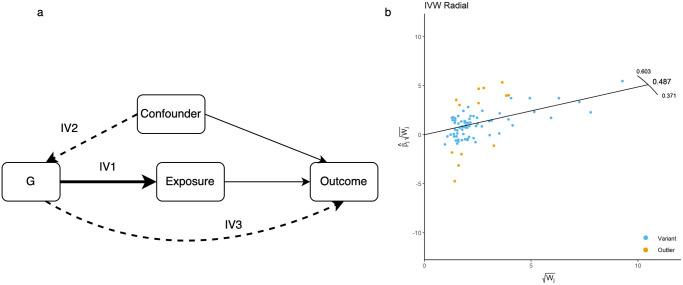
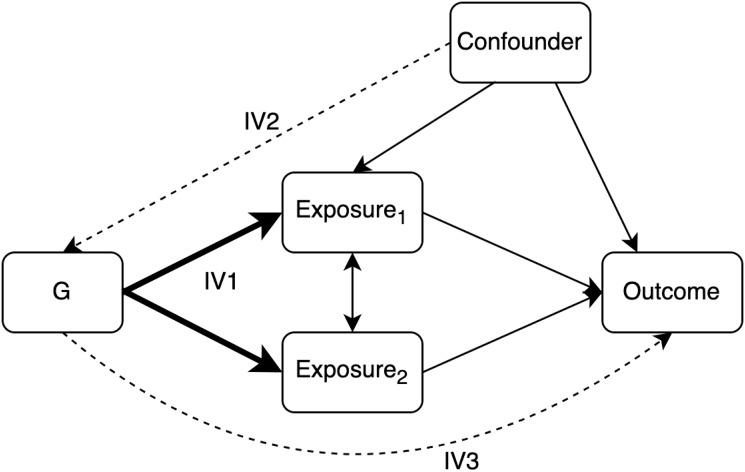
Mendelian randomization (MR) is a statistical approach using genetic variants as instrumental variables to estimate causal effects of a single exposure on an outcome. Multivariable MR (MVMR) extends this to estimate the direct effect of multiple exposures simulatiously. MR and MVMR can be biased by the presence of pleiotropic genetic variants in the set used as instrumental variables, violating one of the core IV assumptions. Genetic variants that give outlying estimates are often considered to be potentially pleiotropic variants. Radial plots can be used in MR to help identify these variants. Analogous plots for MVMR have so far been unavailable due to the multidimensional nature of the analysis.
METHODS
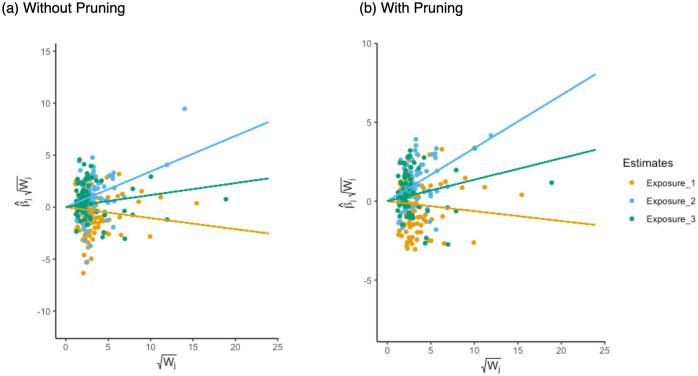
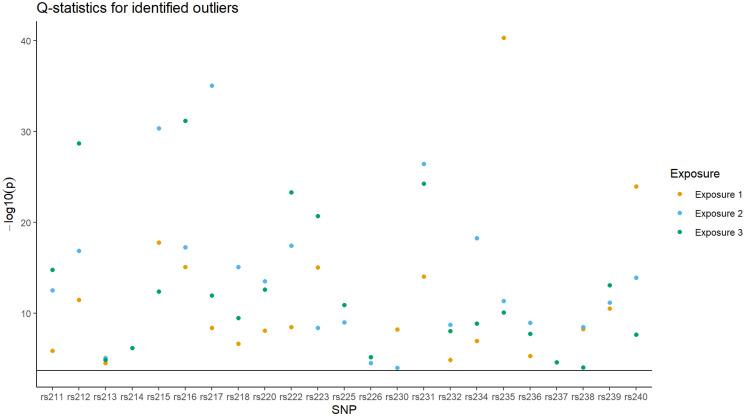
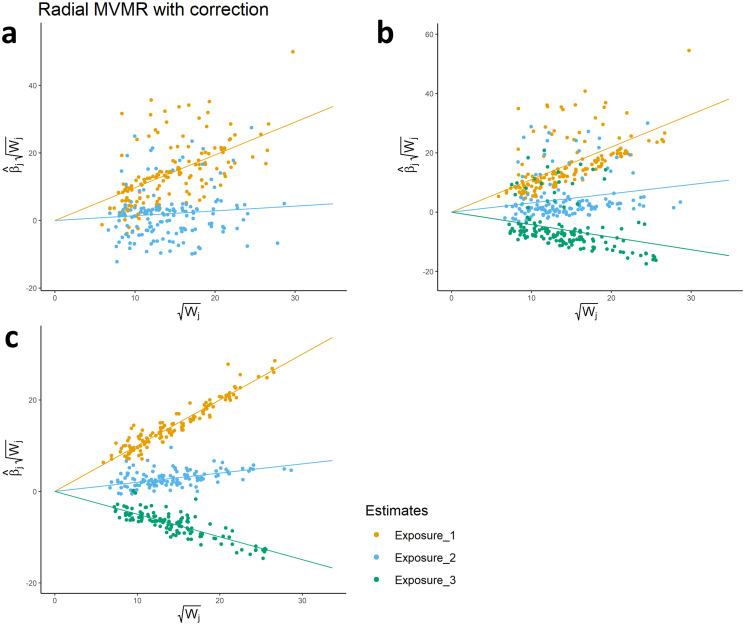
We propose a radial formulation of MVMR, and an adapted Galbraith radial plot, which allows for the estimated effect of each exposure within an MVMR analysis to be visualised. Radial MVMR additionally includes an option for removal of outlying SNPs which may violate one or more assumptions of MVMR. A RMVMR R package is presented as accompanying software for implementing the methods described.
RESULTS
We demonstrate the effectiveness of the radial MVMR approach through simulations and applied analyses. We highlight how outliers with respect to all exposures can be visualised and removed through Radial MVMR. We present simulations that illustrate how outlier removal decreases the bias in estimated effects under various forms of pleiotropy. We apply Radial MVMR to estimate the effect of lipid fractions on coronary heart disease (CHD). In combination with simulated examples, we highlight how important features of MVMR analyses can be explored using a range of tools incorporated within the RMVMR R package.
CONCLUSIONS
Radial MVMR effectively visualises causal effect estimates, and provides valuable diagnostic information with respect to the underlying assumptions of MVMR.
背景
孟德尔随机化(MR)是一种统计方法,使用基因变异作为工具变量来估计单一暴露因素对结局的因果效应。多变量孟德尔随机化(MVMR)将此方法扩展,以同时估计多种暴露因素的直接效应。在用作工具变量的集合中,多效性基因变异的存在可能会使MR和MVMR产生偏差,从而违反了核心工具变量假设之一。给出异常估计值的基因变异通常被认为是潜在的多效性变异。在MR中可以使用径向图来帮助识别这些变异。由于分析的多维性质,到目前为止还没有适用于MVMR的类似图。
方法
我们提出了MVMR的径向公式,以及一种经过改进的加尔布雷斯径向图,它可以直观显示MVMR分析中每种暴露因素的估计效应。径向MVMR还包括一个选项,用于去除可能违反MVMR一个或多个假设的异常单核苷酸多态性(SNP)。我们提供了一个RMVMR R软件包作为实现所述方法的配套软件。
结果
我们通过模拟和应用分析证明了径向MVMR方法的有效性。我们强调了如何通过径向MVMR直观显示并去除与所有暴露因素相关的异常值。我们给出的模拟说明了去除异常值如何在各种形式的多效性情况下减少估计效应中的偏差。我们应用径向MVMR来估计脂质组分对冠心病(CHD)的影响。结合模拟示例,我们强调了如何使用RMVMR R软件包中包含的一系列工具来探索MVMR分析的重要特征。
结论
径向MVMR有效地直观显示了因果效应估计值,并提供了有关MVMR潜在假设的有价值的诊断信息。

 Zotero 插件