
探究白色念珠菌与幼儿龋齿之间的关联:一项全面的系统评价和荟萃分析。
Investigating the association between Candida albicans and early childhood dental caries: A comprehensive systematic review and meta-analysis.
作者信息
Khachatryan Lusine G, Allahbakhsi Fatemeh, Vadiyan Diana E, Mohammadian Mahdi
机构信息
Department of Pediatric Diseases, N.F. Filatov Clinical Institute of Children's Health, I.M. Sechenov First Moscow State Medical University (Sechenov University), Moscow, Russia.
Department of Cardiology, School of Medicine, Tehran University of Medical Sciences, Tehran, Iran.
出版信息
PLoS One. 2024 Dec 16;19(12):e0315086. doi: 10.1371/journal.pone.0315086. eCollection 2024.
BACKGROUND
Early childhood caries (ECC) is a significant public health concern affecting children globally. Recent studies suggest a potential association between the presence of Candida albicans (C. albicans) in the oral cavity and the risk of ECC, but findings have been inconsistent. This systematic review and meta-analysis aimed to investigate the association between C. albicans and ECC.
METHODS
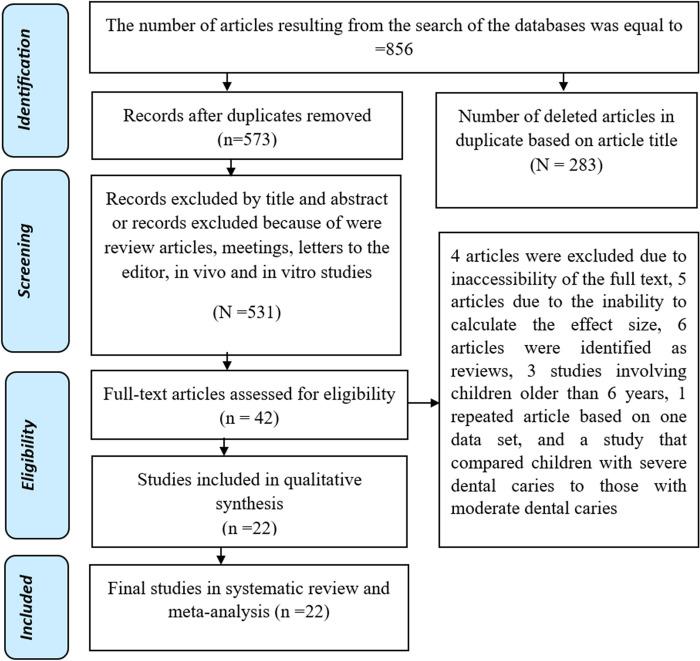
A comprehensive literature search was conducted across databases including PubMed, Web of Science, Cochrane Central Register of Controlled Trials, Embase, Google Scholar, and Scopus. Studies were included if they examined the presence of C. albicans and the occurrence or severity of dental caries in children. Data extraction and quality assessment were performed independently by two reviewers. Statistical analyses, including pooled odds ratios (OR) and 95% confidence intervals (CI), were conducted to synthesize the findings.
RESULTS
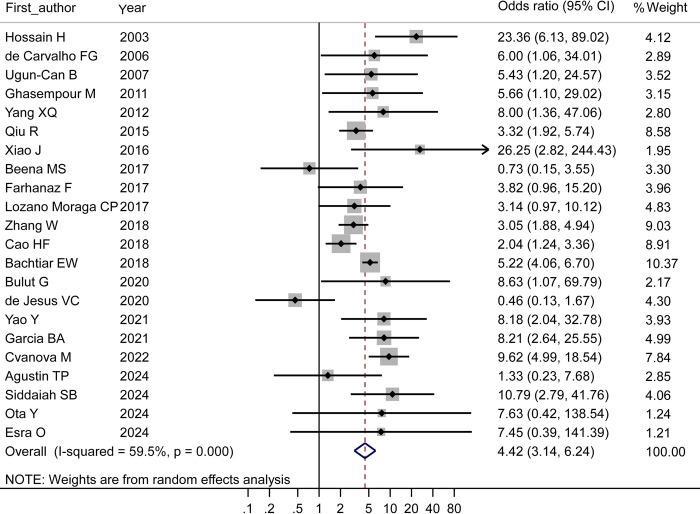
A total of 22 studies, involving 3301 participants, were included in the meta-analysis. The findings revealed a significant association between the presence of C. albicans and an increased likelihood of ECC, with a pooled odds ratio (OR) of 4.42 (95% CI: 3.14-6.24, p < 0.001). Subgroup analyses showed that factors such as geographic region, study design, and detection methods influenced the strength of this association. Studies conducted in Europe reported a stronger association (OR: 10.13, 95% CI: 6.01-17.09) compared to those in Asia (OR: 3.62, 95% CI: 2.53-5.20) and the Americas (OR: 3.98, 95% CI: 1.14-13.87). Case-control studies had a higher pooled OR (5.30, 95% CI: 1.72-16.31) compared to cross-sectional studies (4.30, 95% CI: 2.92-6.33). The odds of ECC in children with C. albicans were 4.08 (95% CI: 2.65-6.27) in dental plaque samples, 9.55 (95% CI: 2.17-42.01) in oral swab samples, and 4.70 (95% CI: 2.44-9.09) in saliva samples. No publication bias was observed based on Begg's test (P-value = 0.612) and Egger's test (P-value = 0.250).
CONCLUSIONS
The findings provide support for the hypothesis that C. albicans plays a role in the development of ECC. Moving forward, it is essential for future research to concentrate on comprehending the mechanisms that underlie this relationship and to develop specific strategies for prevention.
背景
幼儿龋齿(ECC)是一个严重的公共卫生问题,影响着全球儿童。最近的研究表明,口腔中白色念珠菌(白色念珠菌)的存在与ECC风险之间可能存在关联,但研究结果并不一致。本系统评价和荟萃分析旨在研究白色念珠菌与ECC之间的关联。
方法
在包括PubMed、科学网、Cochrane对照试验中央登记册、Embase、谷歌学术和Scopus在内的数据库中进行了全面的文献检索。如果研究检查了白色念珠菌的存在以及儿童龋齿的发生或严重程度,则纳入研究。由两名评审员独立进行数据提取和质量评估。进行了统计分析,包括合并比值比(OR)和95%置信区间(CI),以综合研究结果。
结果
荟萃分析共纳入22项研究,涉及3301名参与者。研究结果显示,白色念珠菌的存在与ECC可能性增加之间存在显著关联,合并比值比(OR)为4.42(95%CI:3.14-6.24,p<0.001)。亚组分析表明,地理区域、研究设计和检测方法等因素影响了这种关联的强度。与亚洲(OR:3.62,95%CI:2.53-5.20)和美洲(OR:3.98,95%CI:1.14-13.87)的研究相比,欧洲进行的研究报告的关联更强(OR:10.13,95%CI:6.01-17.09)。病例对照研究的合并OR(5.30,95%CI:1.72-16.31)高于横断面研究(4.30,95%CI:2.92-6.33)。在牙菌斑样本中,白色念珠菌阳性儿童患ECC的几率为4.08(95%CI:2.65-6.27),在口腔拭子样本中为9.55(95%CI:2.17-42.01),在唾液样本中为4.70(95%CI:2.44-9.09)。根据Begg检验(P值=0.612)和Egger检验(P值=0.250),未观察到发表偏倚。
结论
研究结果支持白色念珠菌在ECC发展中起作用的假设。展望未来,未来的研究必须集中于理解这种关系背后的机制,并制定具体的预防策略。


 Zotero 插件