
基于聚乙烯醇(PVA)、聚乙烯吡咯烷酮(PVP)、壳聚糖(CS)和聚多巴胺(PDA)的新型复合材料
New Composite Materials Based on PVA, PVP, CS, and PDA.
作者信息
Tahir Muhammad, Vicini Silvia, Jędrzejewski Tomasz, Wrotek Sylwia, Sionkowska Alina
机构信息
Department of Biomaterials and Cosmetic Chemistry, Faculty of Chemistry, Nicolaus Copernicus University, Gagarina 7, 87-100 Torun, Poland.
Department of Chemistry and Industrial Chemistry, University of Genova, 16146 Genoa, Italy.
出版信息
Polymers (Basel). 2024 Nov 29;16(23):3353. doi: 10.3390/polym16233353.
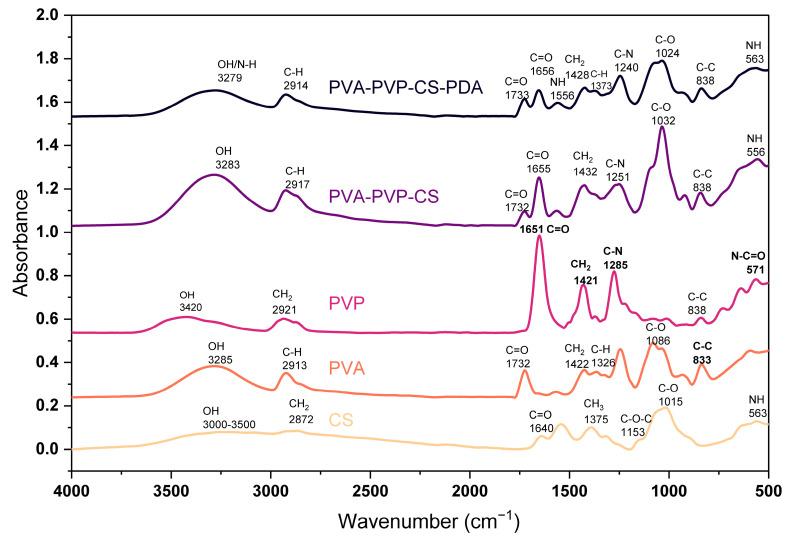
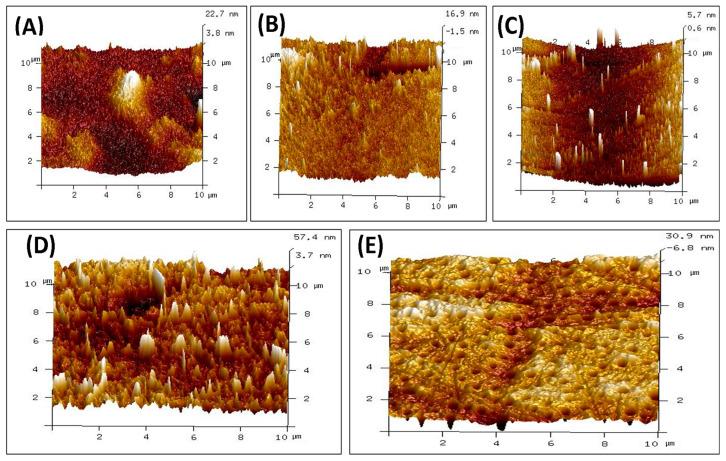
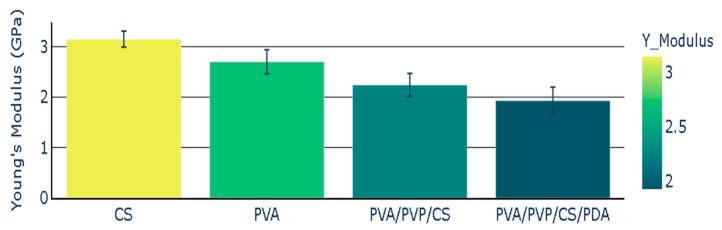
In this work, new materials based on the blends of polyvinyl alcohol (PVA), polyvinyl pyrrolidone (PVP), chitosan (CS), and polydopamine (PDA) have been prepared. Fourier Transform Infrared Spectra have been conducted to verify the presence of individual components in the composite materials. EDX elemental analysis showed a clear view of the element's presence in the composite materials, with the maximum values for carbon and oxygen. Atomic force microscopy (AFM) was used to observe the surface topography and measure the surface roughness. In the case of the individual polymers, CS presented the higher value of surface roughness (Rq = 3.92 nm and Ra = 3.02 nm), and surface roughness was found to be the lowest in the case of polyvinyl pyrrolidone (PVP), and it was with values (Rq = 2.34 nm and Ra = 0.95 nm). PVA films presented the surface roughness, which was with the value (Rq = 3.38 nm and Ra = 2.11 nm). In the case of composites, surface roughness was highest for the composite based on PVA, PVP, and CS, which presented the value (Rq = 11.91 nm and Ra = 8.71 nm). After the addition of polydopamine to the polymeric composite of PVA, PVP, and CS, a reduction in the surface roughness was observed (Rq = 7.49 nm and Ra = 5.15 nm). The surface roughness for composite materials was higher than that of the individual polymers. The addition of PDA to polymeric composite (PVA/PVP/CS) led to a decrease in Young's modulus. The elongation percentage of the polymeric films based on the PVA/PVP/CS/PDA blend was higher than that of the blend without PDA (9.80% vs. 5.68% for the polymeric composite PVA/PVP/CS). The surface of polymeric films was hydrophilic. The results from the MTT assay showed that all tested specimens are non-toxic, and it was manifested by a significant increase in the viability of L929 cells compared with control cells. However, additional studies are required to check the biocompatibility of tested samples.
在本研究中,制备了基于聚乙烯醇(PVA)、聚乙烯吡咯烷酮(PVP)、壳聚糖(CS)和聚多巴胺(PDA)共混物的新型材料。通过傅里叶变换红外光谱验证了复合材料中各组分的存在。能谱元素分析清晰显示了复合材料中元素的存在情况,其中碳和氧的含量最高。利用原子力显微镜(AFM)观察表面形貌并测量表面粗糙度。对于单一聚合物,壳聚糖的表面粗糙度值较高(均方根粗糙度Rq = 3.92 nm,平均粗糙度Ra = 3.02 nm),而聚乙烯吡咯烷酮(PVP)的表面粗糙度最低(Rq = 2.34 nm,Ra = 0.95 nm)。聚乙烯醇(PVA)薄膜的表面粗糙度为(Rq = 3.38 nm,Ra = 2.11 nm)。对于复合材料,基于PVA、PVP和CS的复合材料表面粗糙度最高(Rq = 11.91 nm,Ra = 8.71 nm)。在PVA、PVP和CS的聚合物复合材料中添加聚多巴胺后,表面粗糙度降低(Rq = 7.49 nm,Ra = 5.15 nm)。复合材料的表面粗糙度高于单一聚合物。向聚合物复合材料(PVA/PVP/CS)中添加PDA导致杨氏模量降低。基于PVA/PVP/CS/PDA共混物的聚合物薄膜的伸长率高于不含PDA的共混物(聚合物复合材料PVA/PVP/CS的伸长率分别为9.80%和5.68%)。聚合物薄膜表面具有亲水性。MTT法检测结果表明,所有测试样品均无毒,与对照细胞相比,L929细胞的活力显著增加即证明了这一点。然而,还需要进一步研究来检测测试样品的生物相容性。




 Zotero 插件