
我们应该单独考虑神经退行性变,还是将其与神经炎症和脱髓鞘联系起来综合考量?以多发性硬化症及其他疾病为例。
Should We Consider Neurodegeneration by Itself or in a Triangulation with Neuroinflammation and Demyelination? The Example of Multiple Sclerosis and Beyond.
作者信息
Perdaens Océane, van Pesch Vincent
机构信息
Neurochemistry Group, Institute of NeuroScience, Université Catholique de Louvain (UCLouvain), 1200 Brussels, Belgium.
Department of Neurology, Cliniques Universitaires Saint-Luc, Université Catholique de Louvain (UCLouvain), 1200 Brussels, Belgium.
出版信息
Int J Mol Sci. 2024 Nov 25;25(23):12637. doi: 10.3390/ijms252312637.
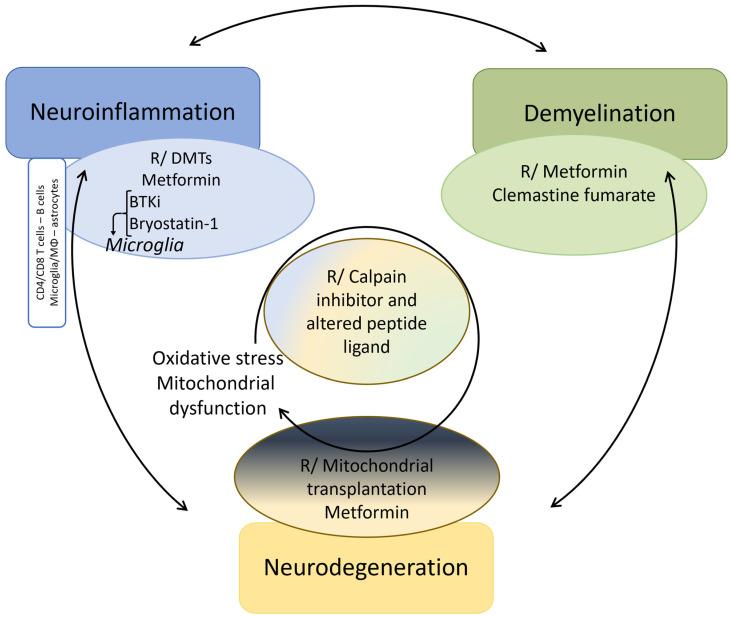
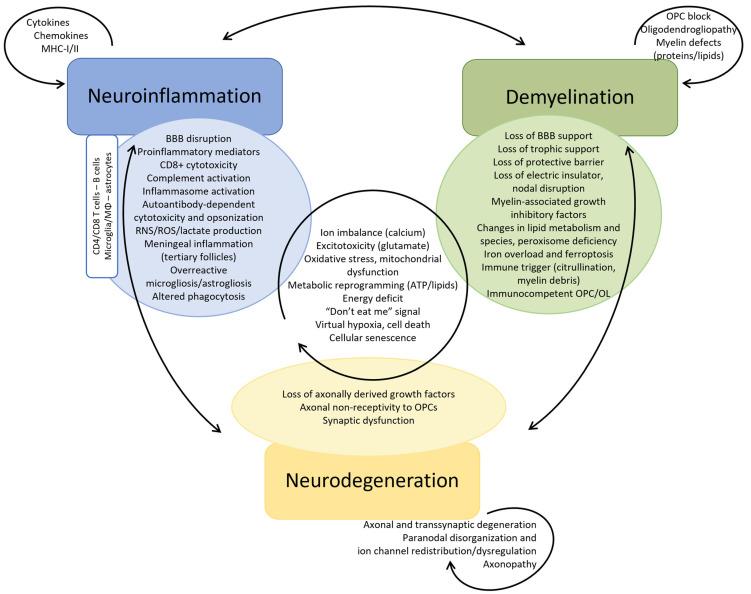
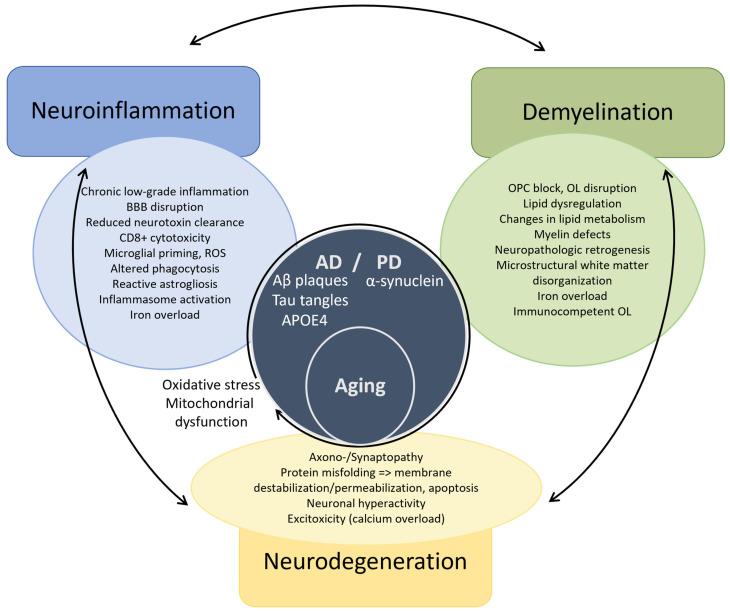
Neurodegeneration is preeminent in many neurological diseases, and still a major burden we fail to manage in patient's care. Its pathogenesis is complicated, intricate, and far from being completely understood. Taking multiple sclerosis as an example, we propose that neurodegeneration is neither a cause nor a consequence by itself. Mitochondrial dysfunction, leading to energy deficiency and ion imbalance, plays a key role in neurodegeneration, and is partly caused by the oxidative stress generated by microglia and astrocytes. Nodal and paranodal disruption, with or without myelin alteration, is further involved. Myelin loss exposes the axons directly to the inflammatory and oxidative environment. Moreover, oligodendrocytes provide a singular metabolic and trophic support to axons, but do not emerge unscathed from the pathological events, by primary myelin defects and cell apoptosis or secondary to neuroinflammation or axonal damage. Hereby, trophic failure might be an overlooked contributor to neurodegeneration. Thus, a complex interplay between neuroinflammation, demyelination, and neurodegeneration, wherein each is primarily and secondarily involved, might offer a more comprehensive understanding of the pathogenesis and help establishing novel therapeutic strategies for many neurological diseases and beyond.
神经退行性变在许多神经系统疾病中都很突出,仍然是我们在患者护理中未能解决的主要负担。其发病机制复杂、精妙,远未被完全理解。以多发性硬化症为例,我们提出神经退行性变本身既不是病因也不是结果。线粒体功能障碍导致能量缺乏和离子失衡,在神经退行性变中起关键作用,部分是由小胶质细胞和星形胶质细胞产生的氧化应激引起的。结旁和 paranodal 破坏,无论是否伴有髓鞘改变,都进一步参与其中。髓鞘丢失使轴突直接暴露于炎症和氧化环境中。此外,少突胶质细胞为轴突提供独特的代谢和营养支持,但在病理事件中也不能幸免,无论是原发性髓鞘缺陷和细胞凋亡,还是继发于神经炎症或轴突损伤。因此,营养支持失败可能是神经退行性变中一个被忽视的因素。因此,神经炎症、脱髓鞘和神经退行性变之间复杂的相互作用,其中每一个都主要和次要地参与其中,可能会为发病机制提供更全面的理解,并有助于为许多神经系统疾病及其他疾病建立新的治疗策略。




 Zotero 插件