
三联CFTR调节剂疗法和阿奇霉素对囊性纤维化中离子通道和炎症的影响。
The effect of triple CFTR modulator therapy and azithromycin on ion channels and inflammation in cystic fibrosis.
作者信息
Bani Melhim Suhad, Douglas Lisa E J, Reihill James A, Downey Damian G, Martin S Lorraine
机构信息
School of Pharmacy, Queen's University Belfast, Belfast, UK.
Department of Clinical Pharmacy and Pharmacy Practice, Faculty of Pharmaceutical Sciences, The Hashemite University, Zarqa, Jordan.
出版信息
ERJ Open Res. 2024 Dec 16;10(6). doi: 10.1183/23120541.00502-2024. eCollection 2024 Nov.
BACKGROUND
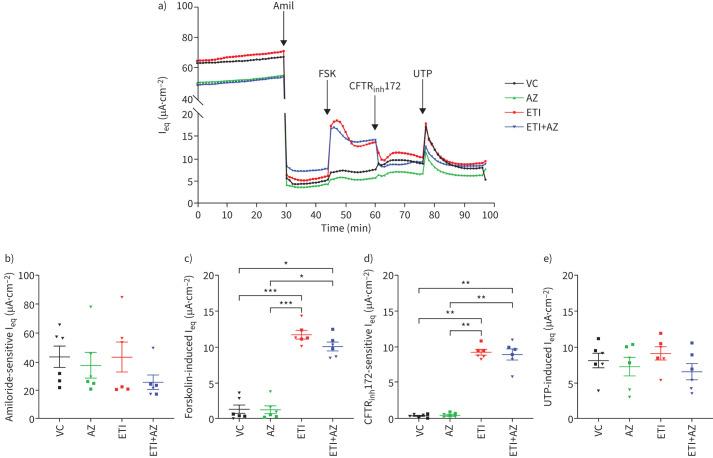
Inflammation in cystic fibrosis (CF) airways is difficult to treat with well-established regimens often including azithromycin (AZ) as an immunomodulatory drug. As AZ has been reported to require CF transmembrane conductance regulator (CFTR) to be able to reduce interleukin (IL)-8 and given the emergence of highly effective CFTR "triple" modulator therapy (elexacaftor/tezacaftor/ivacaftor; ETI), the aim of this study was to investigate the effect of AZ and ETI, singly and in combination, on ion channel activity and to assess the potential anti-inflammatory effects.
METHODS
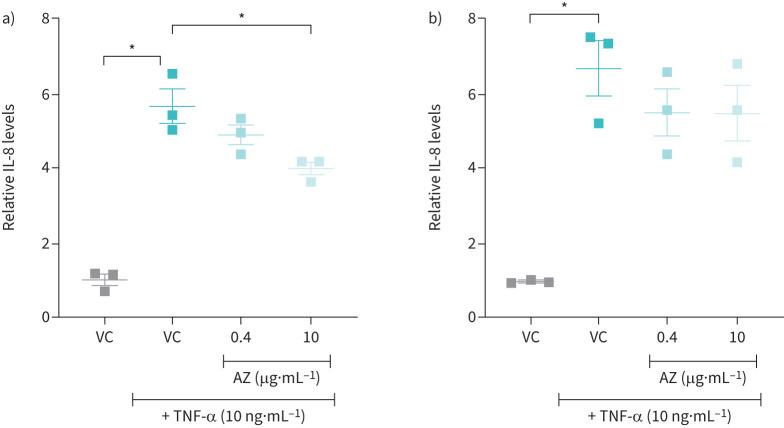
Electrophysiological assessment of ETI and AZ was performed on three-dimensional cultures of primary CF human bronchial epithelial (HBE) cells using a Multi Trans-Epithelial Current Clamp. IL-8 from NuLi-1 (non-CF) and CuFi-1 (CF) cells treated with AZ was measured by ELISA. Inflammatory mediators from primary CF HBE cells exposed to tumour necrosis factor-α in the presence of AZ, ETI and their combination, were screened using the Proteome Profiler™ Human Cytokine Array Kit, with selected targets validated by ELISA.
RESULTS
AZ did not alter CFTR chloride efflux, nor did it have any synergistic/antagonistic effect in combination with ETI. AZ reduced IL-8 in NuLi-1 but not CuFi-1 cells. The Proteome Profiler™ screen identified several disease-relevant cytokines that were modulated by treatment. Subsequent analysis by ELISA showed IL-8, IL-6, CXCL1 and granulocyte-macrophage colony-stimulating factor to be significantly reduced by treatment with ETI, but not by AZ.
CONCLUSIONS
Incorporating ETI into the standard of CF care provides an opportunity to re-evaluate therapeutic regimens to reduce treatment burden and safely discontinue chronic treatments such as AZ, without loss of clinical benefit. Identification of redundant treatments in the era of CFTR modulation may improve medication adherence and overcome potential adverse effects associated with the chronic use AZ and other drugs.
背景
囊性纤维化(CF)气道炎症难以通过常用治疗方案进行治疗,这些方案通常包括将阿奇霉素(AZ)作为免疫调节药物。由于据报道AZ需要囊性纤维化跨膜传导调节因子(CFTR)才能降低白细胞介素(IL)-8,并且随着高效CFTR“三联”调节剂疗法(依列卡福/替扎卡福/艾伐卡福;ETI)的出现,本研究的目的是调查AZ和ETI单独及联合使用对离子通道活性的影响,并评估其潜在的抗炎作用。
方法
使用多通道跨上皮电流钳对原发性CF人支气管上皮(HBE)细胞的三维培养物进行ETI和AZ的电生理评估。通过酶联免疫吸附测定(ELISA)测量用AZ处理的NuLi-1(非CF)和CuFi-1(CF)细胞中的IL-8。使用蛋白质组分析™人细胞因子阵列试剂盒筛选在存在AZ、ETI及其组合的情况下暴露于肿瘤坏死因子-α的原发性CF HBE细胞中的炎症介质,并通过ELISA验证选定的靶点。
结果
AZ未改变CFTR氯离子外流,与ETI联合使用时也没有任何协同/拮抗作用。AZ降低了NuLi-1细胞中的IL-8,但未降低CuFi-1细胞中的IL-8。蛋白质组分析™筛选确定了几种受治疗调节的与疾病相关的细胞因子。随后通过ELISA分析表明,用ETI治疗可显著降低IL-8、IL-6、CXCL1和粒细胞-巨噬细胞集落刺激因子,但AZ不能。
结论
将ETI纳入CF治疗标准为重新评估治疗方案提供了机会,以减轻治疗负担并安全地停用慢性治疗药物,如AZ,同时不损失临床益处。在CFTR调节时代识别冗余治疗可能会提高药物依从性,并克服与长期使用AZ和其他药物相关的潜在不良反应。


 Zotero 插件