
暴露于短期模拟微重力环境下的包封软骨细胞的代谢谱
Metabolic Profiles of Encapsulated Chondrocytes Exposed to Short-Term Simulated Microgravity.
作者信息
Bergstrom Annika R, Glimm Matthew G, Houske Eden A, Cooper Gwendolyn, Viles Ethan, Chapman Marrin, Bourekis Katherine, Welhaven Hope D, Brahmachary Priyanka P, Hahn Alyssa K, June Ronald K
机构信息
Department of Biological and Environmental Science, Carroll College, 1601 N Benton Ave, Helena, MT, 59625, USA.
Department of Chemical and Biological Engineering, Villanova University, Villanova, PA, 19085, USA.
出版信息
Ann Biomed Eng. 2025 Mar;53(3):785-797. doi: 10.1007/s10439-024-03667-x. Epub 2024 Dec 18.
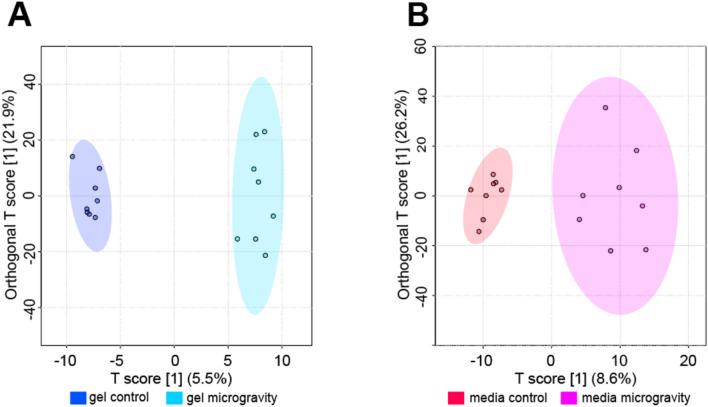
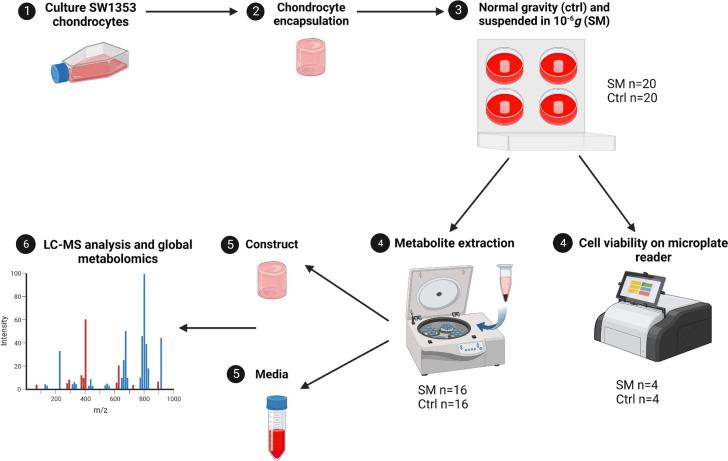
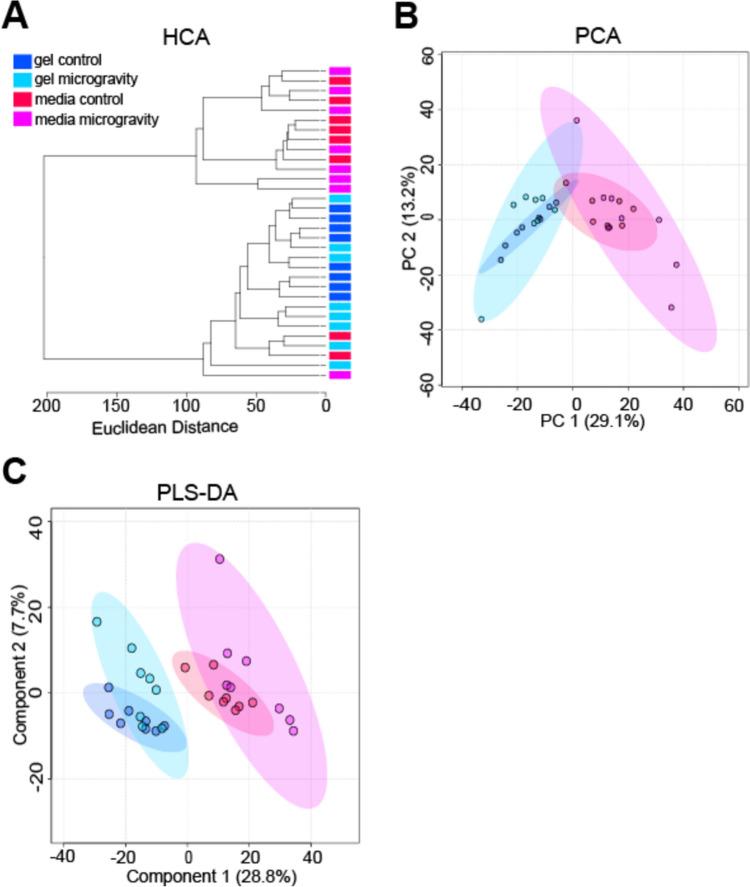
The mechanism by which chondrocytes respond to reduced mechanical loading environments and the subsequent risk of developing osteoarthritis remains unclear. This is of particular concern for astronauts. In space the reduced joint loading forces during prolonged microgravity (10 g) exposure could lead to osteoarthritis (OA), compromising quality of life post-spaceflight. In this study, we encapsulated human chondrocytes in an agarose gel of similar stiffness to the pericellular matrix to mimic the cartilage microenvironment. We then exposed agarose-chondrocyte constructs to simulated microgravity (SM) for four days using a rotating wall vessel (RWV) bioreactor to better assess the cartilage health risks associated with spaceflight. Metabolites extracted from media and agarose gel constructs were analyzed on liquid chromatography-mass spectrometry. Global metabolomic profiling detected a total of 1205 metabolite features, with 497 significant metabolite features identified by ANOVA (FDR-corrected p-value < 0.05). Specific metabolic shifts detected in response to SM exposure resulted in clusters of co-regulated metabolites, with glutathione, nitrogen, histidine, vitamin B, and aminosugars metabolism identified by variable importance in projection scores. Microgravity-induced metabolic shifts in gel constructs and media were indicative of protein synthesis, energy and nucleotide metabolism, and oxidative catabolism. Microgravity associated-metabolic shifts were consistent with our previously published early osteoarthritic metabolomic profiles in human synovial fluid, suggesting that even short-term exposure to microgravity (or other reduced mechanical loading environments) may lead to the development of OA. This work further suggests the potential to detect these metabolic perturbations in synovial fluid in vivo to ascertain osteoarthritis risk in astronauts.
软骨细胞对机械负荷降低环境的反应机制以及随后患骨关节炎的风险仍不清楚。这对宇航员来说尤其令人担忧。在太空中,长时间暴露于微重力(10g)环境下关节负荷力降低可能导致骨关节炎(OA),影响太空飞行后的生活质量。在本研究中,我们将人软骨细胞封装在与细胞周围基质硬度相似的琼脂糖凝胶中,以模拟软骨微环境。然后,我们使用旋转壁式生物反应器(RWV)将琼脂糖-软骨细胞构建体暴露于模拟微重力(SM)环境中四天,以更好地评估与太空飞行相关的软骨健康风险。对从培养基和琼脂糖凝胶构建体中提取的代谢物进行液相色谱-质谱分析。全局代谢组学分析共检测到1205个代谢物特征,通过方差分析(FDR校正p值<0.05)鉴定出497个显著代谢物特征。响应SM暴露检测到的特定代谢变化导致了共调节代谢物的聚类,通过投影得分中的变量重要性鉴定出谷胱甘肽、氮、组氨酸、维生素B和氨基糖代谢。凝胶构建体和培养基中微重力诱导的代谢变化表明蛋白质合成、能量和核苷酸代谢以及氧化分解代谢。微重力相关的代谢变化与我们之前发表的人类滑液早期骨关节炎代谢组学图谱一致,表明即使短期暴露于微重力(或其他机械负荷降低环境)也可能导致OA的发生。这项工作进一步表明,有可能在体内检测滑液中的这些代谢扰动,以确定宇航员患骨关节炎的风险。


 Zotero 插件