
癌症相关成纤维细胞、肿瘤与放射治疗:肿瘤微环境中的相互作用
Cancer-associated fibroblasts, tumor and radiotherapy: interactions in the tumor micro-environment.
作者信息
Raaijmakers Kris T P M, Adema Gosse J, Bussink Johan, Ansems Marleen
机构信息
Radiotherapy and OncoImmunology Laboratory, Department of Radiation Oncology, Radboud University Medical Center, Nijmegen, the Netherlands.
出版信息
J Exp Clin Cancer Res. 2024 Dec 19;43(1):323. doi: 10.1186/s13046-024-03251-0.
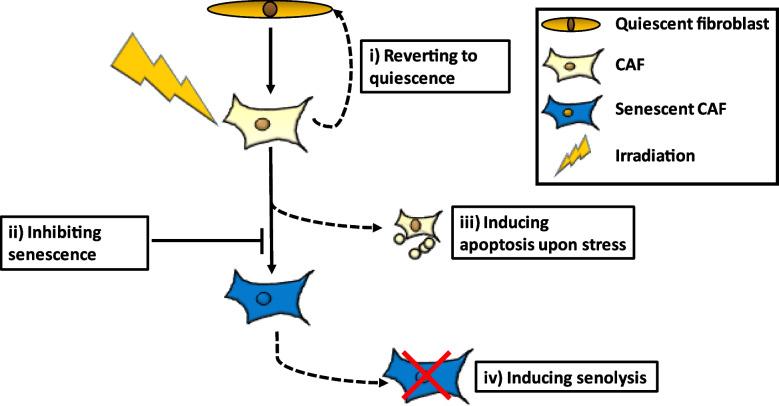
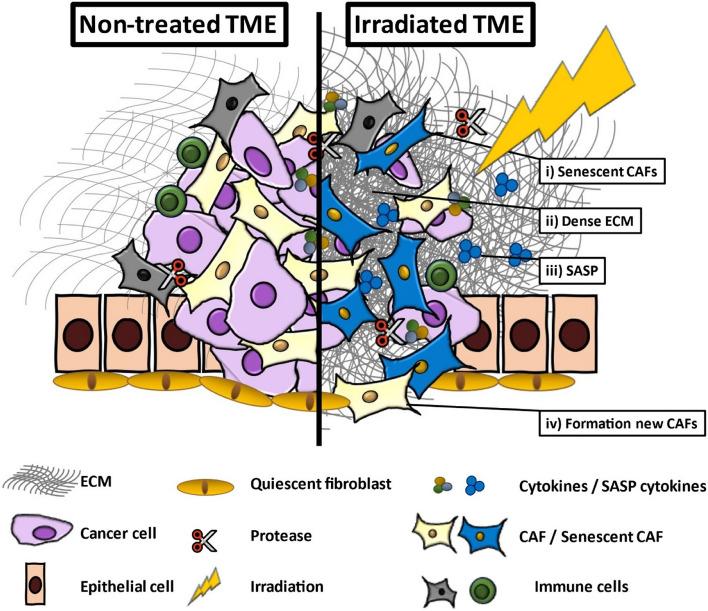
Cancer-associated fibroblasts (CAFs) represent a group of genotypically non-malignant stromal cells in the tumor micro-environment (TME) of solid tumors that encompasses up to 80% of the tumor volume. Even though the phenotypic diversity and plasticity of CAFs complicates research, it is well-established that CAFs can affect many aspects of tumor progression, including growth, invasion and therapy resistance. Although anti-tumorigenic properties of CAFs have been reported, the majority of research demonstrates a pro-tumorigenic role for CAFs via (in)direct signaling to cancer cells, immunomodulation and extracellular matrix (ECM) remodeling. Following harsh therapeutic approaches such as radio- and/or chemotherapy, CAFs do not die but rather become senescent. Upon conversion towards senescence, many pro-tumorigenic characteristics of CAFs are preserved or even amplified. Senescent CAFs continue to promote tumor cell therapy resistance, modulate the ECM, stimulate epithelial-to-mesenchymal transition (EMT) and induce immunosuppression. Consequently, CAFs play a significant role in tumor cell survival, relapse and potentially malignant transformation of surviving cancer cells following therapy. Modulating CAF functioning in the TME therefore is a critical area of research. Proposed strategies to enhance therapeutic efficacy include reverting senescent CAFs towards a quiescent phenotype or selectively targeting (non-)senescent CAFs. In this review, we discuss CAF functioning in the TME before and during therapy, with a strong focus on radiotherapy. In the future, CAF functioning in the therapeutic TME should be taken into account when designing treatment plans and new therapeutic approaches.
癌症相关成纤维细胞(CAFs)是实体瘤肿瘤微环境(TME)中一组基因型非恶性的基质细胞,其在肿瘤体积中占比高达80%。尽管CAFs的表型多样性和可塑性使研究变得复杂,但CAFs可影响肿瘤进展的多个方面,包括生长、侵袭和治疗抗性,这一点已得到充分证实。虽然已有报道称CAFs具有抗肿瘤特性,但大多数研究表明,CAFs通过(直接或间接)向癌细胞发出信号、免疫调节和细胞外基质(ECM)重塑发挥促肿瘤作用。在经历放疗和/或化疗等严苛的治疗方法后,CAFs不会死亡,而是进入衰老状态。在转变为衰老状态后,CAFs的许多促肿瘤特性得以保留甚至增强。衰老的CAFs继续促进肿瘤细胞的治疗抗性,调节ECM,刺激上皮-间质转化(EMT)并诱导免疫抑制。因此,CAFs在肿瘤细胞存活、复发以及治疗后存活癌细胞的潜在恶性转化中发挥着重要作用。因此,调节TME中CAF的功能是一个关键的研究领域。提高治疗效果的建议策略包括使衰老的CAFs恢复为静止表型或选择性靶向(非)衰老的CAFs。在本综述中,我们讨论了治疗前和治疗期间CAF在TME中的功能,重点是放疗。未来,在设计治疗方案和新的治疗方法时,应考虑治疗性TME中CAF的功能。
 Zotero 插件