
光系统II中水氧化过程中质子释放的机制。
Mechanism of proton release during water oxidation in Photosystem II.
作者信息
Allgöwer Friederike, Pöverlein Maximilian C, Rutherford A William, Kaila Ville R I
机构信息
Department of Biochemistry and Biophysics, Stockholm University, Stockholm 10691, Sweden.
Department of Life Sciences, Imperial College London, London SW7 2AZ, United Kingdom.
出版信息
Proc Natl Acad Sci U S A. 2024 Dec 24;121(52):e2413396121. doi: 10.1073/pnas.2413396121. Epub 2024 Dec 19.
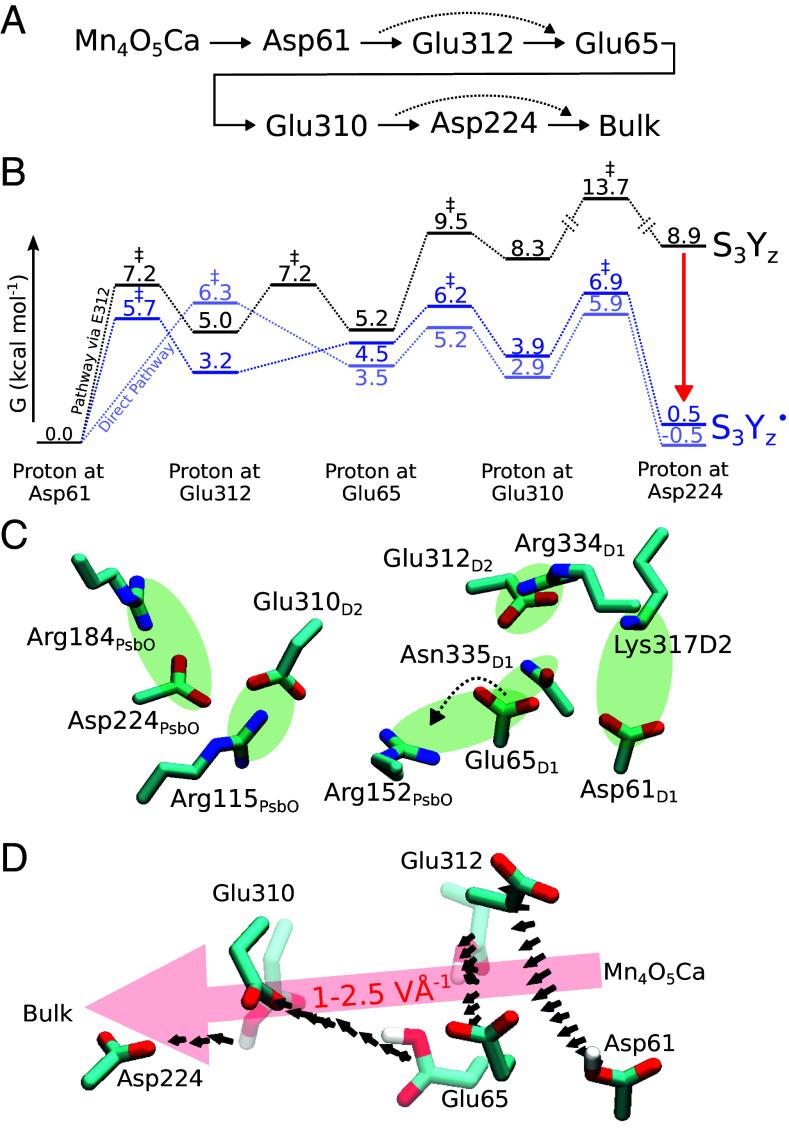
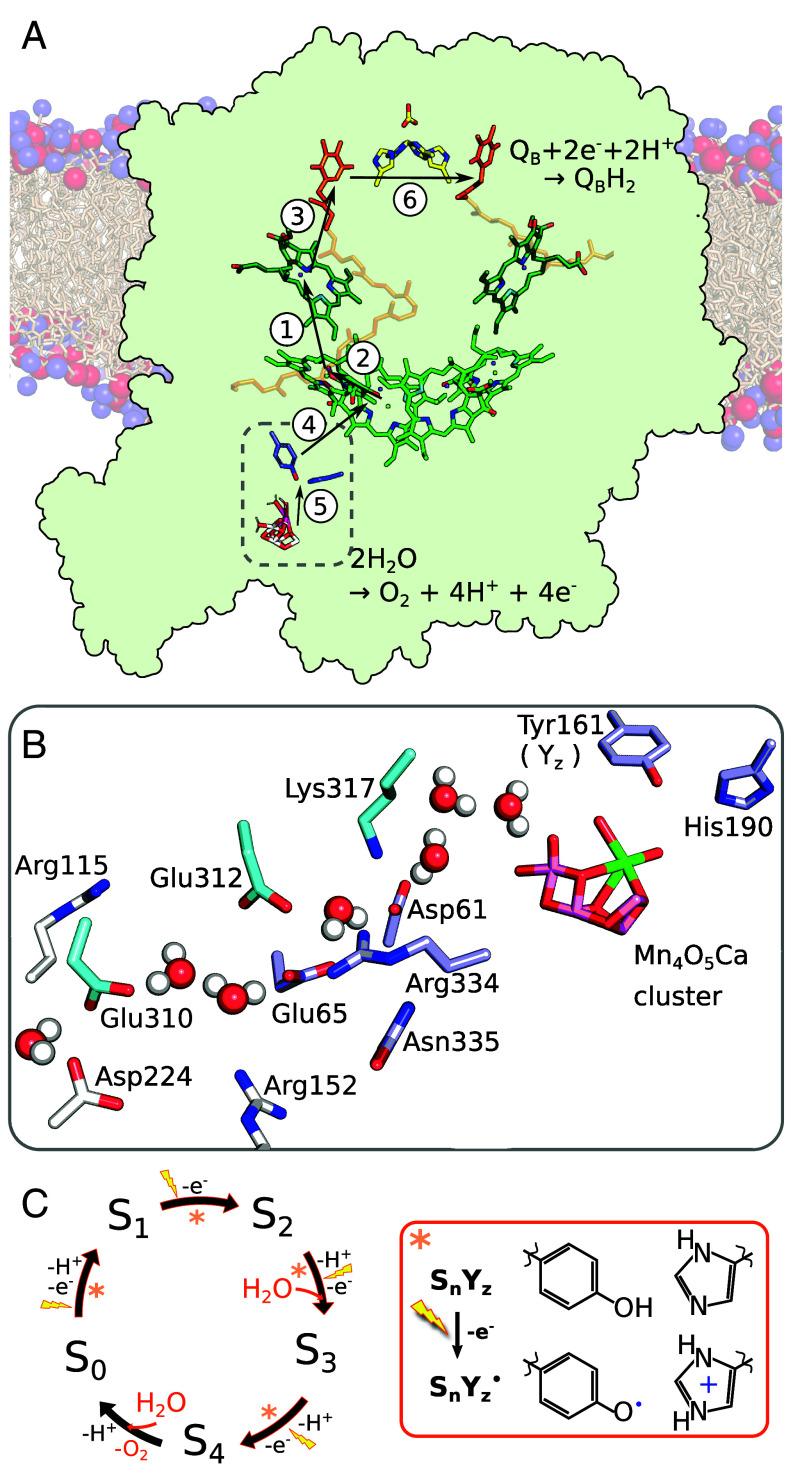
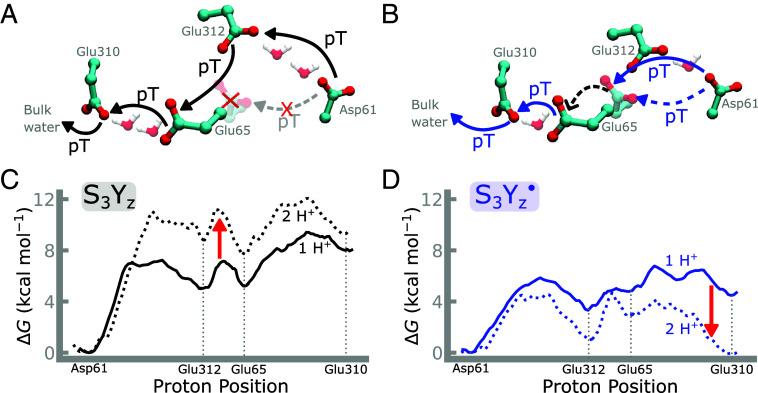
Photosystem II (PSII) catalyzes light-driven water oxidation that releases dioxygen into our atmosphere and provides the electrons needed for the synthesis of biomass. The catalysis occurs in the oxygen-evolving oxo-manganese-calcium (MnOCa) cluster that drives the oxidation and deprotonation of substrate water molecules leading to the O formation. However, despite recent advances, the mechanism of these reactions remains unclear and much debated. Here, we show that the light-driven Tyr161 (Y) oxidation adjacent to the MnOCa cluster, decreases the barrier for proton transfer from the putative substrate water molecule (W3/W) to Glu310, accessible to the luminal bulk. By combining hybrid quantum/classical (QM/MM) free energy calculations with atomistic molecular dynamics simulations, we probe the energetics of the proton transfer along the Cl1 pathway. We demonstrate that the proton transfer occurs via water molecules and a cluster of conserved carboxylates, driven by redox-triggered electric fields directed along the pathway. Glu65 establishes a local molecular gate that controls the proton transfer to the luminal bulk, while Glu312 acts as a local proton storage site. The identified gating region could be important in preventing backflow of protons to the MnOCa cluster. The structural changes, derived here based on the dark-state PSII structure, strongly support recent time-resolved X-ray free electron laser data of the S → S transition (Bhowmick . Nature , 2023) and reveal the mechanistic basis underlying deprotonation of the substrate water molecules. Our findings provide insight into the water oxidation mechanism of PSII and show how the interplay between redox-triggered electric fields, ion-pairs, and hydration effects control proton transport reactions.
光系统II(PSII)催化光驱动的水氧化反应,该反应将氧气释放到大气中,并为生物质合成提供所需的电子。催化作用发生在析氧的氧锰钙(MnOCa)簇中,该簇驱动底物水分子的氧化和去质子化,从而导致氧气的形成。然而,尽管最近取得了进展,但这些反应的机制仍不清楚,存在很多争议。在这里,我们表明,与MnOCa簇相邻的光驱动的Tyr161(Y)氧化降低了质子从假定的底物水分子(W3/W)转移到腔内主体可及的Glu310的势垒。通过将混合量子/经典(QM/MM)自由能计算与原子分子动力学模拟相结合,我们探究了沿Cl1途径的质子转移能量学。我们证明,质子转移是通过水分子和一组保守的羧酸盐发生的,由沿该途径定向的氧化还原触发电场驱动。Glu65建立了一个局部分子门,控制质子向腔内主体的转移,而Glu312充当局部质子储存位点。确定的门控区域对于防止质子回流到MnOCa簇可能很重要。基于暗态PSII结构推导的结构变化,有力地支持了最近关于S→S跃迁的时间分辨X射线自由电子激光数据(Bhowmick.《自然》,2023年),并揭示了底物水分子去质子化的机制基础。我们的研究结果为PSII的水氧化机制提供了见解,并展示了氧化还原触发电场、离子对和水合作用之间的相互作用如何控制质子传输反应。

 Zotero 插件