
宽松与保守氧疗对脓毒症机械通气患者血流动力学参数的影响:一项随机临床试验
Influence of liberal versus conservative oxygen therapies on the hemodynamic parameters of mechanically ventilated patients with sepsis: a randomized clinical trial.
作者信息
Ghazaly Huda F, Aly Ahmed Alsaied A, Tammam Ahmed S, Hassan Mahmoud M, Hammad Soudy S, Mahmoud Naggeh M, Hemaida Tarek S
机构信息
Anesthesia and Surgical Intensive Care Department, Faculty of Medicine, Aswan University, Aswan, Egypt.
Cardiology Department, Faculty of Medicine, Aswan University, Aswan, Egypt.
出版信息
BMC Anesthesiol. 2024 Dec 20;24(1):469. doi: 10.1186/s12871-024-02838-6.
BACKGROUND
There is no significant evidence verifying the efficacy of liberal versus conservative oxygen therapy on hemodynamics in patients with sepsis. We investigated how liberal and conservative oxygen therapy influenced stroke volume, cardiac output, and vasopressor needs in patients with sepsis undergoing mechanical ventilation.
METHODS
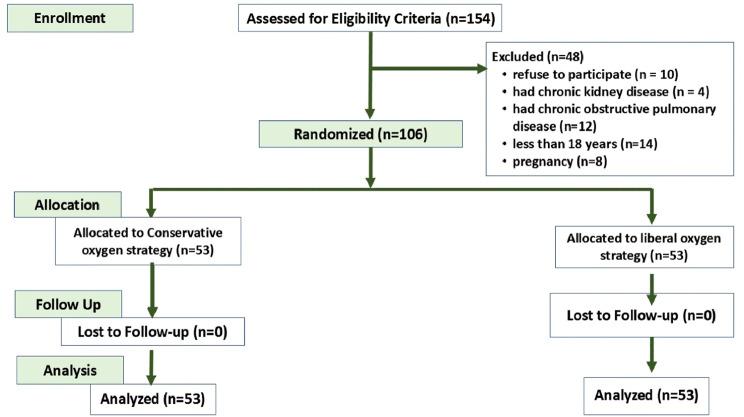
This randomized clinical trial included 106 patients with an admission diagnosis of infection, a Sequential Organ Failure Assessment (SOFA) score of two points or higher and required invasive mechanical ventilation for at least 72 h. Patients were randomly assigned to one of two oxygenation strategies: liberal (n = 53) with a target SpO2 of ≥ 96% or conservative (n = 53) with a target SpO2 of 88-92%. Transthoracic Doppler echocardiography was done twice to measure stroke volume and cardiac output, initially upon enrollment in the trial and then 72 h later. The primary outcome was stroke volume. Secondary outcomes were cardiac output, vasopressor use, mechanical ventilation duration, ICU stay length, and adverse events.
RESULTS
Stroke volume and cardiac output measurements did not differ significantly between research groups after 72 h of oxygenation treatment (p = 0.459 and 0.637, respectively). Forty-five patients (84.9%) in the conservative oxygen therapy group needed vasopressors to maintain their mean arterial pressure above 65 mmHg, whereas 35 patients (66.0%) in the liberal group did (p = 0.024). A multivariate logistic regression analysis of the independent variables for vasopressor requirements revealed that patients in the conservative oxygen group were 3.83 times more likely to require vasopressors (AOR = 3.83, 95% CI: 1.31-11.18, p = 0.014) than those in the liberal group. Older patients (AOR = 1.03, 95% CI: 1.01-1.07, p = 0.038) and those with higher SOFA scores (AOR = 1.36, CI: 1.09-1.68, P = 0.005) were significantly more likely to need vasopressors.
CONCLUSIONS
Liberal or conservative oxygen therapy did not influence stroke volume or cardiac output measurements in mechanically ventilated patients with sepsis. Patients in the conservative oxygen group were more likely to require vasopressors than those in the liberal group.
TRIAL REGISTRATION
This study was approved by the Ethics Committee of Aswan University Hospital (approval number: Aswu/460/5/20) (registration date: 05/05/2020) and registered on ClinicalTrials.gov (NCT04824703) (03/30/2021).
背景
目前尚无充分证据证实脓毒症患者采用宽松或保守氧疗对血流动力学的疗效。我们研究了宽松和保守氧疗对接受机械通气的脓毒症患者每搏输出量、心输出量及血管升压药需求的影响。
方法
这项随机临床试验纳入了106例入院诊断为感染、序贯器官衰竭评估(SOFA)评分2分或更高且需要有创机械通气至少72小时的患者。患者被随机分配至两种氧疗策略之一:宽松组(n = 53),目标SpO2≥96%;保守组(n = 53),目标SpO2为88 - 92%。采用经胸多普勒超声心动图测量每搏输出量和心输出量,分别在试验入组时及72小时后各进行一次。主要结局指标为每搏输出量。次要结局指标包括心输出量、血管升压药使用情况、机械通气时间、重症监护病房(ICU)住院时长及不良事件。
结果
氧疗72小时后,研究组间每搏输出量和心输出量测量值无显著差异(p分别为0.459和0.637)。保守氧疗组45例患者(84.9%)需要血管升压药以维持平均动脉压在65 mmHg以上,而宽松组有35例患者(66.0%)需要(p = 0.024)。对血管升压药需求独立变量的多因素逻辑回归分析显示,保守氧疗组患者需要血管升压药的可能性是宽松组的3.83倍(比值比[AOR]=3.83,95%置信区间[CI]:1.31 - 11.18,p = 0.014)。老年患者(AOR = 1.03,95% CI:1.01 - 1.07,p = 0.038)及SOFA评分较高的患者(AOR = 1.36,CI:1.09 - 1.68,P = 0.005)更有可能需要血管升压药。
结论
宽松或保守氧疗对接受机械通气的脓毒症患者的每搏输出量或心输出量测量值无影响。保守氧疗组患者比宽松组患者更有可能需要血管升压药。
试验注册
本研究经阿斯旺大学医院伦理委员会批准(批准号:Aswu/460/5/20)(注册日期:2020年5月5日),并在ClinicalTrials.gov注册(NCT04824703)(2021年3月30日)。
 Zotero 插件