
膳食类黄酮摄入量与加速衰老呈负相关:一项基于美国人群的横断面研究。
Dietary flavonoid intake is negatively associated with accelerating aging: an American population-based cross-sectional study.
作者信息
Zhong Jintao, Fang Jiamin, Wang Yixuan, Lin Pinli, Wan Biyu, Wang Mengya, Deng Lili, Tang Xiaona
机构信息
The Second Clinical College of Guangzhou University of Chinese Medicine, Guangzhou, China.
Tianjin University of Traditional Chinese Medicine, Tianjin, China.
出版信息
Nutr J. 2024 Dec 20;23(1):158. doi: 10.1186/s12937-024-01052-x.
BACKGROUND
Flavonoids are believed to have potential anti-aging effects due to their anti-inflammatory and antioxidant properties. However, the effectiveness of dietary flavonoids and their subclasses in delaying aging has yet to be confirmed. Our study intends to examine relationship between them.
METHODS
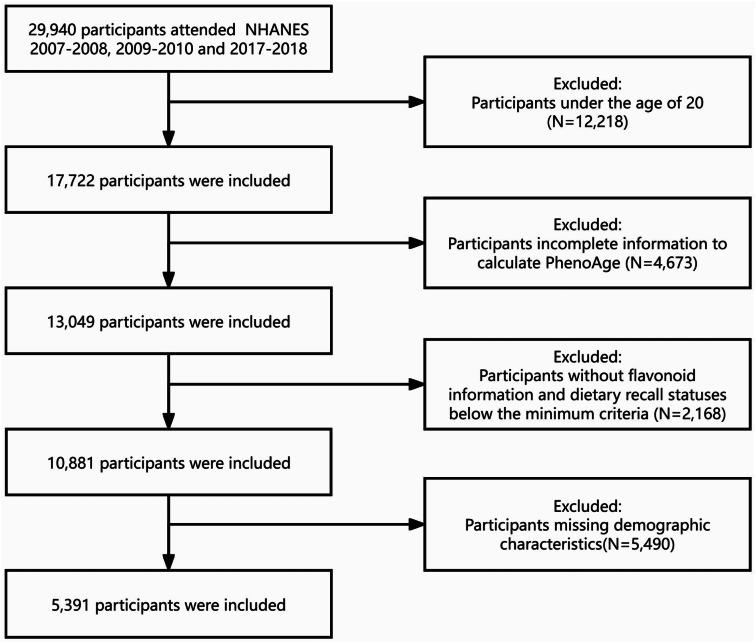
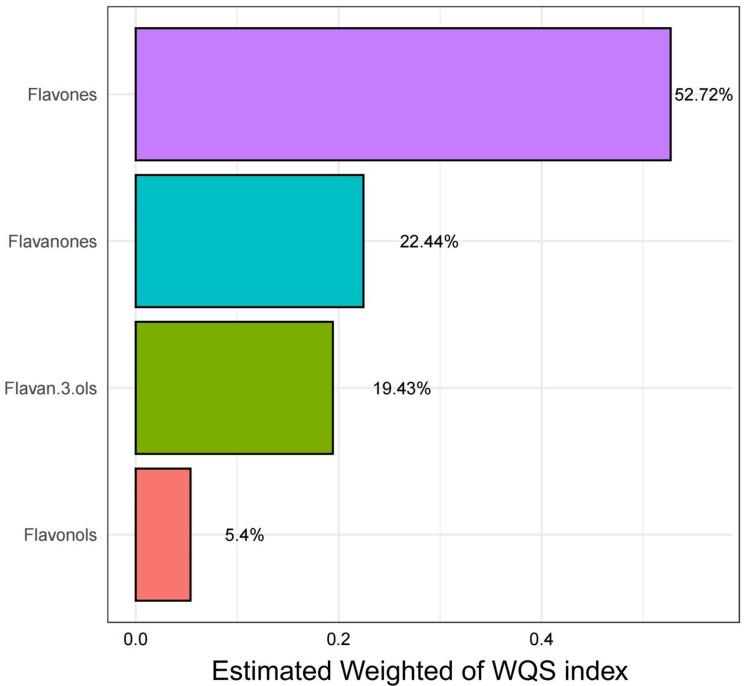
Data from three survey cycles (2007-2008, 2009-2010, and 2017-2018) of the National Health and Nutrition Examination Survey (NHANES) was used to investigate the relationship between PhenoAgeAccel and dietary flavonoid intake. Weighted linear regression was conducted to evaluate the relationship between dietary flavonoid intake and PhenoAgeAccel, and the dose-response relationship was investigated by limited cubic spline (RCS) analysis. Mixed effects were explored using weighted quantile sum (WQS) regression. Further, the subgroup analyses were also conducted.
RESULTS
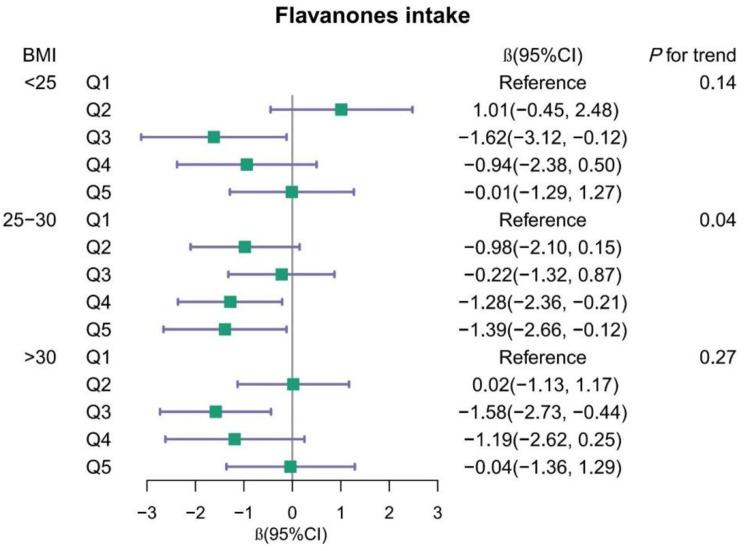
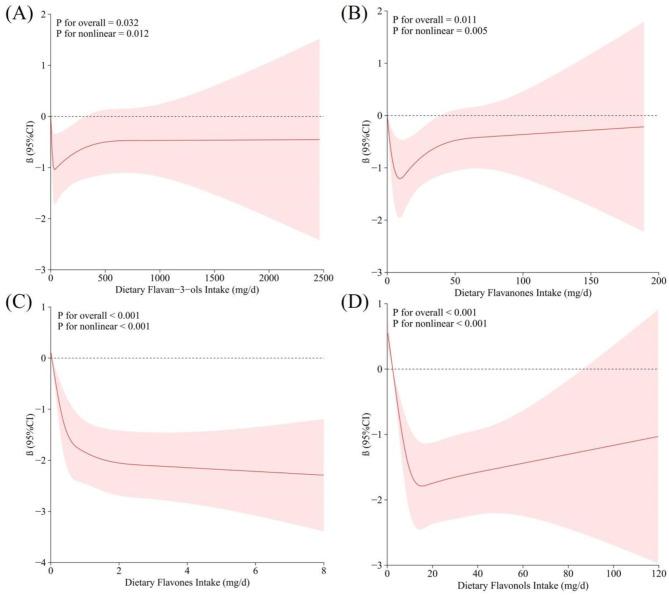
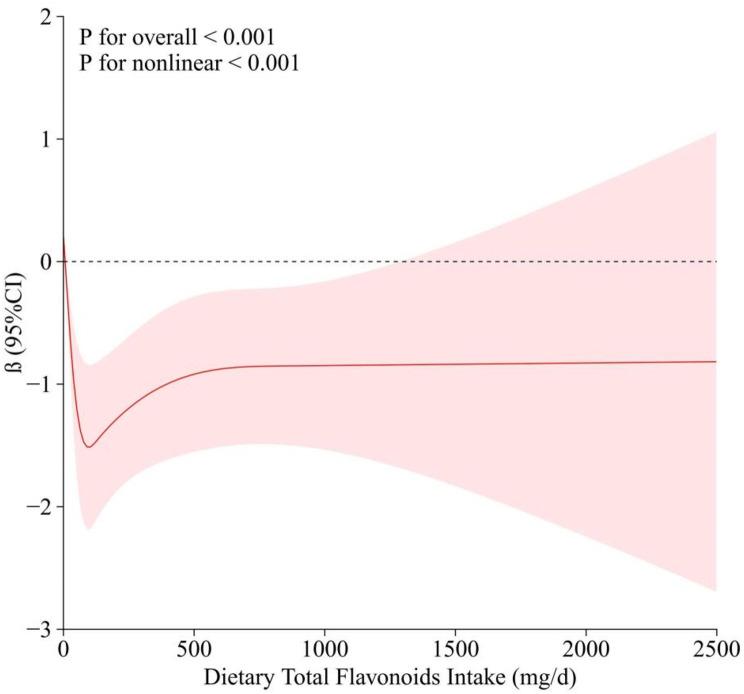
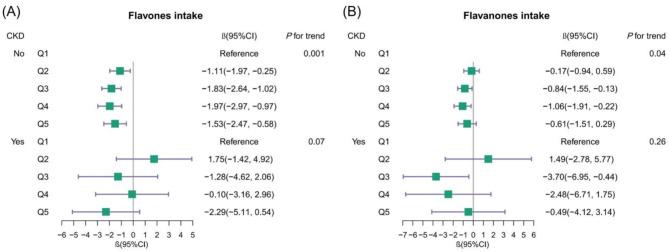
A total of 5391 participants were included, after multivariable adjustments, a negative association was found with total dietary flavonoid, flavan-3-ols, flavanone, flavones and flavonols with a β (95% CI) of -0.87 ( -1.61, -0.13), -0.83 (-1.95, -0.08), -1.18 (-1.98, -0.39), -1.64 (-2.52, -0.77) and - 1.18 (-1.98, -0.39) for the higher quintile compared to the lowest quintile. The RCS analysis show a non-linear relationship between flavan-3-ols (P for nonlinear = 0.024), flavanones (P for nonlinear = 0.005), flavones (P for nonlinear < 0.001), flavonols (P for nonlinear < 0.001) and total flavonoid intake (P for nonlinear < 0.001) and PhenoAgeAccel. WQS regression indicated that flavones had the primary effect on the mixture exposures (52.72%). Finally, the subgroup analysis indicated that participants without chronic kidney disease are more likely to benefit from dietary flavanone and flavone intake in mitigating aging, while the benefits of flavanone intake are more significant in participants with a lower body mass index.
CONCLUSION
Our study suggested that dietary flavonoid intake is negatively associated with accelerating aging in adults of American, and the most influential ones are flavones, flavanones, flavan-3-ols and flavonols.
背景
黄酮类化合物因其抗炎和抗氧化特性被认为具有潜在的抗衰老作用。然而,膳食黄酮类化合物及其亚类在延缓衰老方面的有效性尚未得到证实。我们的研究旨在探讨它们之间的关系。
方法
使用来自美国国家健康与营养检查调查(NHANES)三个调查周期(2007 - 2008年、2009 - 2010年和2017 - 2018年)的数据,研究PhenoAgeAccel与膳食黄酮类化合物摄入量之间的关系。进行加权线性回归以评估膳食黄酮类化合物摄入量与PhenoAgeAccel之间的关系,并通过受限立方样条(RCS)分析研究剂量反应关系。使用加权分位数和(WQS)回归探索混合效应。此外,还进行了亚组分析。
结果
共纳入5391名参与者,经过多变量调整后,发现总膳食黄酮类化合物、黄烷 - 3 - 醇、黄烷酮、黄酮和黄酮醇与PhenoAgeAccel呈负相关,与最低五分位数相比,最高五分位数的β(95%CI)分别为 - 0.87( - 1.61, - 0.13)、 - 0.83( - 1.95, - 0.08)、 - 1.18( - 1.98, - 0.39)、 - 1.64( - 2.52, - 0.77)和 - 1.18( - 1.98, - 0.39)。RCS分析显示黄烷 - 3 - 醇(非线性P = 0.024)、黄烷酮(非线性P = 0.005)、黄酮(非线性P < 0.001)、黄酮醇(非线性P < 0.001)和总黄酮类化合物摄入量(非线性P < 0.001)与PhenoAgeAccel之间存在非线性关系。WQS回归表明黄酮对混合暴露有主要影响(52.72%)。最后,亚组分析表明,没有慢性肾病的参与者更有可能从膳食黄烷酮和黄酮摄入中受益以减轻衰老,而黄烷酮摄入对体重指数较低参与者的益处更为显著。
结论
我们的研究表明,美国成年人膳食黄酮类化合物摄入量与衰老加速呈负相关,其中最具影响力的是黄酮、黄烷酮、黄烷 - 3 - 醇和黄酮醇。
 Zotero 插件