
光生物调节对永生化脂肪来源干细胞形成神经胚状体的影响。
Impact of photobiomodulation on neural embryoid body formation from immortalized adipose-derived stem cells.
作者信息
Mulaudzi Precious Earldom, Abrahamse Heidi, Crous Anine
机构信息
Laser Research Centre, Faculty of Health Sciences, University of Johannesburg, P.O. Box 17011, Doornfontein, 2028, South Africa.
出版信息
Stem Cell Res Ther. 2024 Dec 20;15(1):489. doi: 10.1186/s13287-024-04088-2.
BACKGROUND
Embryoid bodies (EBs) are three-dimensional (3D) multicellular cell aggregates that are derived from stem cell and play a pivotal role in regenerative medicine. They recapitulate many crucial aspects of the early stages of embryonic development and is the first step in the generation of various types of stem cells, including neuronal stem cells. Current methodologies for differentiating stem cells into neural embryoid bodies (NEBs) in vitro have advanced significantly, but they still have limitations which necessitate improvement. Photobiomodulation (PBM) a low powered light therapy is a non-invasive technique shown to promote stem cell proliferation and differentiation.
METHODS
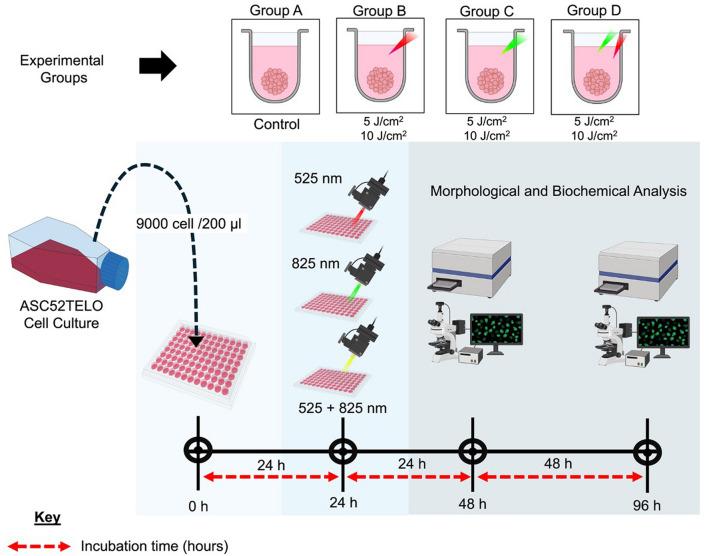
This in vitro study elucidated the effects of photobiomodulation (PBM) on the differentiation of immortalized adipose-derived stem cells (iADSCs) into NEBs within a 3D cell culture environment. The study utilized PBM at wavelengths of 825 nm, 525 nm, and a combination of both, with fluences of 5 and 10 J/cm. Morphology, viability, metabolic activity, and differentiation following PBM treatment was analysed.
RESULTS
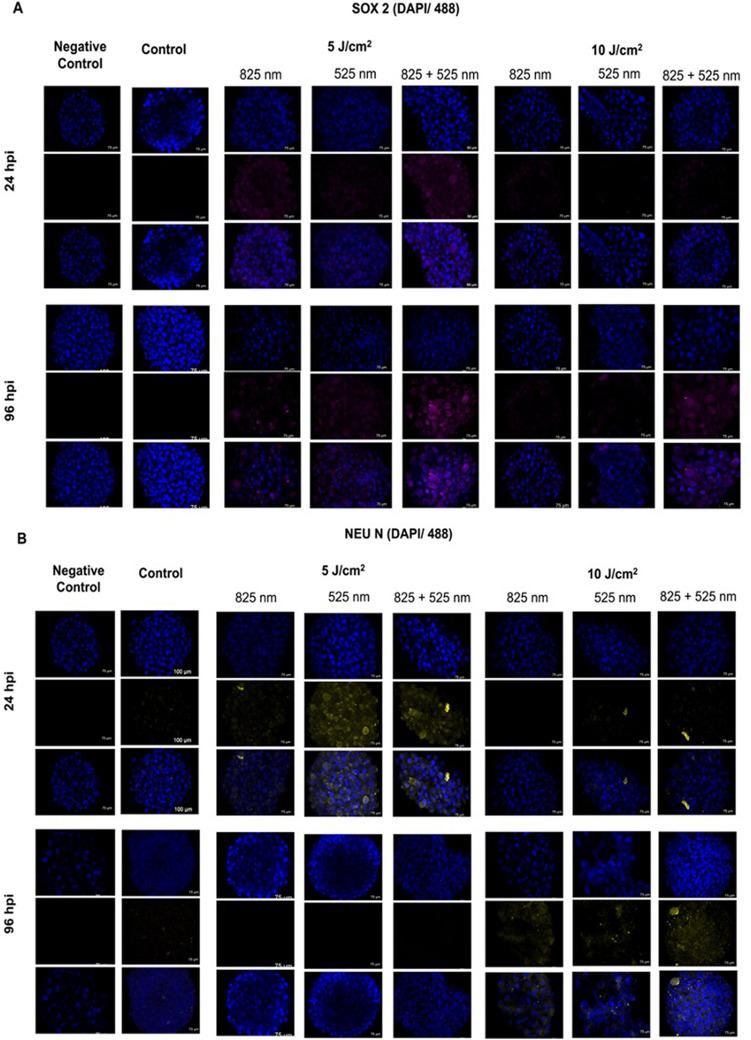
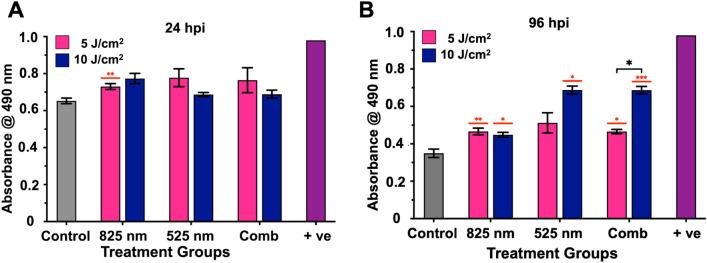
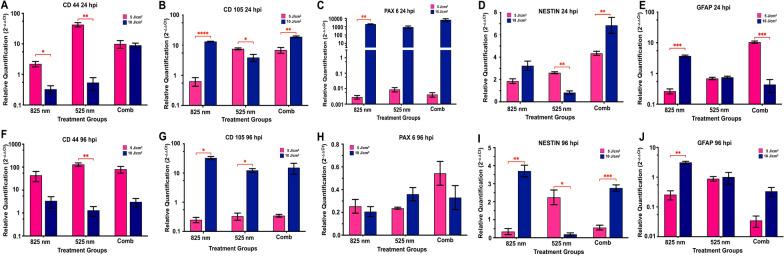
The results revealed that the effects of photobiomodulation (PBM) are dose dependent. PBM, at 825 nm with a fluence of 10 J/cm, significantly enhanced the size of neural embryoid bodies (NEBs), improved cell viability and proliferation, and reduced lactate dehydrogenase (LDH) levels, indicating minimal cell damage. Interestingly, the stem cell marker CD 44 was upregulated at 5 J/cm in all treatment groups at 24 and 96 hpi, CD105 increased with 825 nm at 10 J/cm at 24 hpi, which may be attributed to a heterogeneous cell population within the NEBs. Pax6 expression showed transient activation. Nestin was upregulated at 825 nm with 10 J/cm at 96 hpi, suggesting a promotion of neural precursor populations. GFAP an intermediate filament protein was upregulated at 825 nm at 10 J/cm2 at both 24 and 96 hpi. SOX2, a pluripotency marker, was expressed at 5 J/cm across all wavelengths. Neu N a neuronal nuclei marker was expressed at 5 J/cm in all treatments at 24 hpi and over time the expression was observed in all treatment groups at 10 J/cm.
CONCLUSION
In conclusion, the application of PBM at 825 nm with a fluence of 10 J/cm during the differentiation of iADSCs into NEBs resulted in optimal differentiation. Notably, the neuronal marker Nestin was significantly upregulated, highlighting the potential of the PBM approach for enhancing neuronal differentiation its promising applications in regenerative medicine.
背景
胚状体(EBs)是源自干细胞的三维(3D)多细胞细胞聚集体,在再生医学中发挥着关键作用。它们概括了胚胎发育早期的许多关键方面,是生成包括神经干细胞在内的各种类型干细胞的第一步。目前在体外将干细胞分化为神经胚状体(NEBs)的方法已经有了显著进展,但仍有局限性,需要改进。光生物调节(PBM)是一种低能量光疗法,是一种已被证明可促进干细胞增殖和分化的非侵入性技术。
方法
这项体外研究阐明了光生物调节(PBM)在3D细胞培养环境中对永生化脂肪来源干细胞(iADSCs)分化为NEBs的影响。该研究使用了波长为825nm、525nm以及两者组合的PBM,能量密度为5和10J/cm²。分析了PBM处理后的形态、活力、代谢活性和分化情况。
结果
结果表明,光生物调节(PBM)的作用具有剂量依赖性。波长为825nm、能量密度为10J/cm²的PBM显著增大了神经胚状体(NEBs)的尺寸,提高了细胞活力和增殖能力,并降低了乳酸脱氢酶(LDH)水平,表明细胞损伤最小。有趣的是,在感染后24小时和96小时,所有处理组中干细胞标志物CD44在能量密度为5J/cm²时均上调,CD105在感染后24小时时在波长825nm、能量密度为10J/cm²时增加,这可能归因于NEBs内的异质细胞群体。Pax6表达显示出瞬时激活。在感染后96小时时,波长825nm、能量密度为10J/cm²时Nestin上调,表明神经前体细胞群体增加。中间丝蛋白GFAP在感染后24小时和96小时时在波长825nm、能量密度为10J/cm²时上调。多能性标志物SOX2在所有波长下能量密度为5J/cm²时均有表达。神经元细胞核标志物NeuN在感染后24小时时在所有处理组能量密度为5J/cm²时表达,随着时间推移,在能量密度为10J/cm²的所有处理组中均观察到该表达。
结论
总之,在iADSCs分化为NEBs的过程中,应用波长825nm、能量密度为10J/cm²的PBM可实现最佳分化。值得注意的是,神经元标志物Nestin显著上调,突出了PBM方法在增强神经元分化方面的潜力及其在再生医学中的应用前景。



 Zotero 插件