
老年人中极短端粒与衰老及阿尔茨海默病的脑和血液标志物的关联
Association of critically short telomeres with brain and blood markers of ageing and Alzheimer's disease in older adults.
作者信息
Lehodey Asrar, Kaliman Perla, Palix Cassandre, de Florès Robin, Touron Edelweiss, Turpin Anne-Laure, Fauvel Séverine, Mézenge Florence, Landeau Brigitte, Chocat Anne, Vrillon Agathe, Paquet Claire, Vivien Denis, de La Sayette Vincent, Chételat Gaël, Poisnel Géraldine
机构信息
Normandie Univ, UNICAEN, INSERM, U1237, PhIND "Physiopathology and Imaging of Neurological Disorders", NeuroPresage Team, Cyceron, Boulevard Henri Becquerel, BP 5229, 14074, Caen Cedex, France.
Faculty of Health Sciences, Universitat Oberta de Catalunya, Rambla del Poblenou, 154-156, Sant Martí, 08018, Barcelona, Espagne.
出版信息
Alzheimers Res Ther. 2024 Dec 20;16(1):269. doi: 10.1186/s13195-024-01635-0.
BACKGROUND
Accumulation of critically short telomeres (CST) is implicated in decreased tissular regenerative capacity and increased susceptibility to degenerative diseases such as Alzheimer's disease (AD). Telomere shortening has also been associated with age-related brain changes. However, it remains unclear whether CST accumulation is directly associated with AD markers or instead amplifies age-related effects, potentially increasing susceptibility of developing AD in cognitively healthy older adults.
METHODS
This cross-sectional study used baseline data of 129 community-dwelling cognitively healthy older adults from the Age-Well trial (NCT02977819), aged 65 years and older enrolled between 2016 and 2018, in France. Using linear regressions, we analyzed the relationship between an innovative marker of telomere shortening, the percentage of CST (%CST), structural, functional and molecular neuroimaging outcomes, and multiple blood-based biomarkers related to AD pathophysiology. The effect of apolipoprotein E ε4 genotype (APOE4) was assessed on these relationships using interaction analysis.
RESULTS
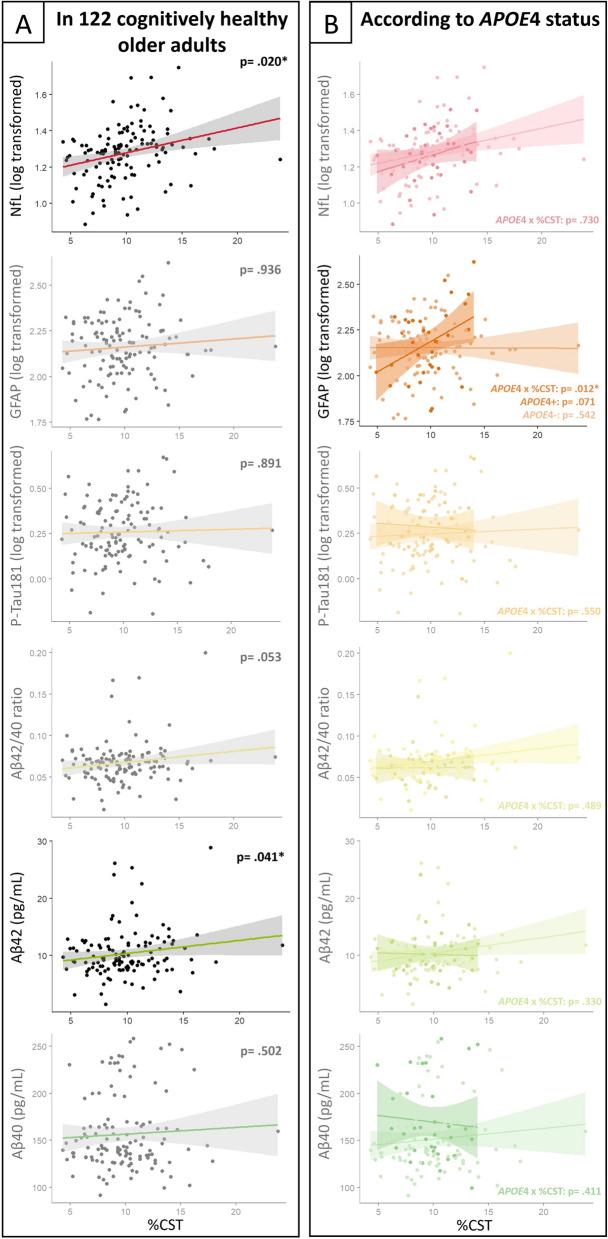
A higher %CST was associated with lower global kurtosis fractional anisotropy (β = -.230; P = .010), particularly in frontal and temporal regions. A higher %CST was also related to higher plasma levels of Neurofilament light chain (β = .195; P = .020) and a lower subiculum volume (β = -.206; P = .020), although these associations did not meet the threshold for multiple comparisons. %CST was not associated with AD-related neuroimaging markers, including the AD-sensitive gray matter pattern (β = -.060; P = .441), glucose metabolism pattern (β = -.099; P = .372), brain perfusion pattern (β = -.106; P = .694) or hippocampus volume (β = -.106; P = .194). In APOE4 carriers, higher %CST was associated with lower subiculum (β = -.423; P = 0.003), DG (β = -.410; P = 0.018) and CA1 volumes (β = -.373; P = 0.024), even though associations with DG and CA1 volumes did not survive multiple comparison.
CONCLUSIONS
Although an increase in %CST does not appear to be directly linked to the pathophysiology of AD in cognitively healthy older adults, it could heighten the susceptibility of APOE4 carriers to develop AD plausibly due to greater vulnerability to age-related effects. However, longitudinal studies would be necessary to determine whether %CST influences the development and progression of AD later in life.
背景
极短端粒(CST)的积累与组织再生能力下降以及患退行性疾病(如阿尔茨海默病(AD))的易感性增加有关。端粒缩短也与年龄相关的脑变化有关。然而,目前尚不清楚CST积累是直接与AD标志物相关,还是相反地放大了年龄相关效应,从而可能增加认知健康的老年人患AD的易感性。
方法
这项横断面研究使用了来自法国“健康老龄化”试验(NCT02977819)的129名社区居住的认知健康老年人的基线数据,这些老年人年龄在65岁及以上,于2016年至2018年入组。通过线性回归,我们分析了端粒缩短的一个创新标志物——CST百分比(%CST)、结构、功能和分子神经影像学结果以及与AD病理生理学相关的多种血液生物标志物之间的关系。使用交互分析评估载脂蛋白Eε4基因型(APOE4)对这些关系的影响。
结果
较高的%CST与较低的全脑峰度分数各向异性相关(β = -0.230;P = 0.010),特别是在额叶和颞叶区域。较高的%CST还与神经丝轻链血浆水平升高(β = 0.195;P = 0.020)和海马下托体积减小(β = -0.206;P = 0.020)有关,尽管这些关联未达到多重比较的阈值。%CST与AD相关的神经影像学标志物无关,包括AD敏感的灰质模式(β = -0.060;P = 0.441)、葡萄糖代谢模式(β = -0.099;P = 0.372)、脑灌注模式(β = -0.106;P = 0.694)或海马体积(β = -0.106;P = 0.194)。在APOE4携带者中,较高的%CST与较小的海马下托(β = -0.423;P = 0.003)、齿状回(β = -0.410;P = 0.018)和CA1体积(β = -0.373;P = 0.024)相关,尽管与齿状回和CA1体积的关联在多重比较后未通过检验。
结论
尽管在认知健康的老年人中,%CST的增加似乎与AD的病理生理学没有直接联系,但由于对年龄相关效应的更大易感性,它可能会增加APOE4携带者患AD的易感性。然而,需要进行纵向研究来确定%CST是否会影响晚年AD的发生和发展。


 Zotero 插件