
碱性pH条件下Fmoc-二苯基丙氨酸的有序聚集体作为原纤维形成和肽凝胶化的前体
Ordered Aggregates of Fmoc-Diphenylalanine at Alkaline pH as a Precursor of Fibril Formation and Peptide Gelation.
作者信息
Hughes Emily, O'Neill Nichole S, Schweitzer-Stenner Reinhard
机构信息
Department of Chemistry, Drexel University, Philadelphia, Pennsylvania 19104, United States.
出版信息
J Phys Chem B. 2025 Jan 9;129(1):260-272. doi: 10.1021/acs.jpcb.4c06796. Epub 2024 Dec 22.
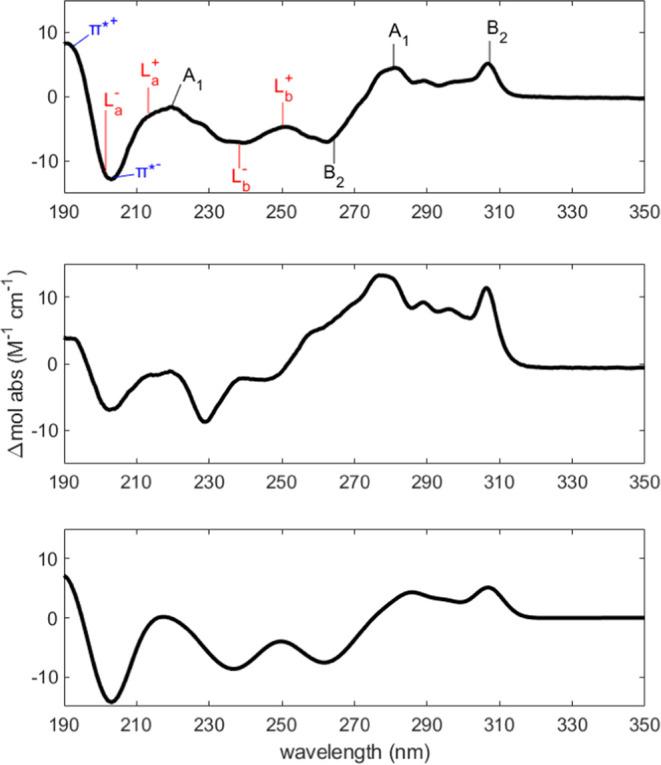
The ultrashort peptide -fluorenylmethoxycarbonyl-phenylalanyl-phenylalanine (FmocFF) has been largely investigated due to its ability to self-assemble into fibrils (100 nm-μm scale) that can form a sample-spanning gel network. The initiation of the gelation process requires either a solvent switch (water added to dimethyl sulfoxide) or a pH-switch (alkaline to neutral) protocol, both of which ensure the solubility of the peptide as a necessary step preceding gelation. While the respective gel phases are well understood in structural and material characteristics terms the pregelation conditions are known to a lesser extent. The question we asked is to what extent the gel-forming fibrils are already partially formed, i.e., oligomers or protofibrils. Focusing on the pregelation conditions for the pH-switch method, we investigated the self-assembly of soluble FmocFF aggregates in alkaline pH by UV circular dichroism, IR, vibrational circular dichroism, and H NMR spectroscopy for different peptide concentrations and more systematically as a function of temperature. The temperature dependence of the UVCD spectra of FmocFF in HO and DO revealed a complicated isotope effect that affects the peptide backbone and fluorene conformations in peptide aggregates differently. Moreover, we found that the melting of formed aggregates depends on peptide concentration in a nonmonotonic way. At 20 mM the UVCD data revealed the population of at least two different thermodynamic intermediate states, which seem to differ in terms of the relative arrangement of the fluorene moiety. The IR spectrum of this sample at room temperature indicates an antiparallel β-sheet arrangement, as suggested earlier in the literature. However, we show that this interpretation can only be valid if one invokes a nondispersive redshift of the two amide I' bands in a locally crystalline environment. The respective vibrational circular dichroism spectrum of the amide I' region is consistent with a left-handed helically twisted structure of the formed aggregates. A comparison of our data with spectra of the aqueous gel phase suggests that fibrils in the latter resemble the ones at alkaline pH probed by our experiments.
超短肽芴甲氧羰基 - 苯丙氨酰 - 苯丙氨酸(FmocFF)因其能够自组装成原纤维(100纳米至微米尺度)并形成贯穿样品的凝胶网络而受到广泛研究。凝胶化过程的启动需要溶剂切换(向二甲基亚砜中加水)或pH切换(从碱性到中性)方案,这两种方案都确保了肽的溶解性,这是凝胶化之前的必要步骤。虽然各自的凝胶相在结构和材料特性方面已得到很好的理解,但对凝胶化前的条件了解较少。我们提出的问题是,形成凝胶的原纤维在多大程度上已经部分形成,即低聚物或原纤维。聚焦于pH切换方法的凝胶化前条件,我们通过紫外圆二色性、红外、振动圆二色性和核磁共振光谱,研究了不同肽浓度下以及更系统地作为温度函数的碱性pH下可溶性FmocFF聚集体的自组装。FmocFF在H₂O和D₂O中的紫外圆二色光谱的温度依赖性揭示了一种复杂的同位素效应,该效应以不同方式影响肽聚集体中的肽主链和芴构象。此外,我们发现形成的聚集体的熔化取决于肽浓度,且呈现非单调方式。在20 mM时,紫外圆二色性数据揭示了至少两种不同热力学中间态的存在,这两种中间态在芴部分的相对排列方面似乎有所不同。该样品在室温下的红外光谱表明存在反平行β - 折叠排列,如文献中先前所述。然而,我们表明,只有在局部晶体环境中调用两个酰胺I'带的非色散红移时,这种解释才有效。酰胺I'区域各自的振动圆二色光谱与形成的聚集体的左手螺旋扭曲结构一致。将我们的数据与水凝胶相的光谱进行比较表明,后者中的原纤维类似于我们实验中探测到的碱性pH下的原纤维。



 Zotero 插件