
耐万古霉素金黄色葡萄球菌危及埃及奶牛群。
Vancomycin-resistant Staphylococcus aureus endangers Egyptian dairy herds.
作者信息
Tartor Yasmine H, Enany Mohamed E, Ismail Noreen I, El-Demerdash Azza S, Eidaroos Nada H, Algendy Reem M, Mahmmod Yasser, Elsohaby Ibrahim
机构信息
Department of Microbiology, Faculty of Veterinary Medicine, Zagazig University, Zagazig, 44511, Egypt.
Department of Bacteriology, Immunology, and Mycology, Faculty of Veterinary Medicine, Suez Canal University, Ismailia, 41522, Egypt.
出版信息
Sci Rep. 2024 Dec 23;14(1):30606. doi: 10.1038/s41598-024-81516-6.
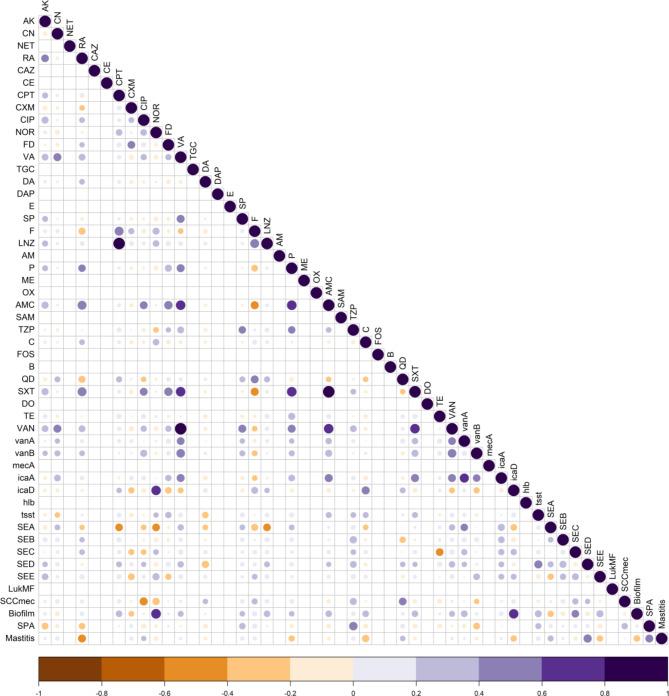
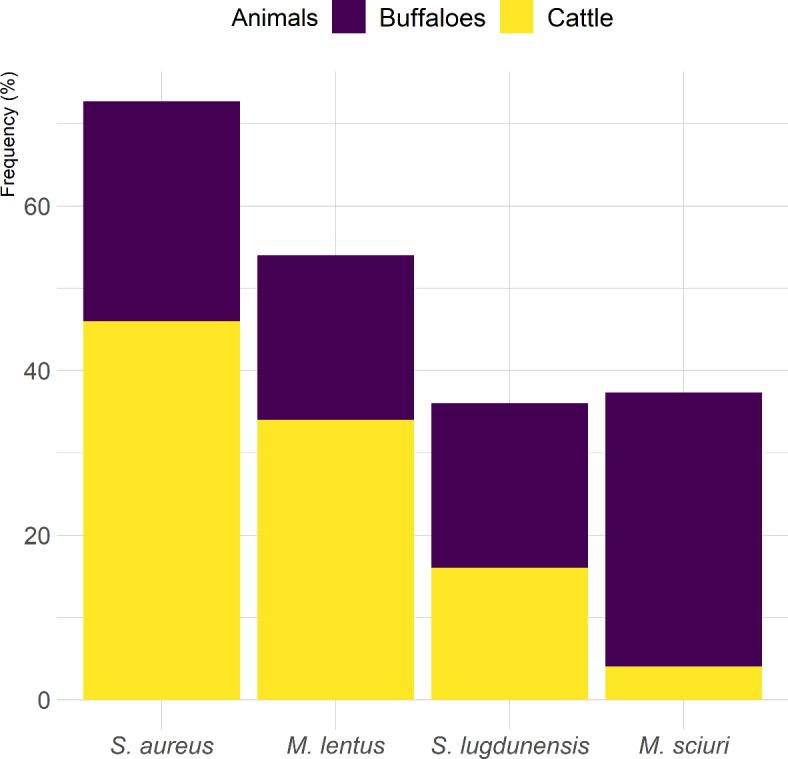
The emergence of pandrug-resistant (PDR) and extensive drug-resistant (XDR) methicillin-resistant and vancomycin-resistant Staphylococcus aureus (MRSA and VRSA) isolates from bovine milk samples along with biofilm formation ability and harboring various virulence genes complicates the treatment of bovine mastitis and highlights the serious threat to public health. This study investigated for the first time the frequency, antimicrobial resistance profiles, biofilm-forming ability, virulence factors, spa and staphylococcal cassette chromosome mec (SCCmec) types of MRSA and VRSA isolated from clinical and subclinical bovine mastitis in Egypt. A total of 808 milk samples were collected from each quarter of 202 dairy animals, including 31 buffaloes and 171 cattle. The frequency of mastitis in the collected milk samples was 48.4% (60/124) in buffaloes and 29.2% (200/684) in cattle. A total of 65 Staphylococcus species isolates were recovered, including 27 coagulase-positive S. aureus (CoPS) isolates and 38 coagulase-negative staphylococci (CoNS). The CoNS included 27 mammaliicocci (20 Mammaliicoccus lentus and 7 M. sciuri) and 11 Non-aureus staphylococci (S. lugdunensis) isolates. All the CoPS isolates were mecA positive and resistant to 20-33 tested antimicrobials with multiple antibiotic resistance index ranging from 0.61 to 1. Three isolates were PDR, four were XDR, and 20 were multidrug resistant isolates. VRSA was detected in 85.2% of CoPS isolates with minimal inhibitory concentration (MIC) ranging from 64 to 1024 µg/mL. The vanA gene was found in 60.8%, vanB in 73.9%, and both genes in 43.5% of VRSA isolates. All the CoPS isolates exhibited biofilm formation ability, with 55.6% being strong, and 44.4% moderate biofilm producers, and harbored icaA (74.1%) and icaD (74.1%) biofilm-forming genes. All S. aureus isolates harbored both beta-haemolysin (hlb) and leucotoxin (lukMF) genes, while 44.4% were positive for toxic shock syndrome toxin (tsst) gene. Enterotoxin genes sea, seb, sec, sed, and see were found in 59.3%, 40.7%, 18.5%, 33.3%, and 14.8% of isolates, respectively. Additionally, 70.4% of the isolates had spa X-region gene, and exhibited eight different MRSA spa types (t127, t267, t037, t011, t843, t1081, t2663, and t1575), with spa t127 being the most common. Three SCCmec types (I, II and III) were identified, with SCCmec I being predominant, and were further classified into subtypes 1.1.1, 1.1.2, 1.n.1, and 4.1.1. The ability of MRSA and VRSA isolates to produce biofilms and resist antimicrobials highlights the serious threat these pathogens pose to bovine milk safety, animal welfare, and public health. Therefore, strict hygiene practices and antimicrobial surveillance are crucial to reduce the risk of MRSA and VRSA colonization and dissemination.
从牛乳样本中分离出的泛耐药(PDR)和广泛耐药(XDR)的耐甲氧西林和耐万古霉素金黄色葡萄球菌(MRSA和VRSA),以及其生物膜形成能力和携带的各种毒力基因,使奶牛乳腺炎的治疗变得复杂,并凸显了对公共卫生的严重威胁。本研究首次调查了从埃及临床和亚临床奶牛乳腺炎中分离出的MRSA和VRSA的频率、抗菌药物耐药谱、生物膜形成能力、毒力因子、spa和葡萄球菌盒式染色体mec(SCCmec)类型。从202头奶牛的每个乳腺中收集了总共808份乳样,其中包括31头水牛和171头牛。所收集乳样中乳腺炎的发生率在水牛中为48.4%(60/124),在奶牛中为29.2%(200/684)。共分离出65株葡萄球菌,其中包括27株凝固酶阳性金黄色葡萄球菌(CoPS)和38株凝固酶阴性葡萄球菌(CoNS)。CoNS包括27株哺乳动物葡萄球菌(20株缓慢哺乳动物葡萄球菌和7株松鼠葡萄球菌)和11株非金黄色葡萄球菌(路邓葡萄球菌)。所有CoPS分离株mecA均为阳性,对20 - 33种测试抗菌药物耐药,多重耐药指数范围为0.61至1。3株为PDR,4株为XDR,20株为多重耐药分离株。在85.2%的CoPS分离株中检测到VRSA,其最低抑菌浓度(MIC)范围为64至1024 μg/mL。在60.8%的VRSA分离株中发现了vanA基因,73.9%发现了vanB基因,43.5%同时发现了这两个基因。所有CoPS分离株均表现出生物膜形成能力,其中55.6%为强生物膜生产者,44.4%为中度生物膜生产者,并携带icaA(74.1%)和icaD(74.1%)生物膜形成基因。所有金黄色葡萄球菌分离株均携带β - 溶血素(hlb)和白细胞毒素(lukMF)基因,而44.4%的菌株毒休克综合征毒素(tsst)基因呈阳性。分别在59.3%、40.7%、18.5%、33.3%和14.8%的分离株中发现了肠毒素基因sea、seb、sec、sed和see。此外,70.4%的分离株具有spa X区域基因,并表现出8种不同的MRSA spa类型(t127、t267、t037、t011、t843、t1081、t2663和t1575),其中spa t127最为常见。鉴定出三种SCCmec类型(I、II和III),其中SCCmec I为主导类型,并进一步分为亚型1.1.1、1.1.2、1.n.1和4.1.1。MRSA和VRSA分离株产生生物膜和抵抗抗菌药物的能力凸显了这些病原体对牛乳安全、动物福利和公共卫生构成的严重威胁。因此,严格的卫生措施和抗菌药物监测对于降低MRSA和VRSA定植和传播的风险至关重要。

 Zotero 插件