
从导管原位癌到浸润性乳腺癌:细胞外微环境的预后价值
From ductal carcinoma in situ to invasive breast cancer: the prognostic value of the extracellular microenvironment.
作者信息
Hulahan Taylor S, Angel Peggi M
机构信息
Department of Pharmacology and Immunology, Medical University of South Carolina, Charleston, SC, USA.
出版信息
J Exp Clin Cancer Res. 2024 Dec 23;43(1):329. doi: 10.1186/s13046-024-03236-z.
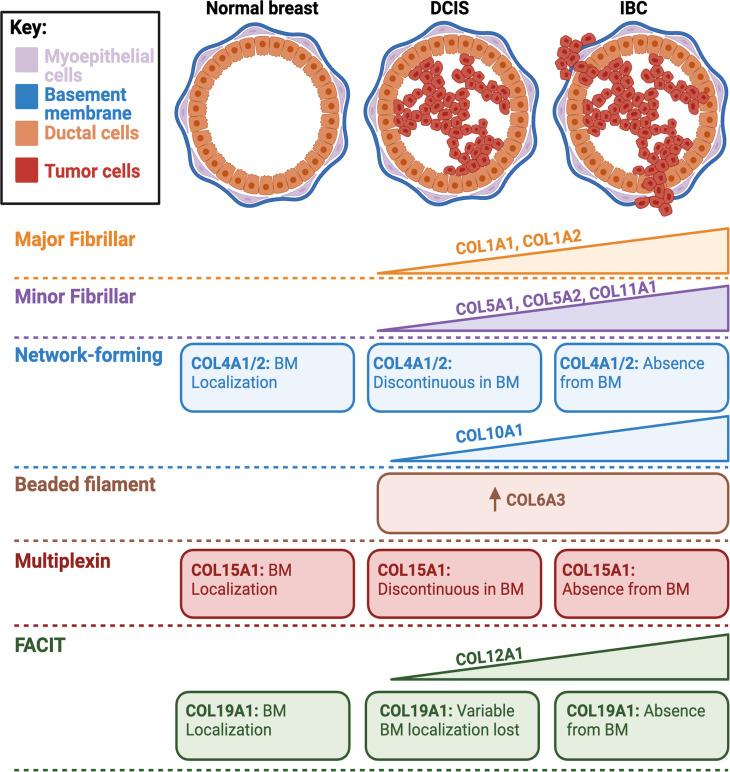
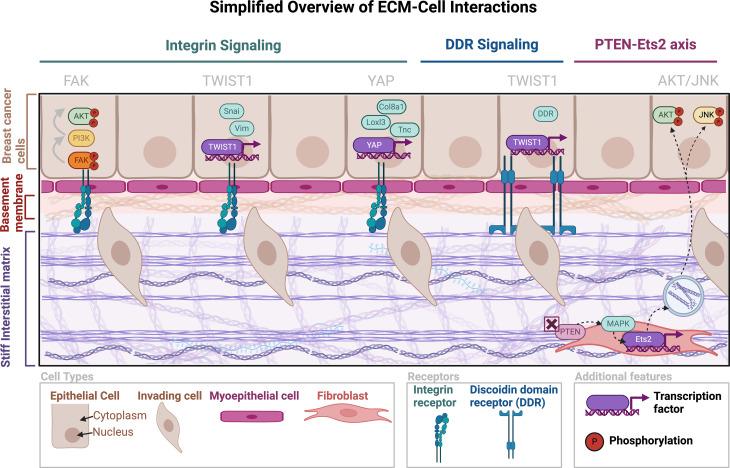
Ductal carcinoma in situ (DCIS) is a noninvasive breast disease that variably progresses to invasive breast cancer (IBC). Given the unpredictability of this progression, most DCIS patients are aggressively managed similar to IBC patients. Undoubtedly, this treatment paradigm places many DCIS patients at risk of overtreatment and its significant consequences. Historically, prognostic modeling has included the assessment of clinicopathological features and genomic markers. Although these provide valuable insights into tumor biology, they remain insufficient to predict which DCIS patients will progress to IBC. Contemporary work has begun to focus on the microenvironment surrounding the ductal cells for molecular patterns that might predict progression. In this review, extracellular microenvironment alterations occurring with the malignant transformation from DCIS to IBC are detailed. Not only do changes in collagen abundance, organization, and localization mediate the transition to IBC, but also the discrete post-translational regulation of collagen fibers is understood to promote invasion. Other extracellular matrix proteins, such as matrix metalloproteases, decorin, and tenascin C, have been characterized for their role in invasive transformation and further demonstrate the prognostic value of the extracellular matrix. Importantly, these extracellular matrix proteins influence immune cells and fibroblasts toward pro-tumorigenic phenotypes. Thus, the progressive changes in the extracellular microenvironment play a key role in invasion and provide promise for prognostic development.
导管原位癌(DCIS)是一种非侵袭性乳腺疾病,其发展为浸润性乳腺癌(IBC)的情况各不相同。鉴于这种进展的不可预测性,大多数DCIS患者的治疗方式与IBC患者相似,都采取积极的治疗手段。毫无疑问,这种治疗模式使许多DCIS患者面临过度治疗及其严重后果的风险。从历史上看,预后模型包括对临床病理特征和基因组标志物的评估。尽管这些评估为肿瘤生物学提供了有价值的见解,但它们仍不足以预测哪些DCIS患者会发展为IBC。当代研究已开始关注导管细胞周围的微环境,以寻找可能预测进展的分子模式。在这篇综述中,详细阐述了DCIS向IBC恶性转化过程中发生的细胞外微环境改变。不仅胶原蛋白丰度、组织和定位的变化介导了向IBC的转变,而且据了解胶原蛋白纤维离散的翻译后调控会促进侵袭。其他细胞外基质蛋白,如基质金属蛋白酶、核心蛋白聚糖和腱生蛋白C,已被确定在侵袭性转化中的作用,并进一步证明了细胞外基质的预后价值。重要的是,这些细胞外基质蛋白会使免疫细胞和成纤维细胞向促肿瘤表型转变。因此,细胞外微环境的渐进性变化在侵袭中起关键作用,并为预后研究的发展带来了希望。
 Zotero 插件