
vCPP2319与转移性乳腺癌细胞外囊泡(EVs)相互作用,并对人血脑屏障模型进行转座。
vCPP2319 interacts with metastatic breast cancer extracellular vesicles (EVs) and transposes a human blood-brain barrier model.
作者信息
Oliveira Filipa D, Cavaco Marco, Figueira Tiago N, Napoleão Patrícia, Valle Javier, Neves Vera, Andreu David, Castanho Miguel A R B
机构信息
Gulbenkian Institute for Molecular Medicine, Faculdade de Medicina da Universidade de Lisboa, Av. Prof. Egas Moniz, Lisbon, 1649-028, Portugal.
Department of Medicine and Life Sciences, Pompeu Fabra University, Barcelona Biomedical Research Park, 08003, Barcelona, Spain.
出版信息
Heliyon. 2024 Dec 4;10(23):e40907. doi: 10.1016/j.heliyon.2024.e40907. eCollection 2024 Dec 15.
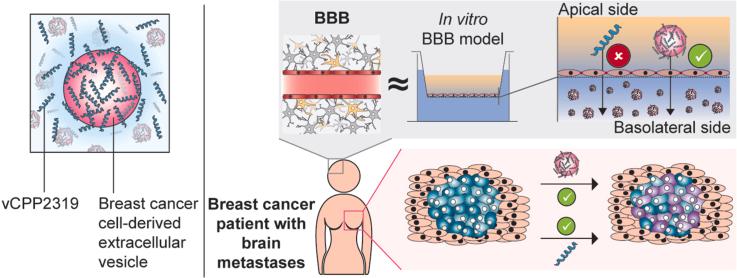
Brain metastases (BM) are frequently found in cancer patients and, though their precise incidence is difficult to estimate, there is evidence for a correlation between BM and specific primary cancers, such as lung, breast, and skin (melanoma). Among all these, breast cancer is the most frequently diagnosed among women and, in this case, BM cause a critical reduction of the overall survival (OS), especially in triple negative breast cancer (TNBC) patients. The main challenge of BM treatment is the impermeable nature of the blood-brain barrier (BBB), which shields the central nervous systems (CNS) from chemotherapeutic drugs. Extracellular vesicles (EVs) have been proposed as ideal natural drug carriers and these may exhibit some advantages over synthetic nanoparticles (NPs). In this work, we isolate breast cancer-derived EVs and study their ability to carry vCPP2319, a peptide with dual cell-penetration and anticancer activities. The selective cytotoxicity of anticancer peptide-loaded EVs towards breast cancer cells and their ability to translocate an BBB model are also addressed. Overall, it was possible to conclude that vCPP2319 naturally interacts with breast cancer-derived EVs, being retained at the surface of these vesicles. Moreover, the results revealed a cytotoxic activity for peptide-loaded EVs similar to that obtained with the peptide alone and the ability of peptide-loaded EVs to translocate an BBB model, which contrasts with the results obtained with the peptide alone. In conclusion, this work supports the use of EVs in the development of biological drug-delivery systems (DDS) capable of translocating the BBB.
脑转移瘤(BM)在癌症患者中很常见,尽管其确切发病率难以估计,但有证据表明BM与特定的原发性癌症之间存在关联,如肺癌、乳腺癌和皮肤癌(黑色素瘤)。在所有这些癌症中,乳腺癌是女性中最常被诊断出的癌症,在这种情况下,BM会导致总生存期(OS)显著缩短,尤其是在三阴性乳腺癌(TNBC)患者中。BM治疗的主要挑战是血脑屏障(BBB)的不可渗透性,它使中枢神经系统(CNS)免受化疗药物的影响。细胞外囊泡(EVs)已被提议作为理想的天然药物载体,并且与合成纳米颗粒(NPs)相比可能具有一些优势。在这项工作中,我们分离出乳腺癌来源的EVs,并研究它们携带vCPP2319的能力,vCPP2319是一种具有双重细胞穿透和抗癌活性的肽。还探讨了负载抗癌肽的EVs对乳腺癌细胞的选择性细胞毒性及其转运穿过血脑屏障模型的能力。总体而言,可以得出结论,vCPP2319与乳腺癌来源的EVs自然相互作用,并保留在这些囊泡的表面。此外,结果显示负载肽的EVs具有与单独使用肽时相似的细胞毒性活性,以及负载肽的EVs转运穿过血脑屏障模型的能力,这与单独使用肽时获得的结果形成对比。总之,这项工作支持在开发能够转运穿过血脑屏障的生物药物递送系统(DDS)中使用EVs。



 Zotero 插件