
新冠疫情的间接影响:对2015年至2022年24个国家预期寿命变化的死因分析
Indirect effects of the COVID-19 pandemic: A cause-of-death analysis of life expectancy changes in 24 countries, 2015 to 2022.
作者信息
Polizzi Antonino, Zhang Luyin, Timonin Sergey, Gupta Aashish, Dowd Jennifer Beam, Leon David A, Aburto José Manuel
机构信息
Department of Sociology, University of Oxford, Oxford OX1 1JD, United Kingdom.
Leverhulme Centre for Demographic Science, University of Oxford, Oxford OX1 1JD, United Kingdom.
出版信息
PNAS Nexus. 2024 Dec 19;4(1):pgae508. doi: 10.1093/pnasnexus/pgae508. eCollection 2025 Jan.
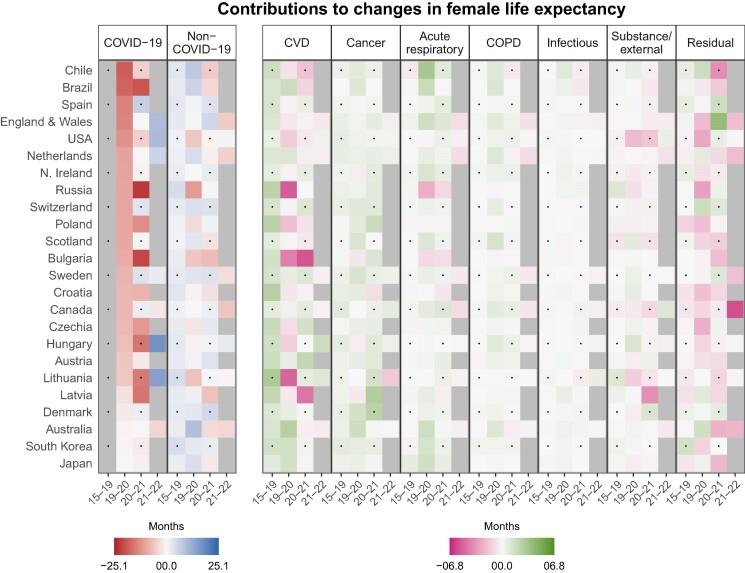
Worldwide, mortality was strongly affected by the COVID-19 pandemic, both directly through COVID-19 deaths and indirectly through changes in other causes of death. Here, we examine the impact of the pandemic on COVID-19 and non-COVID-19 mortality in 24 countries: Australia, Austria, Brazil, Bulgaria, Canada, Chile, Croatia, Czechia, Denmark, England and Wales, Hungary, Japan, Latvia, Lithuania, The Netherlands, Northern Ireland, Poland, Russia, Scotland, South Korea, Spain, Sweden, Switzerland, and the United States. Using demographic decomposition methods, we compare age- and cause-specific contributions to changes in female and male life expectancy at birth in 2019-2020, 2020-2021, and 2021-2022 with those before the COVID-19 pandemic (2015-2019). We observe large life expectancy losses due to COVID-19 in most countries, usually followed by partial recoveries. Life expectancy losses due to cardiovascular disease (CVD) mortality were widespread during the pandemic, including in countries with substantial (Russia, Central and Eastern Europe, and the Baltic countries) and more modest (United States) improvements in CVD mortality before the pandemic. Many Anglo-Saxon countries, including Canada, Scotland, and the United States, continued their prepandemic trajectories of rising drug-related mortality. Most countries saw small changes in suicide mortality during the pandemic, while alcohol mortality increased and cancer mortality continued to decline. Patterns for other causes were more variable. By 2022, life expectancy had still not returned to prepandemic levels in several countries. Our results suggest important indirect effects of the pandemic on non-COVID-19 mortality through the consequences of COVID-19 infection, nonpharmaceutical interventions, and underreporting of COVID-19-related deaths.
在全球范围内,死亡率受到新冠疫情的严重影响,既包括直接因新冠死亡,也包括因其他死因变化产生的间接影响。在此,我们研究了疫情对24个国家新冠及非新冠死亡率的影响,这些国家包括:澳大利亚、奥地利、巴西、保加利亚、加拿大、智利、克罗地亚、捷克、丹麦、英格兰和威尔士、匈牙利、日本、拉脱维亚、立陶宛、荷兰、北爱尔兰、波兰、俄罗斯、苏格兰、韩国、西班牙、瑞典、瑞士和美国。我们使用人口分解方法,比较了2019 - 2020年、2020 - 2021年和2021 - 2022年按年龄和死因划分的对出生时女性和男性预期寿命变化的贡献,与新冠疫情之前(2015 - 2019年)的情况。我们观察到,大多数国家因新冠疫情导致预期寿命大幅下降,随后通常会有部分恢复。在疫情期间,心血管疾病(CVD)死亡率导致的预期寿命损失普遍存在,包括在疫情前心血管疾病死亡率有显著改善(俄罗斯、中东欧和波罗的海国家)以及改善幅度较小(美国)的国家。许多盎格鲁 - 撒克逊国家,包括加拿大、苏格兰和美国,延续了疫情前与药物相关死亡率上升的趋势。疫情期间,大多数国家自杀死亡率变化不大,而酒精相关死亡率上升,癌症死亡率持续下降。其他死因的模式则更具变异性。到2022年,仍有几个国家的预期寿命尚未恢复到疫情前的水平。我们的研究结果表明,疫情通过新冠感染的后果、非药物干预措施以及新冠相关死亡的漏报,对非新冠死亡率产生了重要的间接影响。

 Zotero 插件