
罗马尼亚裔抗乙酰胆碱受体抗体阳性和双血清阴性重症肌无力患者的HLA I类和II类等位基因
HLA Class I and II Alleles in Anti-Acetylcholine Receptor Antibodies Positive and Double-Seronegative Myasthenia Gravis Patients of Romanian Descent.
作者信息
Croitoru Cristina Georgiana, Constantinescu Daniela, Pavel-Tanasa Mariana, Cuciureanu Dan Iulian, Cianga Corina Maria, Hodorog Diana Nicoleta, Cianga Petru
机构信息
Neurology Clinic I, "Prof. Dr. Nicolae Oblu" Emergency Clinical Hospital, 700309 Iași, Romania.
Department of Immunology, "Grigore T. Popa" University of Medicine and Pharmacy, 700115 Iași, Romania.
出版信息
Neurol Int. 2024 Dec 10;16(6):1819-1836. doi: 10.3390/neurolint16060130.
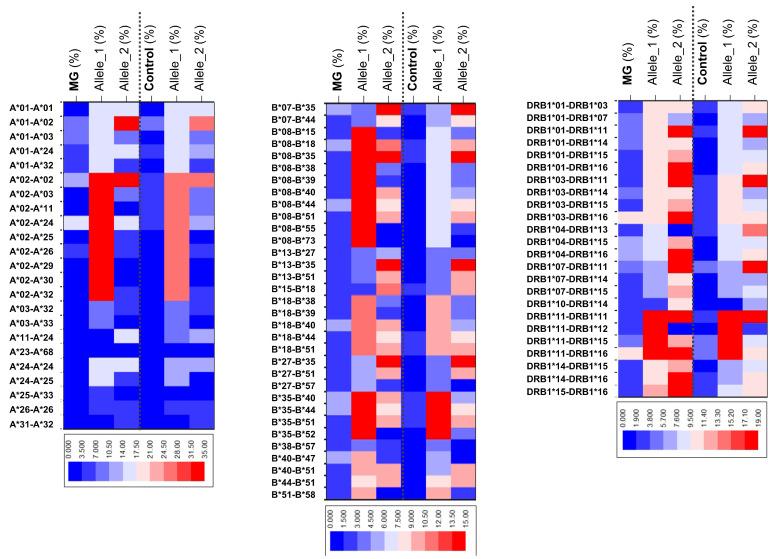
: Several significant associations between certain Human Leukocyte Antigen (HLA) alleles and myasthenia gravis (MG) subtypes were established in populations from Western Europe and North America and, to a lesser extent, from China and Japan. However, such data are scarcely available for Eastern Europe. This study aimed to analyze the associations of HLA Class I and II alleles with MG and its serological subtypes (with anti-acetylcholine receptor autoantibodies, RAch+MG, and double-seronegative, dSNMG) in myasthenic patients of Romanian descent. We consecutively enrolled adult Romanian unrelated myasthenic patients, which were genotyped by next-generation sequencing for HLA-A, -B, -C, -DRB1 and -DQB1. The descent-matched controls were represented by two separate groups of random normal subjects genotyped for the main five HLA loci at the two-digit and four-digit levels, respectively, collected from the Allele Frequency Net Database. A total of 40 patients (females: 80.00%; median age at onset: 42.5 years, range: 1-78; RAch+MG: 75.00%; dSNMG: 22.50%) were included. We were able to confirm previously acknowledged allelic associations: positive for HLA-B08, DRB114:54 and DRB116:01 and negative for DRB113. However, we found some potential novel significant positive associations between MG and the HLA-A02:36, B47, B73, B44:27 and B57:02 alleles. All alleles positively associated with MG remained significantly associated with RAch+MG, regardless of the patients' clinical and thymic heterogeneity. We found significant positive associations between dSNMG and the HLA-B47, B44:27 and DRB114:54 alleles that are shared with RAch+MG. These results suggest both distinct and common etiopathogenic mechanisms between dSNMG and RAch+MG. Our study pioneers allele associations in Romanian MG patients.
在西欧和北美人群中,以及在一定程度上在中国和日本人群中,已经确定了某些人类白细胞抗原(HLA)等位基因与重症肌无力(MG)亚型之间存在几种显著关联。然而,东欧地区几乎没有此类数据。本研究旨在分析罗马尼亚血统的重症肌无力患者中HLA I类和II类等位基因与MG及其血清学亚型(抗乙酰胆碱受体自身抗体阳性,RAch + MG,以及双血清阴性,dSNMG)之间的关联。我们连续招募了成年罗马尼亚无关重症肌无力患者,通过下一代测序对HLA - A、- B、- C、- DRB1和- DQB1进行基因分型。血统匹配的对照组由分别从等位基因频率网络数据库收集的两组随机正常受试者代表,分别在两位和四位水平对主要的五个HLA位点进行基因分型。共纳入40例患者(女性:80.00%;发病年龄中位数:42.5岁,范围:1 - 78岁;RAch + MG:75.00%;dSNMG:22.50%)。我们能够证实先前公认的等位基因关联:HLA - B08、DRB114:54和DRB116:01呈阳性,DRB113呈阴性。然而,我们发现MG与HLA - A02:36、B47、B73、B44:27和B57:02等位基因之间存在一些潜在的新的显著正相关。所有与MG呈正相关的等位基因与RAch + MG仍保持显著相关,无论患者的临床和胸腺异质性如何。我们发现dSNMG与RAch + MG共有的HLA - B47、B44:27和DRB;114:54等位基因之间存在显著正相关。这些结果表明dSNMG和RAch + MG之间存在不同和共同的病因发病机制。我们的研究开创了罗马尼亚MG患者等位基因关联的先河。
 Zotero 插件