
对衰老时钟及可能影响衰老速度的因素的批判性综述。
Critical review of aging clocks and factors that may influence the pace of aging.
作者信息
Min Mildred, Egli Caitlin, Dulai Ajay S, Sivamani Raja K
机构信息
Integrative Research Institute, Sacramento, CA, United States.
Integrative Skin Science and Research, Sacramento, CA, United States.
出版信息
Front Aging. 2024 Dec 13;5:1487260. doi: 10.3389/fragi.2024.1487260. eCollection 2024.
BACKGROUND AND OBJECTIVES
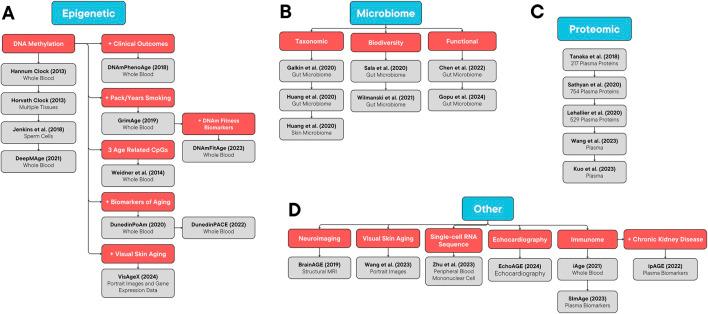
Aging clocks are computational models designed to measure biological age and aging rate based on age-related markers including epigenetic, proteomic, and immunomic changes, gut and skin microbiota, among others. In this narrative review, we aim to discuss the currently available aging clocks, ranging from epigenetic aging clocks to visual skin aging clocks.
METHODS
We performed a literature search on PubMed/MEDLINE databases with keywords including: "aging clock," "aging," "biological age," "chronological age," "epigenetic," "proteomic," "microbiome," "telomere," "metabolic," "inflammation," "glycomic," "lifestyle," "nutrition," "diet," "exercise," "psychosocial," and "technology."
RESULTS
Notably, several CpG regions, plasma proteins, inflammatory and immune biomarkers, microbiome shifts, neuroimaging changes, and visual skin aging parameters demonstrated roles in aging and aging clock predictions. Further analysis on the most predictive CpGs and biomarkers is warranted. Limitations of aging clocks include technical noise which may be corrected with additional statistical techniques, and the diversity and applicability of samples utilized.
CONCLUSION
Aging clocks have significant therapeutic potential to better understand aging and the influence of chronic inflammation and diseases in an expanding older population.
背景与目的
衰老时钟是一种计算模型,旨在根据包括表观遗传、蛋白质组学和免疫组学变化、肠道和皮肤微生物群等与年龄相关的标志物来测量生物年龄和衰老速率。在这篇叙述性综述中,我们旨在讨论目前可用的衰老时钟,从表观遗传衰老时钟到视觉皮肤衰老时钟。
方法
我们在PubMed/MEDLINE数据库中进行了文献检索,关键词包括:“衰老时钟”“衰老”“生物年龄”“实足年龄”“表观遗传”“蛋白质组学”“微生物组”“端粒”“代谢”“炎症”“糖组学”“生活方式”“营养”“饮食”“运动”“心理社会”和“技术”。
结果
值得注意的是,几个CpG区域、血浆蛋白、炎症和免疫生物标志物、微生物组变化、神经影像学变化以及视觉皮肤衰老参数在衰老和衰老时钟预测中发挥了作用。有必要对最具预测性的CpG和生物标志物进行进一步分析。衰老时钟的局限性包括可能需要用额外的统计技术校正的技术噪声,以及所使用样本的多样性和适用性。
结论
衰老时钟在更好地理解衰老以及慢性炎症和疾病对不断增加的老年人群的影响方面具有巨大的治疗潜力。
 Zotero 插件