
氧化平衡评分与美国2型糖尿病成年人心血管疾病、全因死亡率及心血管死亡率的关联:来自1999 - 2018年美国国家健康与营养检查调查的数据
Association of oxidative balance score with cardiovascular disease and all-cause and cardiovascular mortality in American adults with type 2 diabetes: data from the National Health and Nutrition examination survey 1999-2018.
作者信息
Fan Meilin, Song Shina, Chu Tingting, Li Ronghong, Yue Miao, Li Xiaofeng, Yang Jing
机构信息
Department of Endocrinology, First Hospital of Shanxi Medical University, Taiyuan, China.
Department of Endocrinology, Linfen City People's Hospital, Linfen, China.
出版信息
Front Endocrinol (Lausanne). 2024 Dec 16;15:1458039. doi: 10.3389/fendo.2024.1458039. eCollection 2024.
BACKGROUND
Oxidative stress has an important role in type 2 diabetes (T2D). Oxidative balance score (OBS) is an emerging assessment of dietary and lifestyle oxidative balance. We aimed to explore the association of OBS with cardiovascular disease (CVD) and all-cause and CVD mortality in the T2D population through NHANES 1999-2018.
METHODS
OBS integrated 16 dietary components and 4 lifestyle components. T2D was diagnosed according to the American Diabetes Association criteria. Multivariate logistic regression and multivariate Cox proportional hazards regression analyses were used to explore the association of OBS with CVD and mortality in T2D, respectively.
RESULTS
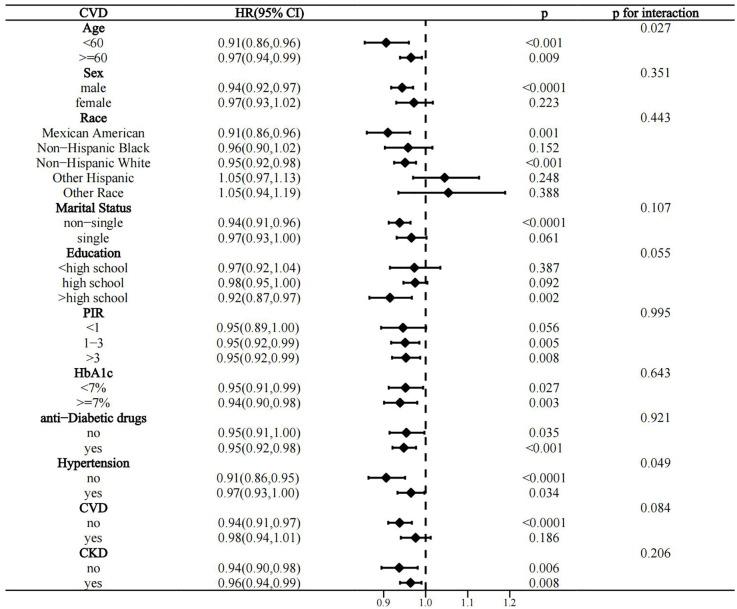
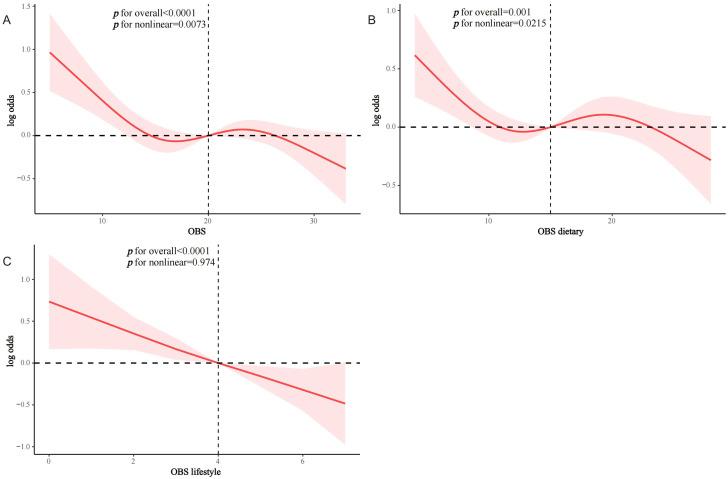
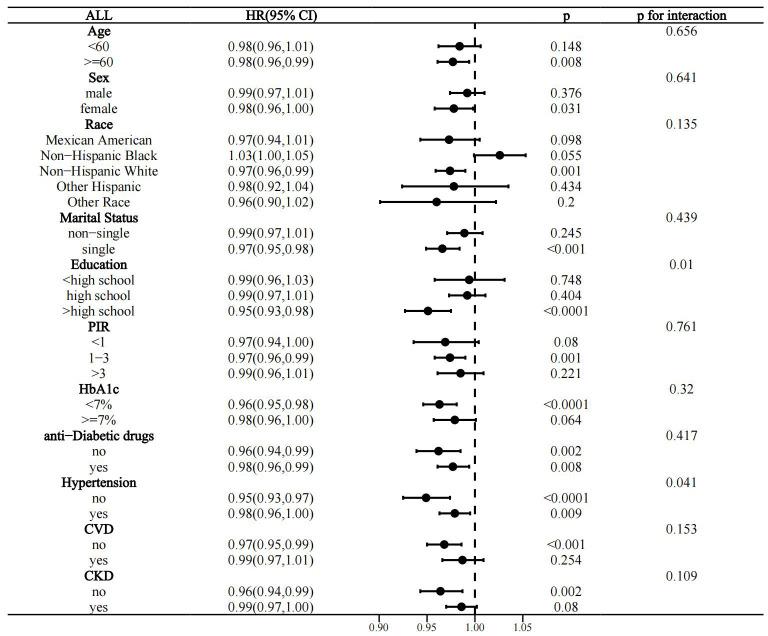
3801 adult T2D participants were included. In fully adjusted models, OBS, dietary OBS, and lifestyle OBS were all negatively associated with the prevalence of CVD (odds ratios of 0.98, 0.98, and 0.85, respectively). Higher OBS and lifestyle OBS (p for trend 0.016 and <0.001, respectively) rather than dietary OBS (p for trend = 0.06) were associated with significantly lower odds of CVD. Higher OBS, dietary OBS, and lifestyle OBS were all negatively associated with all-cause mortality (hazard ratios [HR] of 0.98, 0.98, and 0.92, respectively; p for trend of 0.002, 0.009, and 0.035, respectively). Higher OBS and dietary OBS were negatively associated with CVD mortality (HR 0.96 and 0.95, respectively; p for trend both <0.001), whereas lifestyle OBS was not. Restricted cubic spline analysis suggested that most associations were linear. Stratified analyses showed that these associations were influenced by some demographic variables and disease status.
CONCLUSIONS
Adherence to higher OBS was associated with reduced CVD prevalence and mortality risk in T2D. Antioxidant diet and lifestyle had more significant associations with mortality and CVD prevalence, respectively. However, as these findings are merely associations and do not allow causal inferences to be drawn, future validation in high-quality randomized controlled trials is needed.
背景
氧化应激在2型糖尿病(T2D)中起重要作用。氧化平衡评分(OBS)是对饮食和生活方式氧化平衡的一种新评估。我们旨在通过1999 - 2018年美国国家健康与营养检查调查(NHANES)探讨T2D人群中OBS与心血管疾病(CVD)以及全因死亡率和CVD死亡率之间的关联。
方法
OBS整合了16种饮食成分和4种生活方式成分。根据美国糖尿病协会标准诊断T2D。分别使用多变量逻辑回归和多变量Cox比例风险回归分析来探讨OBS与T2D中CVD和死亡率之间的关联。
结果
纳入了3801名成年T2D参与者。在完全调整模型中,OBS、饮食OBS和生活方式OBS均与CVD患病率呈负相关(比值比分别为0.98、0.98和0.85)。较高的OBS和生活方式OBS(趋势p值分别为0.016和<0.001)而非饮食OBS(趋势p值 = 0.06)与CVD的较低几率显著相关。较高的OBS、饮食OBS和生活方式OBS均与全因死亡率呈负相关(风险比[HR]分别为0.98、0.98和0.92;趋势p值分别为0.002、0.009和0.035)。较高的OBS和饮食OBS与CVD死亡率呈负相关(HR分别为0.96和0.95;趋势p值均<0.001),而生活方式OBS则不然。受限立方样条分析表明大多数关联是线性的。分层分析表明这些关联受一些人口统计学变量和疾病状态的影响。
结论
坚持较高的OBS与T2D中CVD患病率降低和死亡风险降低相关。抗氧化饮食和生活方式分别与死亡率和CVD患病率有更显著的关联。然而,由于这些发现仅仅是关联,无法得出因果推论,未来需要在高质量随机对照试验中进行验证。



 Zotero 插件