
双层光谱探测器CT参数对鉴别高级别与低级别膀胱癌的诊断价值
Diagnostic value of dual-layer spectral detector CT parameters for differentiating high- from low-grade bladder cancer.
作者信息
Chen Li, Xu Lili, Zhang Xiaoxiao, Zhang Jiahui, Bai Xin, Peng Qianyu, Guo Erjia, Lu Xiaomei, Yu Shenghui, Jin Zhengyu, Zhang Gumuyang, Xie Yi, Xue Huadan, Sun Hao
机构信息
Department of Radiology, State Key Laboratory of Complex Severe and Rare Disease, Peking Union Medical College Hospital, Chinese Academy of Medical Sciences and Peking Union Medical College, Beijing, People's Republic of China.
Department of Radiology, Zhejiang Cancer Hospital, Hangzhou Institute of Medicine (HIM), Chinese Academy of Sciences, Hangzhou, People's Republic of China.
出版信息
Insights Imaging. 2025 Jan 2;16(1):6. doi: 10.1186/s13244-024-01881-8.
OBJECTIVES
This study aimed to investigate the diagnostic value of spectral parameters of dual-layer spectral detector computed tomography (DLCT) in distinguishing between low- and high-grade bladder cancer (BCa).
METHODS
This single-center retrospective study included pathologically confirmed BCa patients who underwent preoperative contrast-enhanced DLCT. Patients were divided into low- and high-grade groups based on pathology. We measured and calculated the following spectral CT parameters: iodine density (ID), normalized ID (NID), arterial enhancement fraction (AEF), extracellular volume (ECV) fraction, virtual non-contrast (VNC), slope of the attenuation curve, and Z effective (Z). Univariate and multivariable logistic regression analyses were used to determine the best predictive factors in differentiating between low- and high-grade BCa. We used receiver operating characteristic curve analysis to assess diagnostic performance and decision curve analysis to determine the net benefit.
RESULTS
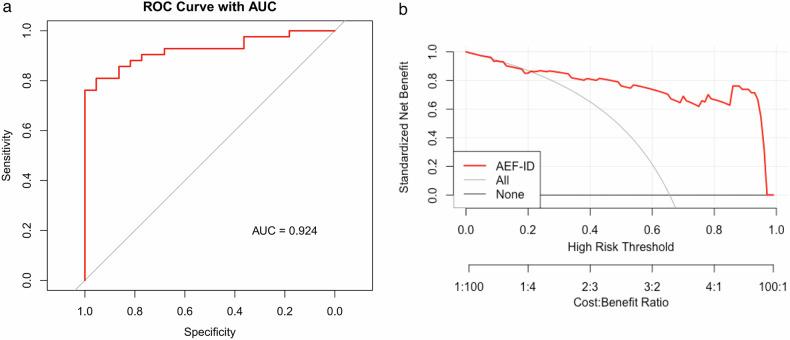
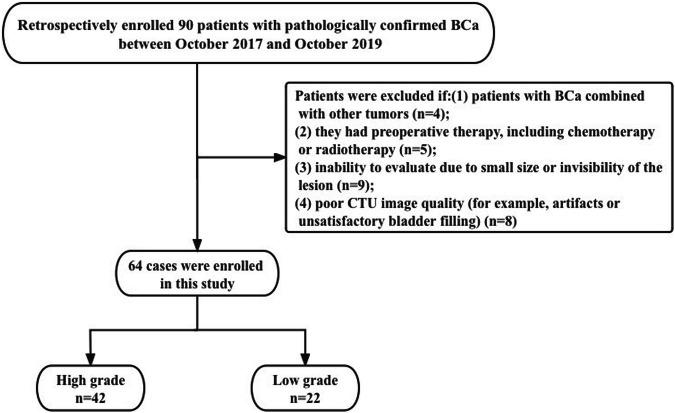
The study included 64 patients (mean age, 64 ± 11.0 years; 46 men), of whom 42 had high-grade BCa and 22 had low-grade BCa. Univariate analysis revealed that differences in ID and NID in the corticomedullary phase, AEF, ECV, VNC, and Z images were statistically significant (p = 0.001-0.048). Multivariable analysis found that AEF was the best predictor of high-grade tumors (p = 0.006). With AEF higher in high-grade BCa, AEF results were as follows: area under the curve (AUC), 0.924 (95% confidence interval, 0.861-0.988); sensitivity, 95.5%; specificity, 81.0%; and accuracy, 85.9%. The cutoff valve of AEF for predicting high-grade BCa was 67.7%.
CONCLUSION
Using DLCT AEF could help distinguish high-grade from low-grade BCa.
CRITICAL RELEVANCE STATEMENT
This research demonstrates that the arterial enhancement fraction (AEF), a parameter derived from dual-layer spectral detector CT (DLCT), effectively distinguishes between high- and low-grade bladder cancer, thereby aiding in the selection of appropriate clinical treatment strategies.
KEY POINTS
This study investigated the value of dual-layer spectral detector CT in the assessment of bladder cancer (BCa) histological grade. The spectral parameter arterial enhancement fraction could help determine BCa grade. Our results can help clinicians formulate initial treatment strategies and improve prognostications.
目的
本研究旨在探讨双层光谱探测器计算机断层扫描(DLCT)的光谱参数在鉴别低级别和高级别膀胱癌(BCa)中的诊断价值。
方法
这项单中心回顾性研究纳入了经病理证实且术前行对比增强DLCT检查的BCa患者。根据病理结果将患者分为低级别组和高级别组。我们测量并计算了以下光谱CT参数:碘密度(ID)、标准化碘密度(NID)、动脉强化分数(AEF)、细胞外容积(ECV)分数、虚拟平扫(VNC)、衰减曲线斜率和有效原子序数(Z)。采用单因素和多因素逻辑回归分析来确定鉴别低级别和高级别BCa的最佳预测因素。我们使用受试者工作特征曲线分析来评估诊断性能,并使用决策曲线分析来确定净效益。
结果
该研究纳入了64例患者(平均年龄64±11.0岁;46例男性),其中42例为高级别BCa,22例为低级别BCa。单因素分析显示,皮质髓质期的ID和NID、AEF、ECV、VNC及Z图像的差异具有统计学意义(p = 0.001 - 0.048)。多因素分析发现,AEF是高级别肿瘤的最佳预测指标(p = 0.006)。由于高级别BCa的AEF较高,AEF的结果如下:曲线下面积(AUC)为0.924(95%置信区间,0.861 - 0.988);敏感性为95.5%;特异性为81.0%;准确性为85.9%。预测高级别BCa的AEF临界值为67.7%。
结论
使用DLCT的AEF有助于区分高级别和低级别BCa。
关键相关性声明
本研究表明,源自双层光谱探测器CT(DLCT)的参数动脉强化分数(AEF)能有效区分高级别和低级别膀胱癌,从而有助于选择合适的临床治疗策略。
要点
本研究探讨了双层光谱探测器CT在评估膀胱癌(BCa)组织学分级中的价值。光谱参数动脉强化分数有助于确定BCa分级。我们的研究结果可帮助临床医生制定初始治疗策略并改善预后。

 Zotero 插件