
非小细胞肺癌免疫治疗耐药的生物标志物
Biomarkers for immunotherapy resistance in non-small cell lung cancer.
作者信息
Rother Catriona, John Tom, Wong Annie
机构信息
Wellington Blood and Cancer Centre, Te Whatu Ora Capital, Wellington, New Zealand.
Department of Medical Oncology, Peter MacCallum, Cancer Centre, Melbourne, VIC, Australia.
出版信息
Front Oncol. 2024 Dec 19;14:1489977. doi: 10.3389/fonc.2024.1489977. eCollection 2024.
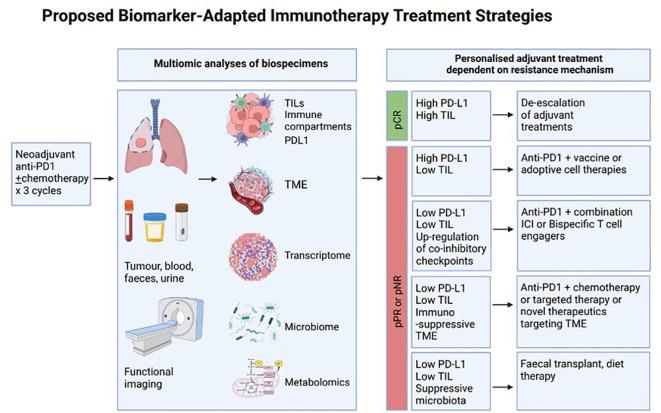
Immunotherapy has revolutionised the treatment landscape of non-small cell lung cancer (NSCLC), significantly improving survival outcomes and offering renewed hope to patients with advanced disease. However, the majority of patients experience limited long-term benefits from immune checkpoint inhibition (ICI) due to the development of primary or acquired immunotherapy resistance. Accurate predictive biomarkers for immunotherapy resistance are essential for individualising treatment strategies, improving survival outcomes, and minimising potential treatment-related harm. This review discusses the mechanisms underlying resistance to immunotherapy, addressing both cancer cell-intrinsic and cancer cell-extrinsic resistance processes. We summarise the current utility and limitations of two clinically established biomarkers: programmed death ligand 1 (PD-L1) expression and tumour mutational burden (TMB). Following this, we present a comprehensive review of emerging immunotherapy biomarkers in NSCLC, including tumour neoantigens, epigenetic signatures, markers of the tumour microenvironment (TME), genomic alterations, host-microbiome composition, and circulating biomarkers. The potential clinical applications of these biomarkers, along with novel approaches to their biomarker identification and targeting, are discussed. Additionally, we explore current strategies to overcome immunotherapy resistance and propose incorporating predictive biomarkers into an adaptive clinical trial design, where specific immune signatures guide subsequent treatment selection.
免疫疗法彻底改变了非小细胞肺癌(NSCLC)的治疗格局,显著改善了生存结局,并为晚期疾病患者带来了新的希望。然而,由于原发性或获得性免疫疗法耐药性的出现,大多数患者从免疫检查点抑制(ICI)中获得的长期益处有限。用于免疫疗法耐药性的准确预测生物标志物对于个性化治疗策略、改善生存结局以及将潜在的治疗相关伤害降至最低至关重要。本综述讨论了免疫疗法耐药的潜在机制,涉及癌细胞内在和癌细胞外在的耐药过程。我们总结了两种临床确定的生物标志物:程序性死亡配体1(PD-L1)表达和肿瘤突变负荷(TMB)的当前应用及局限性。在此之后,我们全面综述了NSCLC中新兴的免疫疗法生物标志物,包括肿瘤新抗原、表观遗传特征、肿瘤微环境(TME)标志物、基因组改变、宿主微生物组组成和循环生物标志物。讨论了这些生物标志物的潜在临床应用,以及识别和靶向它们的新方法。此外,我们探讨了当前克服免疫疗法耐药性的策略,并建议将预测性生物标志物纳入适应性临床试验设计,其中特定的免疫特征指导后续的治疗选择。
 Zotero 插件