
人子宫内膜干细胞衍生的小细胞外囊泡通过激活PI3K/AKT信号通路促进神经突生长和周围神经再生。
Human endometrial stem cell-derived small extracellular vesicles enhance neurite outgrowth and peripheral nerve regeneration through activating the PI3K/AKT signaling pathway.
作者信息
Namini Mojdeh Salehi, Beheshtizadeh Nima, Ebrahimi-Barough Somayeh, Ai Jafar
机构信息
Department of Tissue Engineering, School of Advanced Technologies in Medicine, Tehran University of Medical Sciences, Tehran, Iran.
Regenerative Medicine Group (REMED), Universal Scientific Education and Research Network (USERN), Tehran, Iran.
出版信息
J Transl Med. 2025 Jan 3;23(1):6. doi: 10.1186/s12967-024-06048-z.
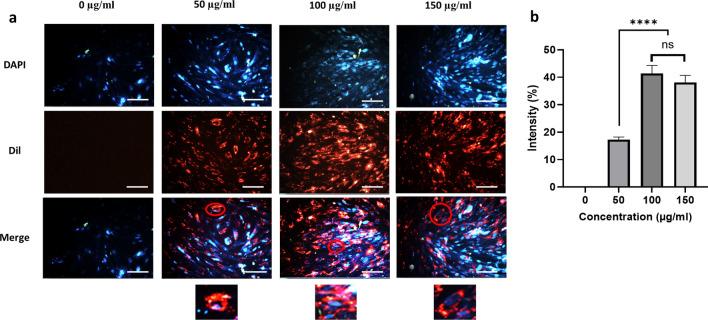
Nowadays, extracellular vesicles (EVs) such as exosomes participate in cell-cell communication and gain attention as a new approach for cell-free therapies. Recently, various studies have demonstrated the therapeutic ability of exosomes, while the biological effect of human endometrial stem cell (hEnSC)-derived small EVs such as exosomes is still unclear. Herein, we obtained small EVs from hEnSC and indicated that these small EVs activate the vital cell signaling pathway and progress neurite outgrowth in PC-12 cell lines. For this purpose, hEnSC-derived small EVs were extracted by ultracentrifuge and characterized by DLS, SEM, TEM, and western blot. Also, dil-staining of hEnSC-derived small EVs was done to determine the penetration of hEnSC-derived small EVs into PC12 cells. The MTT assay, scratch assay, and western blot assay were applied to PC12 cells that were exposed to different concentrations of small EVs (0, 50, 100, and 150 µg/ml). Our results demonstrated that small EVs significantly increased neurite outgrowth, proliferation, and migration in PC12 cells in a dose-dependent manner. Moreover, the analysis of western blots showed increased expression of the PI3k/AKT signaling pathway in PC12 cells exposed to hEnSC-derived small EVs in a dose-dependent manner. Also, the results of this study indicated that hEnSC-derived small EVs can enhance cell proliferation and migration and promote neural outgrowth by activating the PI3k/AKT signaling pathway. Accordingly, hEnSC-derived small EVs became an effective strategy for cell-free therapies. Altogether, these positive effects make hEnSC-derived small EVs a new efficient approach in regenerative medicine, especially for the cure of neural injury.
如今,细胞外囊泡(EVs),如外泌体,参与细胞间通讯,并作为一种无细胞治疗的新方法受到关注。最近,各种研究已经证明了外泌体的治疗能力,而人子宫内膜干细胞(hEnSC)来源的小细胞外囊泡(如外泌体)的生物学效应仍不清楚。在此,我们从hEnSC中获得了小细胞外囊泡,并表明这些小细胞外囊泡激活了重要的细胞信号通路,并促进了PC-12细胞系中的神经突生长。为此,通过超速离心提取hEnSC来源的小细胞外囊泡,并通过动态光散射(DLS)、扫描电子显微镜(SEM)、透射电子显微镜(TEM)和蛋白质免疫印迹法进行表征。此外,对hEnSC来源的小细胞外囊泡进行了dil染色,以确定hEnSC来源的小细胞外囊泡对PC12细胞的穿透情况。将MTT法、划痕试验和蛋白质免疫印迹法应用于暴露于不同浓度小细胞外囊泡(0、50、100和150μg/ml)的PC12细胞。我们的结果表明,小细胞外囊泡以剂量依赖的方式显著增加了PC12细胞中的神经突生长、增殖和迁移。此外,蛋白质免疫印迹分析表明,暴露于hEnSC来源的小细胞外囊泡的PC12细胞中PI3k/AKT信号通路的表达以剂量依赖的方式增加。此外,本研究结果表明,hEnSC来源的小细胞外囊泡可以通过激活PI3k/AKT信号通路来增强细胞增殖和迁移,并促进神经突生长。因此,hEnSC来源的小细胞外囊泡成为无细胞治疗的有效策略。总之,这些积极作用使hEnSC来源的小细胞外囊泡成为再生医学中的一种新的有效方法,特别是用于治疗神经损伤。




 Zotero 插件