
应用于不同组织类型的DNA甲基化时钟算法的特征分析。
Characterization of DNA methylation clock algorithms applied to diverse tissue types.
作者信息
Richardson Mark, Brandt Courtney, Jain Niyati, Li James L, Demanelis Kathryn, Jasmine Farzana, Kibriya Muhammad G, Tong Lin, Pierce Brandon L
机构信息
Department of Public Health Sciences, University of Chicago, Chicago, IL 60615, USA.
Department of Medicine, University of Pittsburgh, Pittsburgh, PA 15261, USA.
出版信息
Aging (Albany NY). 2025 Jan 3;17(1):67-96. doi: 10.18632/aging.206182.
BACKGROUND
DNA methylation (DNAm) data from human samples has been leveraged to develop "epigenetic clock" algorithms that predict age and other aging-related phenotypes. Some DNAm clocks were trained using DNAm obtained from blood cells, while other clocks were trained using data from diverse tissue/cell types. To assess how DNAm clocks perform across non-blood tissue types, we applied DNAm algorithms to DNAm data generated from 9 different human tissue types.
METHODS
We generated array-based DNAm measurements for 973 samples from deceased tissue donors from the GTEx (Genotype Tissue Expression) project representing nine distinct tissue types: lung, colon, prostate, ovary, breast, kidney, testis, skeletal muscle, and whole blood. For all samples, we generated DNAm clock estimates for 8 epigenetic clocks and characterized these tissue-specific clock estimates in terms of their distributions, correlations with chronological age, correlations of clock estimates between tissue types, and association with participant characteristics.
RESULTS
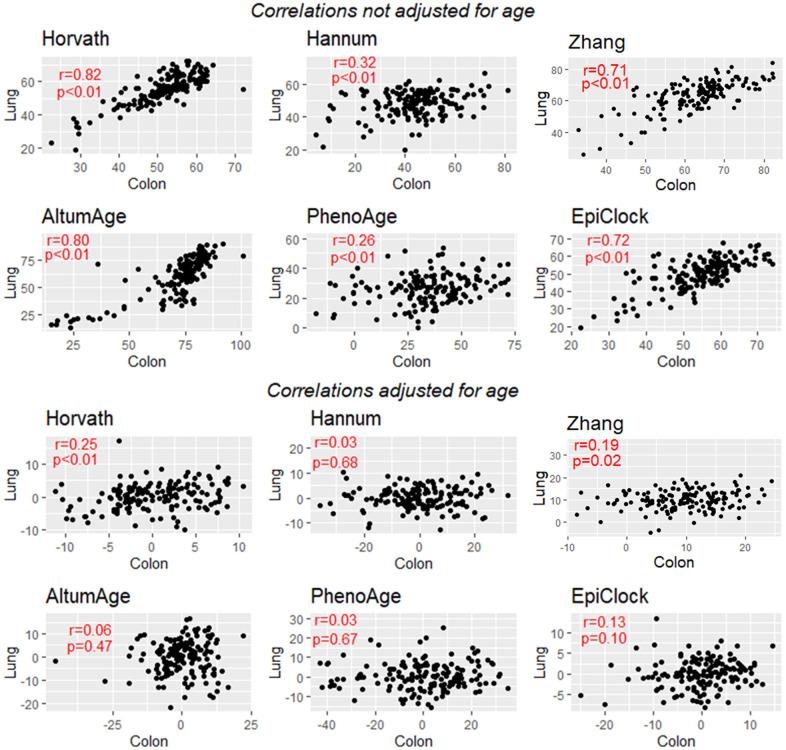
For each clock, the mean DNAm age estimate varied substantially across tissue types, and the mean values for the different clocks varied substantially within tissue types. For most clocks, the correlation with chronological age varied across tissue types, with blood often showing the strongest correlation. Each clock showed strong correlation across tissues, with some evidence of some residual correlation after adjusting for chronological age. In lung tissue, smoking generally had a positive association with epigenetic age.
CONCLUSIONS
This work demonstrates how differences in epigenetic aging among tissue types leads to clear differences in DNAm clock characteristics across tissue types. Tissue or cell-type specific epigenetic clocks are needed to optimize predictive performance of DNAm clocks in non-blood tissues and cell types.
背景
来自人类样本的DNA甲基化(DNAm)数据已被用于开发预测年龄和其他与衰老相关表型的“表观遗传时钟”算法。一些DNAm时钟是使用从血细胞中获得的DNAm进行训练的,而其他时钟则是使用来自不同组织/细胞类型的数据进行训练的。为了评估DNAm时钟在非血液组织类型中的表现,我们将DNAm算法应用于从9种不同人类组织类型生成的DNAm数据。
方法
我们对来自基因型组织表达(GTEx)项目的已故组织捐赠者的973个样本进行了基于芯片的DNAm测量,这些样本代表9种不同的组织类型:肺、结肠、前列腺、卵巢、乳腺、肾脏、睾丸、骨骼肌和全血。对于所有样本,我们对8个表观遗传时钟生成了DNAm时钟估计值,并根据其分布、与实际年龄的相关性、不同组织类型之间时钟估计值的相关性以及与参与者特征的关联,对这些组织特异性时钟估计值进行了表征。
结果
对于每个时钟,DNAm年龄估计的平均值在不同组织类型之间有很大差异,不同时钟的平均值在组织类型内也有很大差异。对于大多数时钟,与实际年龄的相关性在不同组织类型之间有所不同,血液通常显示出最强的相关性。每个时钟在不同组织之间都显示出很强的相关性,在调整实际年龄后,仍有一些残余相关性的证据。在肺组织中,吸烟通常与表观遗传年龄呈正相关。
结论
这项工作表明组织类型之间表观遗传衰老的差异如何导致不同组织类型的DNAm时钟特征存在明显差异。需要组织或细胞类型特异性的表观遗传时钟来优化DNAm时钟在非血液组织和细胞类型中的预测性能。


 Zotero 插件