
医疗相关感染的经济负担:意大利医疗环境中的倾向得分分析。
The financial burden of healthcare-associated infections: a propensity score analysis in an Italian healthcare setting.
作者信息
Orlando S, Cicala M, De Santo C, Mosconi C, Ciccacci F, Guarente L, Carestia M, Liotta G, Di Giovanni D, Buonomo E, Riccardi F, Palombi L, Emberti Gialloreti L
机构信息
Department of Biomedicine and Prevention, University of Rome "Tor Vergata", Rome, Italy.
Faculty of Medicine, Unicamillus Saint Camillus International University of Health Sciences, Rome, Italy.
出版信息
Infect Prev Pract. 2024 Oct 10;7(1):100406. doi: 10.1016/j.infpip.2024.100406. eCollection 2025 Mar.
INTRODUCTION
Hospital-acquired infections (HAIs) present a global public health challenge, impacting patient safety and incurring substantial economic costs across healthcare settings. This study aims to accurately measure the financial burden of HAIs by analyzing real costs associated with various infections, providing insights for targeted prevention and management strategies.
METHODS
This retrospective cohort study at a university hospital in Rome, Italy, analysed Hospital Discharge Records (HDR) from January to December 2018, focusing on patients with and without HAIs. The study employed ICD-9-CM codes, microbiology databases, and stratified analyses by infection site and microorganism. Cost increments were calculated using DRG reimbursement data. Propensity score matching compared infected patients with matched non-infected counterparts, simulating a randomized trial through two models: one adjusting for length of stay and mortality (less conservative), and one not using these factors as confounders (more conservative).
RESULTS
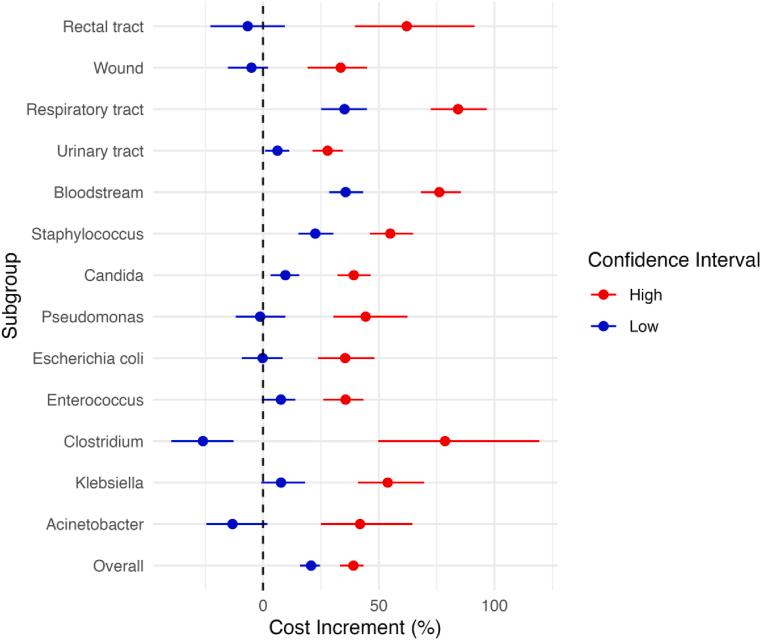
In the study of 12,033 patients at Policlinico Universitario Tor Vergata, 10.07% developed an HAI, significantly raising mean DRG by 53.4% (€3,744 to €5,744). Propensity score analysis showed HAIs elevated costs by €4,695 (60.45%) in one model, and by €3,335 (31.15%) in another. Specific microbes and infection sites further influenced the cost impact, highlighting the need for targeted HAI prevention strategies.
CONCLUSION
Our study reveals the significant economic impact of hospital-acquired infections (HAIs), with a substantial increase in costs linked to specific microorganisms and infection sites. These findings highlight the need for effective HAI prevention strategies to enhance patient safety and reduce healthcare expenditures.
引言
医院获得性感染(HAIs)是一项全球性的公共卫生挑战,影响患者安全,并在各个医疗机构中产生巨大的经济成本。本研究旨在通过分析与各种感染相关的实际成本,准确衡量医院获得性感染的经济负担,为有针对性的预防和管理策略提供见解。
方法
这项在意大利罗马一家大学医院进行的回顾性队列研究,分析了2018年1月至12月的医院出院记录(HDR),重点关注有和没有医院获得性感染的患者。该研究采用国际疾病分类第九版临床修订本(ICD-9-CM)编码、微生物学数据库,并按感染部位和微生物进行分层分析。使用诊断相关分组(DRG)报销数据计算成本增量。倾向得分匹配将感染患者与匹配的未感染患者进行比较,通过两种模型模拟随机试验:一种调整住院时间和死亡率(较不保守),另一种不将这些因素作为混杂因素(较保守)。
结果
在对托韦尔加塔大学综合医院的12,033名患者进行的研究中,10.07%的患者发生了医院获得性感染,使平均DRG显著提高了53.4%(从3,744欧元提高到5,744欧元)。倾向得分分析表明,在一种模型中,医院获得性感染使成本增加了4,695欧元(60.45%),在另一种模型中增加了3,335欧元(31.15%)。特定微生物和感染部位进一步影响了成本影响,突出了针对性医院获得性感染预防策略的必要性。
结论
我们的研究揭示了医院获得性感染(HAIs)的重大经济影响,与特定微生物和感染部位相关的成本大幅增加。这些发现突出了有效医院获得性感染预防策略的必要性,以提高患者安全并减少医疗保健支出。

 Zotero 插件