
循环微RNA作为一种预后工具,用于判断接受帕博利珠单抗PD-1阻断免疫治疗的肺癌患者的治疗效果。
Circulating microRNAs as a Prognostic Tool to Determine Treatment Efficacy in Lung Cancer Patients Undergoing Pembrolizumab PD-1 Blockade Immunotherapy.
作者信息
Mohamed Mansoor Mishfak A, Zhu Xiang, Ashiqueali Sarah Aslam, Alam Md Tanjim, Winiarska Hanna, Pazdrowski Pawel, Kaminski Filip, Copik Alicja, Masternak Michal M, Kuznar-Kaminska Barbara
机构信息
Burnett School of Biomedical Sciences, College of Medicine, University of Central Florida, Orlando, FL 32827, USA.
Department of Pulmonology, Allergology and Respiratory Oncology, Poznan University of Medical Sciences, 61-701 Poznan, Poland.
出版信息
Cancers (Basel). 2024 Dec 17;16(24):4202. doi: 10.3390/cancers16244202.
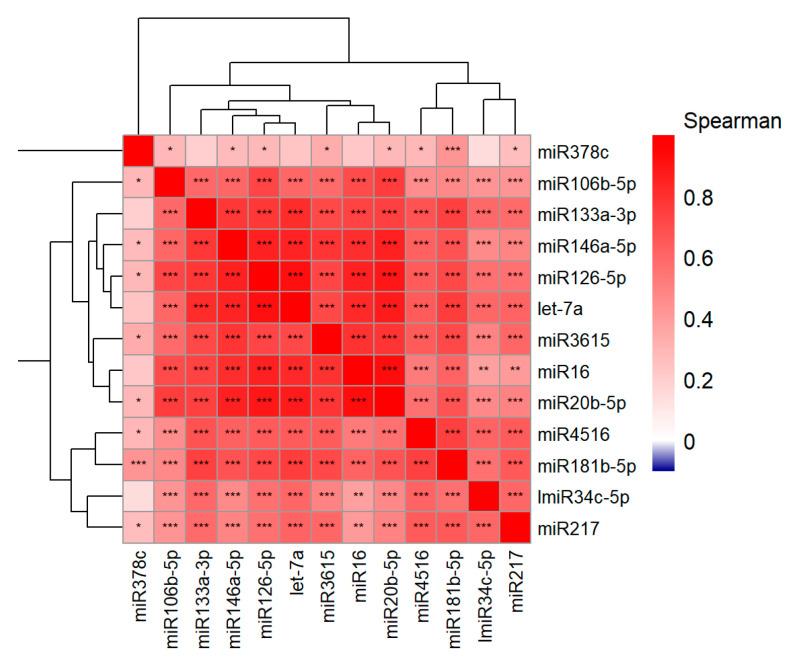
Pembrolizumab has recently emerged as a PD-1 blockade immunotherapy treatment for lung cancer. It is critical that such treatment strategies for lung cancer should be chosen not only on the basis of histopathological features and the expression of targetable cell surface proteins (such as PD-1), but should rather be selected based on other determinants of treatment success or risk factors for poor prognosis. One method to forecast cancer trajectory is the identification of biomolecular signatures such as microRNAs (miRNAs), non-protein-coding RNA molecules that play a regulatory role in gene expression by modulating the translation or stability of messenger RNA. To find out which miRNAs have an important influence on anti-PD-1 treatment outcomes, we evaluated miRNA levels in sera from 38 lung cancer patients undergoing 3 months of pembrolizumab treatment. We selected a panel of miRNAs previously shown to be involved in lung cancer or PD-1 signaling and performed qPCR analysis. Overall, we observed a significant decrease in the levels of miR126-5p (4-fold), let-7a (5-fold), miR133a-3p (4-fold), miR3615 (2-fold), miR4516 (3-fold), miR16 (3-fold), miR34c-5p (2-fold), miR20b-5p (5-fold), miR106b-5p (5-fold), miR146a-5p (3-fold) and miR181b-5p (3-fold) in response to treatment indicating effectiveness of immunotherapy. Within our selected panel of miRNAs, we identified two markers relevant to cancer prognosis: miR-217, which is negatively associated with patient survival, and let-7a, which is positively associated with patient survival. Our findings suggest that circulating miRNAs can be used for future treatment evaluation and lung cancer prognosis, with potential as therapeutic targets.
派姆单抗最近作为一种用于肺癌的PD - 1阻断免疫疗法出现。至关重要的是,肺癌的治疗策略不仅应基于组织病理学特征和可靶向细胞表面蛋白(如PD - 1)的表达来选择,而更应根据治疗成功的其他决定因素或预后不良的风险因素来选择。预测癌症发展轨迹的一种方法是识别生物分子特征,如微小RNA(miRNA),即通过调节信使RNA的翻译或稳定性在基因表达中起调节作用的非蛋白质编码RNA分子。为了找出哪些miRNA对抗PD - 1治疗结果有重要影响,我们评估了38名接受3个月派姆单抗治疗的肺癌患者血清中的miRNA水平。我们选择了一组先前显示与肺癌或PD - 1信号传导有关的miRNA,并进行了qPCR分析。总体而言,我们观察到miR126 - 5p(4倍)、let - 7a(5倍)、miR133a - 3p(4倍)、miR3615(2倍)、miR4516(3倍)、miR16(3倍)、miR34c - 5p(2倍)、miR20b - 5p(5倍)、miR106b - 5p(5倍)、miR146a - 5p(3倍)和miR181b - 5p(3倍)的水平因治疗而显著下降,表明免疫疗法有效。在我们所选的miRNA组中,我们鉴定出两个与癌症预后相关的标志物:与患者生存率呈负相关的miR - 217和与患者生存率呈正相关的let - 7a。我们的研究结果表明,循环miRNA可用于未来的治疗评估和肺癌预后判断,具有作为治疗靶点的潜力。


 Zotero 插件