
用于抗癌药物筛选的基于细胞的胶质瘤模型:从传统贴壁细胞培养到肿瘤特异性三维构建体
Cell-Based Glioma Models for Anticancer Drug Screening: From Conventional Adherent Cell Cultures to Tumor-Specific Three-Dimensional Constructs.
作者信息
Lanskikh Daria, Kuziakova Olga, Baklanov Ivan, Penkova Alina, Doroshenko Veronica, Buriak Ivan, Zhmenia Valeriia, Kumeiko Vadim
机构信息
School of Medicine and Life Sciences, Far Eastern Federal University, 690922 Vladivostok, Russia.
出版信息
Cells. 2024 Dec 17;13(24):2085. doi: 10.3390/cells13242085.
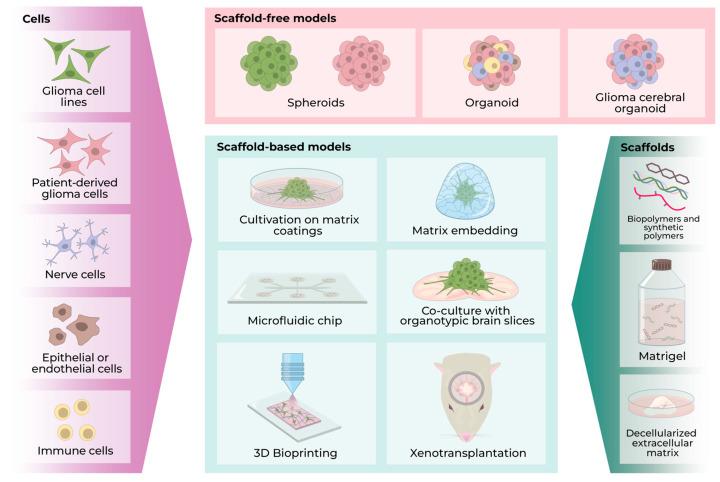
Gliomas are a group of primary brain tumors characterized by their aggressive nature and resistance to treatment. Infiltration of surrounding normal tissues limits surgical approaches, wide inter- and intratumor heterogeneity hinders the development of universal therapeutics, and the presence of the blood-brain barrier reduces the efficiency of their delivery. As a result, patients diagnosed with gliomas often face a poor prognosis and low survival rates. The spectrum of anti-glioma drugs used in clinical practice is quite narrow. Alkylating agents are often used as first-line therapy, but their effectiveness varies depending on the molecular subtypes of gliomas. This highlights the need for new, more effective therapeutic approaches. Standard drug-screening methods involve the use of two-dimensional cell cultures. However, these models cannot fully replicate the conditions present in real tumors, making it difficult to extrapolate the results to humans. We describe the advantages and disadvantages of existing glioma cell-based models designed to improve the situation and build future prospects to make drug discovery comprehensive and more effective for each patient according to personalized therapy paradigms.
胶质瘤是一组原发性脑肿瘤,其特点是具有侵袭性且对治疗有抗性。周围正常组织的浸润限制了手术方法,肿瘤间和肿瘤内广泛的异质性阻碍了通用疗法的开发,而血脑屏障的存在降低了药物递送的效率。因此,被诊断为胶质瘤的患者通常预后不良且生存率低。临床实践中使用的抗胶质瘤药物种类相当有限。烷化剂常被用作一线治疗,但它们的有效性因胶质瘤的分子亚型而异。这凸显了需要新的、更有效的治疗方法。标准的药物筛选方法涉及使用二维细胞培养。然而,这些模型无法完全复制真实肿瘤中的情况,因此难以将结果外推至人体。我们描述了现有的基于胶质瘤细胞的模型的优缺点,旨在改善这种情况并构建未来前景,以便根据个性化治疗模式,使药物发现对每个患者而言更全面、更有效。

 Zotero 插件