
评估抗菌肽的细胞毒性、蛋白水解稳定性和选择性:对骨科应用的启示。
Assessing Cytotoxicity, Proteolytic Stability, and Selectivity of Antimicrobial Peptides: Implications for Orthopedic Applications.
作者信息
Campoccia Davide, Bottau Giulia, De Donno Andrea, Bua Gloria, Ravaioli Stefano, Capponi Eleonora, Sotgiu Giovanna, Bellotti Chiara, Costantini Silvia, Arciola Carla Renata
机构信息
Laboratorio di Patologia delle Infezioni Associate all'Impianto, IRCCS Istituto Ortopedico Rizzoli, Via di Barbiano 1/10, 40136 Bologna, Italy.
Institute for Organic Synthesis and Photoreactivity (ISOF), National Research Council, Via Gobetti 101, 40129 Bologna, Italy.
出版信息
Int J Mol Sci. 2024 Dec 10;25(24):13241. doi: 10.3390/ijms252413241.
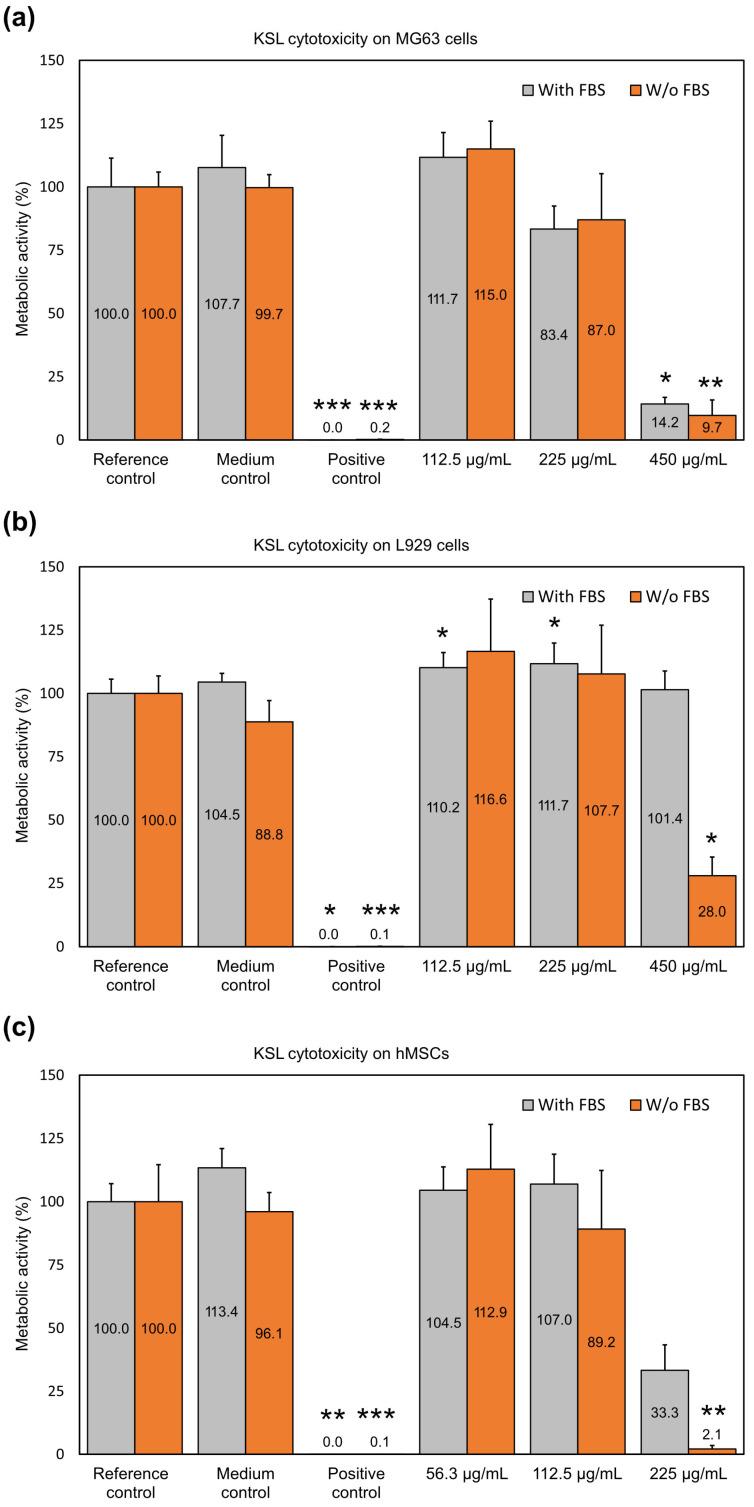
In orthopedics, the use of anti-infective biomaterials is considered the most promising strategy to contrast the bacterial contamination of implant surfaces and reduce the infection rate. KSL, KSL-W, and Dadapin-1 are three antimicrobial peptides (AMPs) that possess significant antibacterial properties, making them promising candidates for producing anti-infective biomaterials not based on antibiotics. To fully assess their true potential, this study explores in detail their cytocompatibility on human osteoblast-like MG63 cells, murine fibroblastoid L929 cells, and hMSCs. To this end, the cytotoxicity of the AMPs in terms of IC was tested over a range of concentrations of 450-0.22 µg/mL using the ATP bioluminescence assay. The tests were performed both in the presence and absence of bovine serum to assess the effects of serum components on peptide stability. IC values obtained under the most stringent conditions were used to extrapolate the selectivity index (S.I.) toward salient bacterial species. In medium containing serum, all AMPs exhibited minimal to no cytotoxicity, with IC values exceeding 100 µg/mL. Dadapin-1 was the peptide that exhibited the lowest cytotoxicity, KSL-W exhibited the highest stability, and KSL exhibited the highest selectivity. Overall, these findings highlight the potential of these AMPs for the future production of anti-infective materials.
在骨科领域,使用抗感染生物材料被认为是对抗植入物表面细菌污染并降低感染率最具前景的策略。KSL、KSL-W和Dadapin-1是三种具有显著抗菌特性的抗菌肽(AMPs),这使它们成为生产非抗生素类抗感染生物材料的有潜力候选物。为了全面评估它们的真正潜力,本研究详细探讨了它们对人成骨样MG63细胞、鼠成纤维样L929细胞和人骨髓间充质干细胞(hMSCs)的细胞相容性。为此,使用ATP生物发光测定法在450 - 0.22 µg/mL的一系列浓度下测试了抗菌肽的细胞毒性(以IC表示)。测试在有和没有牛血清的情况下进行,以评估血清成分对肽稳定性的影响。在最严格条件下获得的IC值用于推断对主要细菌种类的选择性指数(S.I.)。在含血清的培养基中,所有抗菌肽均表现出最小至无细胞毒性,IC值超过100 µg/mL。Dadapin-1是细胞毒性最低的肽,KSL-W表现出最高的稳定性,而KSL表现出最高的选择性。总体而言,这些发现突出了这些抗菌肽在未来生产抗感染材料方面的潜力。




 Zotero 插件