
芦丁与传统抗生素联合使用对抗……的协同作用及作用机制
Synergistic Effects and Mechanisms of Action of Rutin with Conventional Antibiotics Against .
作者信息
Yi Lankun, Bai Yubin, Chen Xu, Wang Weiwei, Zhang Chao, Shang Zixuan, Zhang Zhijin, Li Jiajing, Cao Mingze, Zhu Zhen, Zhang Jiyu
机构信息
Key Laboratory of New Animal Drug Project of Gansu Province, Key Laboratory of Veterinary Pharmaceutical Development, Ministry of Agriculture and Rural Affairs, Lanzhou Institute of Husbandry and Pharmaceutical Sciences, Chinese Academy of Agricultural Sciences, Lanzhou 730050, China.
School of Life Sciences and Food Engineering, Hebei University of Engineering, Hanshan District, Handan 056038, China.
出版信息
Int J Mol Sci. 2024 Dec 21;25(24):13684. doi: 10.3390/ijms252413684.
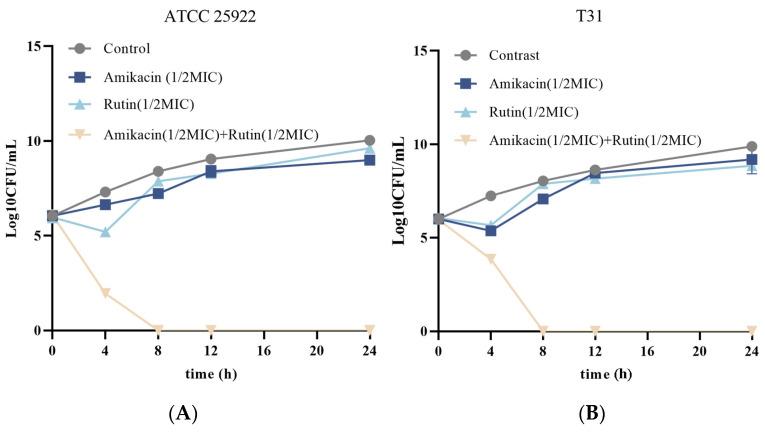
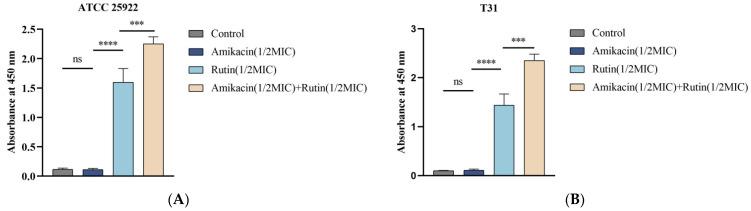
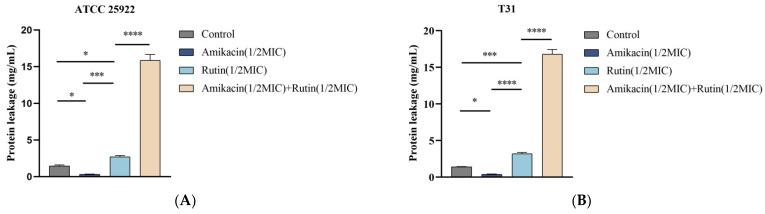
Rutin is a widely known plant secondary metabolite that exhibits multiple physiological functions. The present study focused on screening for synergistic antibacterial combinations containing rutin, and further explored the mechanisms behind this synergy. In vitro antibacterial test results of rutin showed that the ranges of minimum inhibitory concentration (MIC) and Minimum bactericidal concentration (MBC) are 0.125-1 and 0.125-2 mg/mL, respectively. However, rutin and amikacin have a significant synergistic effect, with a fractional inhibitory concentration index (FICI) range of 0.1875-0.5. The time bactericidal curve proved that the combination of rutin and amikacin inhibited bacterial growth within 8 h. Scanning electron microscopy (SEM) revealed that a low-dose combination treatment could disrupt the cell membrane of (). A comprehensive analysis using alkaline phosphatase (AKP), K, and a protein leakage assay revealed that co-treatment destroyed the cell membrane of , resulting in the significant leakage of AKP, intracellular K, and proteins. Moreover, confocal laser scanning microscopy (CLSM) and red-green cell ratio analysis indicated severe damage to the cell membrane following the co-treatment of rutin and amikacin. This study indicates the remarkable potential of strategically selecting antibacterial agents with maximum synergistic effect, which could significantly control antibiotic resistance.
芦丁是一种广为人知的植物次生代谢产物,具有多种生理功能。本研究着重于筛选含芦丁的协同抗菌组合,并进一步探究这种协同作用背后的机制。芦丁的体外抗菌测试结果表明,其最小抑菌浓度(MIC)范围为0.125 - 1mg/mL,最小杀菌浓度(MBC)范围为0.125 - 2mg/mL。然而,芦丁与阿米卡星具有显著的协同作用,部分抑菌浓度指数(FICI)范围为0.1875 - 0.5。时间杀菌曲线证明芦丁与阿米卡星的组合在8小时内抑制了细菌生长。扫描电子显微镜(SEM)显示低剂量联合处理可破坏(此处原文缺失相关细菌名称)的细胞膜。使用碱性磷酸酶(AKP)、钾和蛋白质渗漏试验进行的综合分析表明,联合处理破坏了(此处原文缺失相关细菌名称)的细胞膜,导致AKP、细胞内钾和蛋白质大量渗漏。此外,共聚焦激光扫描显微镜(CLSM)和红绿细胞比率分析表明,芦丁与阿米卡星联合处理后(此处原文缺失相关细菌名称)的细胞膜受到严重损伤。本研究表明,战略性地选择具有最大协同效应的抗菌剂具有显著潜力,这可以有效控制抗生素耐药性。



 Zotero 插件