
橄榄油生产全过程中增塑剂污染情况分析
Analysis of Plasticizer Contamination Throughout Olive Oil Production.
作者信息
Freitas Flávia, Brinco João, Cabrita Maria João, Gomes da Silva Marco
机构信息
LAQV/REQUIMTE, Department of Chemistry, NOVA School of Science and Technology, NOVA University Lisbon, 2829-516 Caparica, Portugal.
MED-Mediterranean Institute for Agriculture, Environment and Development & CHANGE-Global Change and Sustainability Institute, Institute for Advanced Studies and Research, Universidade de Évora, Pólo da Mitra, Ap. 94, 7006-554 Évora, Portugal.
出版信息
Molecules. 2024 Dec 20;29(24):6013. doi: 10.3390/molecules29246013.
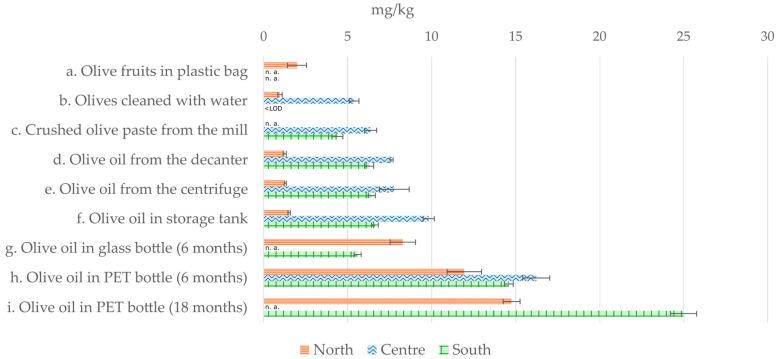
This study monitored the contamination of 32 plasticizers in olive oil throughout the production and storage process. Samples were collected at different stages of production from three olive oil production lines in distinct regions of Portugal and analyzed for 23 phthalates and 9 phthalates substitutes to identify contamination sources. The developed analytical method employed liquid-liquid extraction with hexane/methanol (1:4, /), followed by centrifugation, extract removal, and freezing as a clean-up step. Analysis was conducted using gas chromatography tandem mass spectrometry (GC-MS/MS), with detection limits ranging from 0.001 to 0.103 mg/kg. The results revealed that plasticizer concentrations progressively increased at each stage of the production process, although unprocessed olives also contained contaminants. Di-isononyl phthalate (DINP) was the most prevalent compound, but all phthalates regulated by the European Union for food contact materials were detected, as well as some unregulated plasticizers. In a few packaged olive oils, DINP concentrations exceeded the specific migration limits established by European regulations. Samples stored in glass and plastic bottles showed no significant differences in plasticizer concentrations after six months of storage. However, higher concentrations were observed in plastic-packaged samples after 18 months of storage. Our findings indicate that the primary source of plasticizer contamination in olive oil originates from the production process itself, except for prolonged storage in plastic bottles, which should be avoided.
本研究监测了橄榄油在整个生产和储存过程中32种增塑剂的污染情况。在葡萄牙不同地区的三条橄榄油生产线的不同生产阶段采集样品,分析其中23种邻苯二甲酸盐和9种邻苯二甲酸盐替代品,以确定污染源。所开发的分析方法采用己烷/甲醇(1:4,v/v)液液萃取,随后进行离心、提取萃取物,并冷冻作为净化步骤。使用气相色谱串联质谱法(GC-MS/MS)进行分析,检测限为0.001至0.103 mg/kg。结果显示,尽管未加工的橄榄中也含有污染物,但增塑剂浓度在生产过程的每个阶段都逐渐增加。邻苯二甲酸二异壬酯(DINP)是最普遍的化合物,但检测到了欧盟对食品接触材料规定的所有邻苯二甲酸盐,以及一些未受监管的增塑剂。在一些包装橄榄油中,DINP浓度超过了欧洲法规规定的特定迁移限量。储存在玻璃瓶和塑料瓶中的样品在储存六个月后增塑剂浓度没有显著差异。然而,储存18个月后,塑料包装样品中的增塑剂浓度更高。我们的研究结果表明,橄榄油中增塑剂污染的主要来源是生产过程本身,但应避免长时间储存在塑料瓶中。


 Zotero 插件