
氧化应激和Keap1-Nrf2信号通路参与双酚A诱导的大鼠肝损伤
Oxidative Stress and Keap1-Nrf2 Pathway Involvement in Bisphenol A-Induced Liver Damage in Rats.
作者信息
Tang Juan, Wang Kai, Shen Dan, Li Chunmei
机构信息
College of Animal Science and Technology, Nanjing Agricultural University, Nanjing 210095, China.
Department of Occupational Medicine and Environmental Toxicology, Nantong Key Laboratory of Environmental Toxicology, School of Public Health, Nantong University, Nantong 226019, China.
出版信息
Toxics. 2024 Nov 28;12(12):864. doi: 10.3390/toxics12120864.
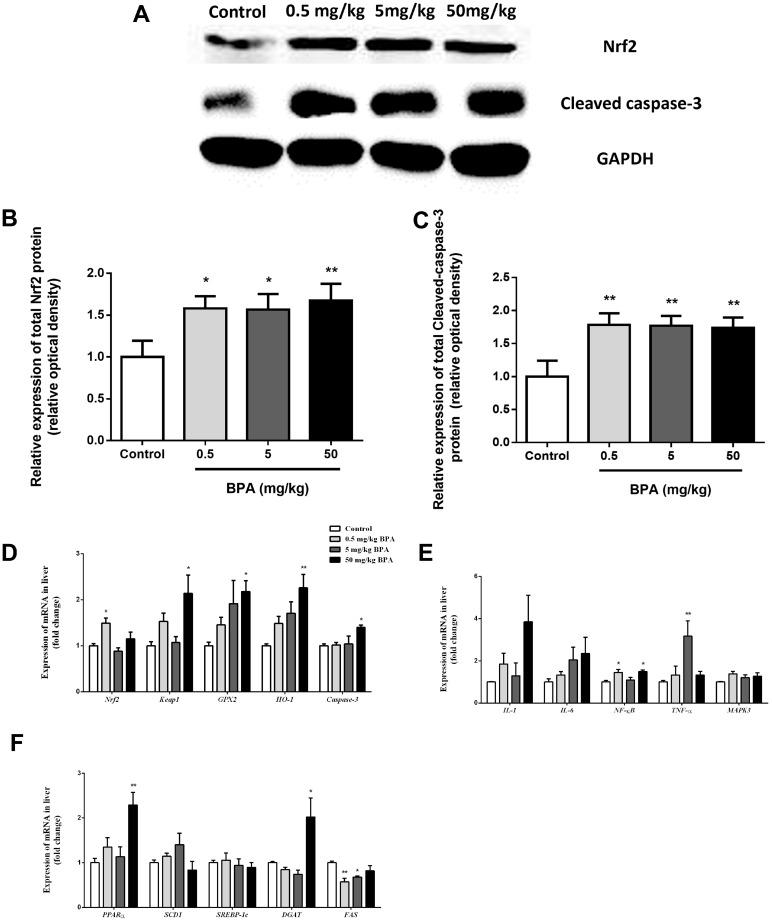
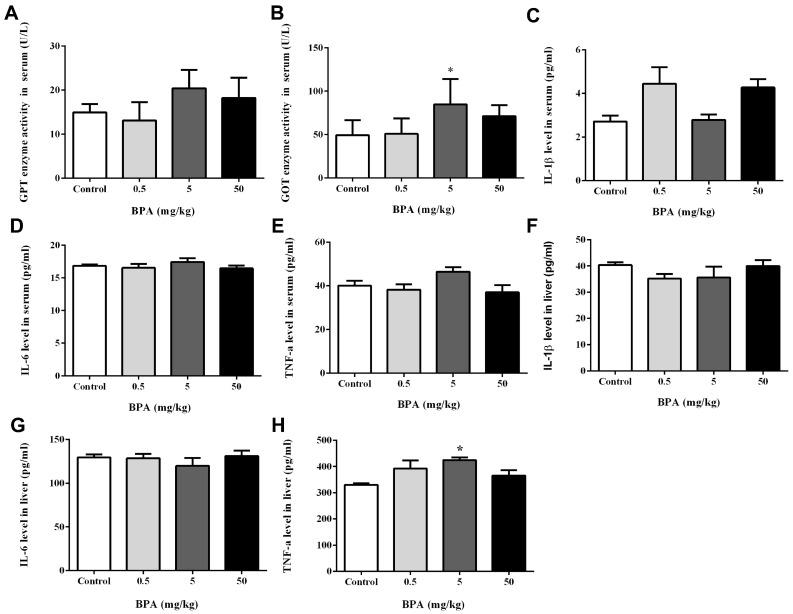
Bisphenol A (BPA), extensively utilized in the manufacture of epoxy resins and polycarbonate plastics, is prevalent in the environment. Its exposure has been associated with an increased risk of hepatic lesions; however, the underlying mechanisms and the spectrum of its effects remain poorly understood. This study investigates the role of the Keap1-Nrf2 signaling pathway in regulating BPA-induced hepatotoxicity in vivo using a rat model. Over a 30-day period, rats were orally administered either corn oil or BPA (0.5, 5, and 50 mg/kg). Changes in hepatic and kidney histology were assessed via transmission electron microscopy and HE staining. Oxidative stress levels in the liver tissue and serum were quantified, while the mRNA expression of , , , , and was evaluated using qRT-PCR. Additionally, the expression of Nrf2 and cleaved caspase-3 in the liver tissue was measured through immunohistochemistry and Western blotting. Results indicated that BPA exposure significantly reduced the liver and adrenal coefficients in the treated rats compared to controls. Notable histomorphological alterations were observed in the liver and kidney tissues of the BPA-treated rats. The serum levels of GOT and TNF-α were significantly elevated in the BPA group relative to the controls. Evidence of oxidative stress was supported by increased malondialdehyde levels and decreased total superoxide dismutase activity in the liver and kidney, alongside a reduction in glutathione peroxidase activity in the liver tissue. Furthermore, BPA exposure enhanced the mRNA expression levels of , , , , and in the liver tissue. Concurrently, Nrf2 and cleaved caspase-3 expression levels were elevated in the BPA-treated group compared to the controls. These findings suggest that BPA may contribute to metabolic disorders of liver function and poses a hepatotoxicity risk. Moreover, the activation of the Keap1-Nrf2 pathway may offer protective effects against hepatotoxicity, with potential implications for human liver disease.
双酚A(BPA)广泛用于制造环氧树脂和聚碳酸酯塑料,在环境中普遍存在。其暴露与肝脏病变风险增加有关;然而,其潜在机制及其影响范围仍知之甚少。本研究使用大鼠模型研究Keap1-Nrf2信号通路在调节BPA诱导的体内肝毒性中的作用。在30天的时间里,给大鼠口服玉米油或BPA(0.5、5和50 mg/kg)。通过透射电子显微镜和HE染色评估肝脏和肾脏组织学变化。定量肝脏组织和血清中的氧化应激水平,同时使用qRT-PCR评估、、、和的mRNA表达。此外,通过免疫组织化学和蛋白质印迹法测量肝脏组织中Nrf2和裂解的半胱天冬酶-3的表达。结果表明,与对照组相比,BPA暴露显著降低了处理组大鼠的肝脏和肾上腺系数。在BPA处理的大鼠的肝脏和肾脏组织中观察到明显的组织形态学改变。与对照组相比,BPA组血清中谷草转氨酶和肿瘤坏死因子-α水平显著升高。肝脏和肾脏中丙二醛水平升高、总超氧化物歧化酶活性降低以及肝脏组织中谷胱甘肽过氧化物酶活性降低,支持了氧化应激的证据。此外,BPA暴露增强了肝脏组织中、、、和的mRNA表达水平。同时,与对照组相比,BPA处理组中Nrf2和裂解的半胱天冬酶-3表达水平升高。这些发现表明,BPA可能导致肝功能代谢紊乱并带来肝毒性风险。此外,Keap1-Nrf2途径的激活可能对肝毒性具有保护作用,对人类肝脏疾病具有潜在影响。


 Zotero 插件