
常见化学增塑剂邻苯二甲酸二(2-乙基己基)酯暴露会加剧柯萨奇病毒B3感染。
Common Chemical Plasticizer Di(2-Ethhylhexyl) Phthalate Exposure Exacerbates Coxsackievirus B3 Infection.
作者信息
Kordbacheh Ramina, Ashley Madelyn, Cutts William D, Keyzer Taryn E, Chatterjee Shruti, Altman Tyler J, Alexander Natalie G, Sparer Timothy E, Kim Brandon J, Sin Jon
机构信息
Department of Biological Sciences, University of Alabama, Tuscaloosa, AL 35487, USA.
Department of Microbiology, University of Tennessee, Knoxville, TN 37996, USA.
出版信息
Viruses. 2024 Nov 23;16(12):1821. doi: 10.3390/v16121821.
UNLABELLED
Di(2-ethhylhexyl) phthalate (DEHP) is a common plastic rubberizer. DEHP leaches from plastic matrices and is under increasing scrutiny as numerous studies have linked it to negative human health manifestations. Coxsackievirus B3 (CVB) is a human pathogen that typically causes subclinical infections but can sometimes cause severe diseases such as pancreatitis, myocarditis, and meningoencephalitis. Though CVB infections are common, severe illness is relatively rare, and it is unclear what factors mediate disease severity. In this study, we sought to determine the effects that DEHP has on CVB infection in a variety of human cell types to evaluate whether this plastic-derived pollutant could represent a proviral environmental factor.
METHODS
HeLa cervical cancer cells, human induced pluripotent stem cell-derived brain-like endothelial cells (iBECs), and Caco-2 colon carcinoma cells were exposed to 40 µg/mL DEHP for 24 h prior to infecting with enhanced green fluorescent protein (EGFP)-expressing CVB. The severity of the infection was evaluated via fluorescence microscopy and flow cytometry-based viral EGFP detection, viral plaque assay on tissue culture media, and Western blotting to detect VP1 viral capsid protein. Interferon-associated proteins such as interferon regulatory factor (IRF) 3, IRF7, interferon-induced transmembrane (IFITM) 2, and IFITM3 were measured by Western blotting. The roles of IFITM2 and IFITM3 in the context of CVB infection were evaluated via siRNA silencing.
RESULTS
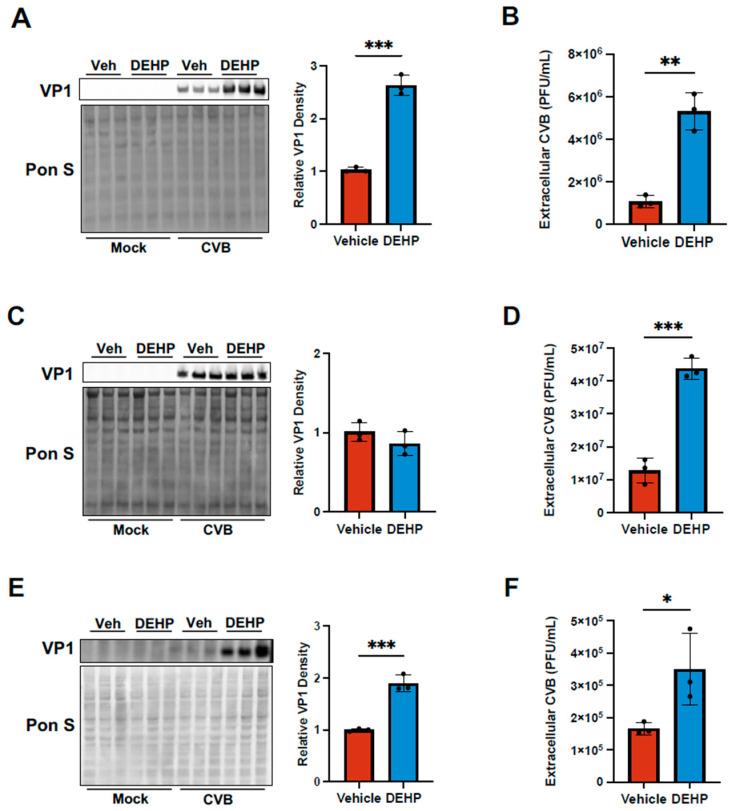
We found that DEHP drastically increased CVB infection in each of the cell types we tested, and, while the cellular processes underlying DEHP's proviral properties were not entirely clear, we observed that DEHP may subvert CVB-induced interferon signaling and elevate levels of IFITMs, which appeared to bolster CVB infection.
CONCLUSIONS
DEHP may represent a major environmental factor associated with the severity of CVB infection. Further understanding of how DEHP exacerbates infection may better elucidate its potential role as a proviral environmental factor.
未标注
邻苯二甲酸二(2-乙基己基)酯(DEHP)是一种常见的塑料增塑剂。DEHP会从塑料基质中渗出,并且随着大量研究将其与对人类健康的负面影响联系起来,它受到了越来越多的关注。柯萨奇病毒B3(CVB)是一种人类病原体,通常引起亚临床感染,但有时会导致严重疾病,如胰腺炎、心肌炎和脑膜脑炎。虽然CVB感染很常见,但严重疾病相对较少见,目前尚不清楚哪些因素介导疾病的严重程度。在本研究中,我们试图确定DEHP对多种人类细胞类型中CVB感染的影响,以评估这种源自塑料的污染物是否可能是一种促病毒的环境因素。
方法
在感染表达增强绿色荧光蛋白(EGFP)的CVB之前,将HeLa宫颈癌细胞、人诱导多能干细胞衍生的脑样内皮细胞(iBECs)和Caco-2结肠癌细胞暴露于40μg/mL的DEHP中24小时。通过荧光显微镜和基于流式细胞术的病毒EGFP检测、组织培养基上的病毒空斑试验以及Western印迹法检测VP1病毒衣壳蛋白来评估感染的严重程度。通过Western印迹法检测干扰素相关蛋白,如干扰素调节因子(IRF)3、IRF7、干扰素诱导跨膜蛋白(IFITM)2和IFITM3。通过小干扰RNA(siRNA)沉默来评估IFITM2和IFITM3在CVB感染中的作用。
结果
我们发现DEHP在我们测试的每种细胞类型中都显著增加了CVB感染,并且,虽然DEHP促病毒特性背后的细胞过程尚不完全清楚,但我们观察到DEHP可能会破坏CVB诱导的干扰素信号传导并提高IFITMs的水平,这似乎增强了CVB感染。
结论
DEHP可能是与CVB感染严重程度相关的主要环境因素。进一步了解DEHP如何加剧感染可能会更好地阐明其作为促病毒环境因素的潜在作用。



 Zotero 插件