
神经精神性睡眠障碍患者的光周期和室外温度与睡眠结构的关系
Relating Photoperiod and Outdoor Temperature With Sleep Architecture in Patients With Neuropsychiatric Sleep Disorders.
作者信息
Weihrich Katy Sarah, Bes Frederik, de Zeeuw Jan, Haberecht Martin, Kunz Dieter
机构信息
Institute of Physiology, Sleep Research & Clinical Chronobiology, Charité-Universitätsmedizin Berlin, corporate member of Freie Universität Berlin, Humboldt-Universität zu Berlin, and Berlin Institute of Health, Berlin, Germany.
Clinic for Sleep & Chronomedicine, St. Hedwig-Hospital, Berlin, Germany.
出版信息
J Pineal Res. 2025 Jan;77(1):e70030. doi: 10.1111/jpi.70030.
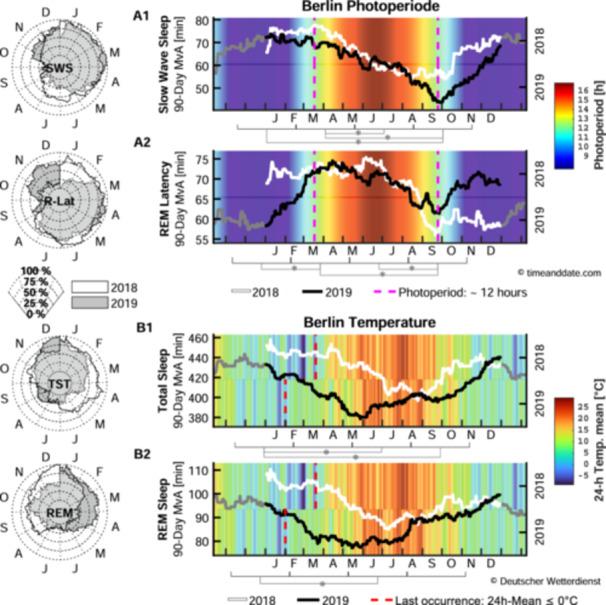
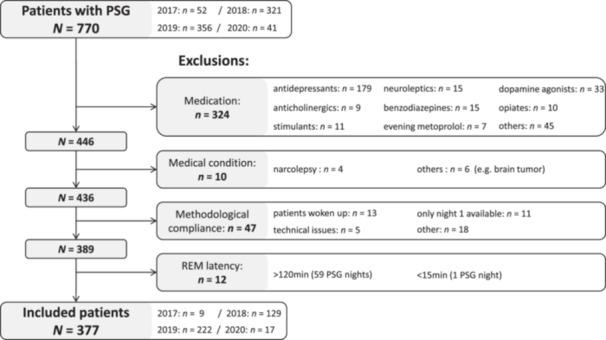
While artificial light in urban environments was previously thought to override seasonality in humans, recent studies have challenged this assumption. We aimed to explore the relationship between seasonally varying environmental factors and changes in sleep architecture in patients with neuropsychiatric sleep disorders by comparing two consecutive years. In 770 patients, three-night polysomnography was performed at the Clinic for Sleep & Chronomedicine (St. Hedwig Hospital, Berlin, Germany) in 2018/2019. Sleep times were adjusted to patients' preferred schedules, patients slept in, and were unaware of day-night indicators. Digital devices and clocks were not allowed. Days were spent outside the lab with work or naps not allowed. After exclusions (mostly due to psychotropic medication), analysis was conducted on the second PSG-night in 377 patients (49.1 ± 16.8 year; 54% female). Sleep parameters were plotted as 90-day moving-averages (MvA) across date-of-record. Periodicity and seasonal windows in the MvA were identified by utilizing autocorrelations. Linear mixed-effect models were applied to seasonal windows. Sleep parameters were correlated with same-day photoperiod, temperature, and sunshine duration. The MvA of total sleep time (TST) and REM sleep began a 5-month-long decline shortly after the last occurrence of freezing 24-h mean temperatures (correlation of TST between 2018 and 2019 at 2-month lag: rs = 0.87, p < 0.001; maximum peak-to-nadir amplitude: ΔTST ~ 62 min, ΔREM ~ 24 min). The MvA nadirs of slow wave sleep (SWS) occurred approximately at the autumnal equinox (correlation between 2018 and 2019: rs = 0.83, p < 0.001). Post hoc testing following significant linear mixed-effect model indicate that TST and REM sleep were longer around November till February than May till August (ΔTST = 36 min; ΔREM = 14 min), while SWS was 23 min longer around February till May than August till November. Proportional seasonal variation of SWS and of REM sleep as percentages of TST differed profoundly (SWS = 31.6%; REM = 8.4%). In patients with neuropsychiatric sleep disorders living in an urban environment, data collected in 2018 show similar patterns and magnitudes in seasonal variation of sleep architecture as the 2019 data. Interestingly, whereas SWS patterns were consistent between years with possible links to photoperiod, annual variations of TST and REM sleep seem to be related to times of outside freezing temperature. For generalization, the data need to be confirmed in a healthy population. No clinical trial was registered.
虽然城市环境中的人造光以前被认为会掩盖人类的季节性,但最近的研究对这一假设提出了挑战。我们旨在通过比较连续两年的情况,探讨神经精神性睡眠障碍患者中季节性变化的环境因素与睡眠结构变化之间的关系。2018/2019年,在德国柏林圣海德维希医院睡眠与时间医学诊所对770名患者进行了为期三晚的多导睡眠图检查。睡眠时间根据患者的偏好时间表进行调整,患者睡懒觉,且不知道昼夜指标。不允许使用数字设备和时钟。白天在实验室外度过,不允许工作或小睡。排除(主要由于精神药物治疗)后,对377名患者(49.1±16.8岁;54%为女性)的第二次多导睡眠图检查夜进行了分析。将睡眠参数绘制为记录日期的90天移动平均值(MvA)。通过利用自相关确定MvA中的周期性和季节性窗口。将线性混合效应模型应用于季节性窗口。睡眠参数与同一天的光周期、温度和日照时长相关。总睡眠时间(TST)和快速眼动睡眠的MvA在24小时平均温度最后一次出现冰点后不久开始了为期5个月的下降(2018年和2019年TST在2个月滞后时的相关性:rs = 0.87,p < 0.001;最大峰谷振幅:ΔTST约62分钟,ΔREM约24分钟)。慢波睡眠(SWS)的MvA最低点大约出现在秋分(2018年和2019年之间的相关性:rs = 0.83,p < 0.001)。显著线性混合效应模型后的事后检验表明,11月至2月左右的TST和快速眼动睡眠比5月至8月更长(ΔTST = 36分钟;ΔREM = 14分钟),而2月至5月左右的SWS比8月至11月长23分钟。SWS和快速眼动睡眠占TST的比例季节性变化差异很大(SWS = 31.6%;快速眼动睡眠 = 8.4%)。在生活在城市环境中的神经精神性睡眠障碍患者中,2018年收集的数据在睡眠结构季节性变化方面显示出与2019年数据相似的模式和幅度。有趣的是,虽然SWS模式在几年间是一致的,可能与光周期有关,但TST和快速眼动睡眠的年度变化似乎与外界冰点温度的时间有关。为了进行推广,需要在健康人群中确认这些数据。未注册临床试验。
 Zotero 插件