
海葵库尼茨肽HCIQ2c1通过抑制促炎介质减轻组胺、脂多糖和角叉菜胶诱导的炎症。
Sea Anemone Kunitz Peptide HCIQ2c1 Reduces Histamine-, Lipopolysaccharide-, and Carrageenan-Induced Inflammation via the Suppression of Pro-Inflammatory Mediators.
作者信息
Kvetkina Aleksandra N, Klimovich Anna A, Deriavko Yulia V, Pislyagin Evgeniy A, Menchinskaya Ekaterina S, Bystritskaya Evgenia P, Isaeva Marina P, Lyukmanova Ekaterina N, Shenkarev Zakhar O, Aminin Dmitriy L, Leychenko Elena V
机构信息
Elyakov Pacific Institute of Bioorganic Chemistry, Far Eastern Branch, Russian Academy of Sciences, 690022 Vladivostok, Russia.
Laboratory of Structural Biology of Ion Channels, Shemyakin-Ovchinnikov Institute of Bioorganic Chemistry, Russian Academy of Sciences, 119997 Moscow, Russia.
出版信息
Int J Mol Sci. 2025 Jan 6;26(1):431. doi: 10.3390/ijms26010431.
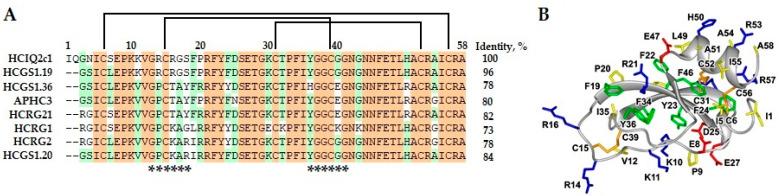
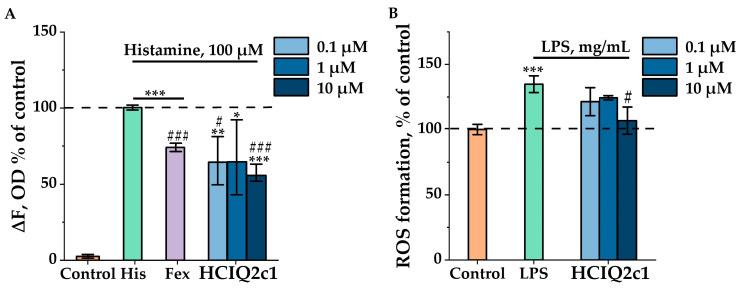
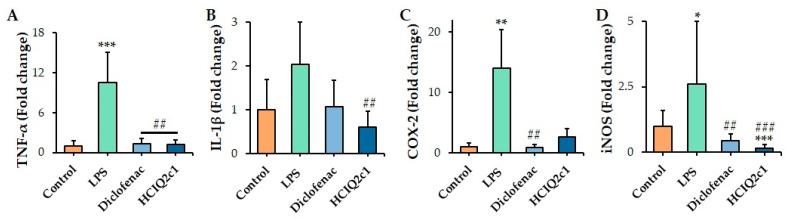
Inflammation is a physiological response of the immune system to infectious agents or tissue injury, which involves a cascade of vascular and cellular events and the activation of biochemical pathways depending on the type of harmful agent and the stimulus generated. The Kunitz peptide HCIQ2c1 of sea anemone is a strong protease inhibitor and exhibits neuroprotective and analgesic activities. In this study, we investigated the anti-inflammatory potential of HCIQ2c1 in histamine- and lipopolysaccharide (LPS)-activated RAW 264.7 macrophages as well as in LPS-induced systemic inflammation and carrageenan-induced paw edema models in CD-1 mice. We found that 10 μM HCIQ2c1 dramatically decreases histamine-induced intracellular Ca release and LPS-induced reactive oxygen species (ROS) production in RAW 264.7 macrophages. Moreover, HCIQ2c1 significantly inhibited the production of LPS-induced tumor necrosis factor α (TNF-α), inducible NO-synthase (iNOS), and 5-lipoxygenase (5-LO) but slightly influenced the IL-1β and cyclooxygenase-2 (COX-2) expression level in macrophages. Furthermore, intravenous administration by HCIQ2c1 at 0.1 mg/kg dose reduced LPS-induced TNF-α, IL-1β, COX-2, and iNOS gene expression in CD-1 mice. The subplantar administration of HCIQ2c1 at 0.1 mg/kg dose to mice significantly reduced carrageenan-induced paw edema by a factor of two, which is comparable to the effect of diclofenac at 1 mg/kg dose. Thus, peptide HCIQ2c1 has a strong anti-inflammatory potential by the attenuation of systemic and local inflammatory effects through the inhibition of intracellular Ca release, the production of ROS and pro-inflammatory cytokines, and enzymes involved in arachidonic acid metabolism.
炎症是免疫系统对感染因子或组织损伤的生理反应,它涉及一系列血管和细胞事件以及根据有害因子的类型和产生的刺激而激活的生化途径。海葵的库尼茨肽HCIQ2c1是一种强大的蛋白酶抑制剂,具有神经保护和镇痛活性。在本研究中,我们研究了HCIQ2c1在组胺和脂多糖(LPS)激活的RAW 264.7巨噬细胞中以及在LPS诱导的全身炎症和角叉菜胶诱导的足爪水肿模型中的抗炎潜力。我们发现10μM HCIQ2c1可显著降低RAW 264.7巨噬细胞中组胺诱导的细胞内钙释放和LPS诱导的活性氧(ROS)产生。此外,HCIQ2c1显著抑制LPS诱导的肿瘤坏死因子α(TNF-α)、诱导型一氧化氮合酶(iNOS)和5-脂氧合酶(5-LO)的产生,但对巨噬细胞中IL-1β和环氧化酶-2(COX-2)的表达水平影响较小。此外,以0.1mg/kg剂量静脉注射HCIQ2c1可降低CD-1小鼠中LPS诱导的TNF-α、IL-1β、COX-2和iNOS基因表达。以0.1mg/kg剂量对小鼠进行足底皮下注射HCIQ2c1可使角叉菜胶诱导的足爪水肿显著减轻一半,这与1mg/kg剂量双氯芬酸的效果相当。因此,肽HCIQ2c1通过抑制细胞内钙释放、ROS和促炎细胞因子的产生以及参与花生四烯酸代谢的酶,减轻全身和局部炎症效应,具有强大的抗炎潜力。


 Zotero 插件