
儿童的疫苗接种状况与甲型肝炎免疫力:来自土耳其一项大规模研究的见解
Vaccination status and hepatitis A immunity in children: insights from a large-scale study in Turkey.
作者信息
Yigit Metin, Kalayci Furkan
机构信息
Department of Pediatrics, Yildirim Beyazit University, Ankara Bilkent City Hospital, Bilkent, Ankara, 06800, Turkey.
Department of Pediatrics, Ankara Bilkent City Hospital, Bilkent, Ankara, 06800, Turkey.
出版信息
BMC Infect Dis. 2025 Jan 14;25(1):61. doi: 10.1186/s12879-025-10458-9.
BACKGROUND
Hepatitis A remains a public health concern, particularly in areas with suboptimal sanitation. Introduced in Turkey's immunization schedule in 2011, the vaccine has improved immunity; however, gaps persist, especially in older, unvaccinated children. This study examines the seropositivity rates and antibody levels in children across different vaccination statuses and age groups, and to identify gaps in immunity, particularly among children those born before the introduction of the hepatitis A vaccine in Turkey.
METHODS
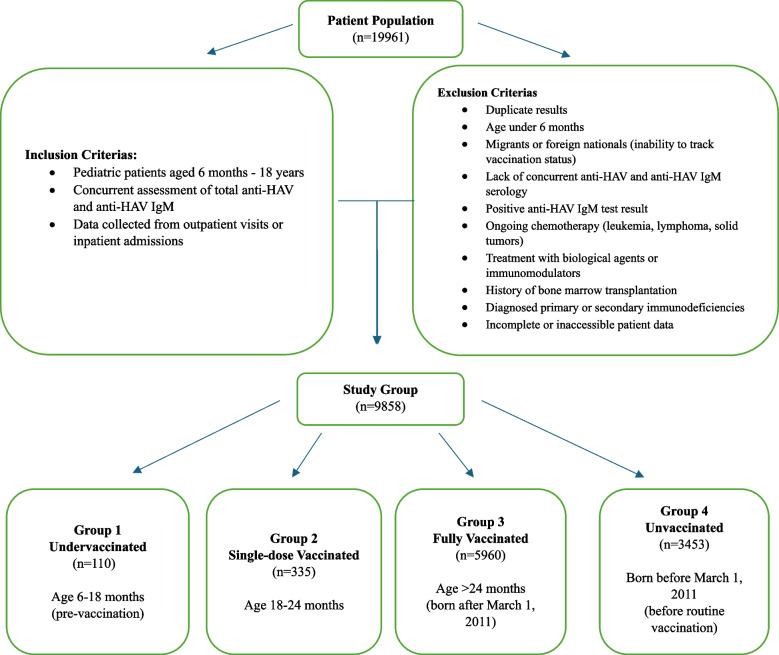
Data from 9,858 patients, collected between August 2019 and March 2024, were analyzed to evaluate the immunological response to the vaccine. Patients were categorized into four groups based on vaccination status: under-vaccinated (children 6-18 months old), single-dose vaccinated (children 18-24 months old), fully vaccinated (children over 24 months old born after March 1, 2011), and unvaccinated (born before March 1, 2011, when routine hepatitis A vaccination began). Seropositivity rates and antibody levels were measured and statistically analyzed.
RESULTS
In this study, a total of 9,858 pediatric patients were assessed, with 1.1% under-vaccinated, 3.4% single-dose vaccinated, 60.5% fully vaccinated, and 35% unvaccinated. Seropositivity rates reached 93% in the fully vaccinated group, compared to 83% in the single-dose group and 63% in the unvaccinated group. Antibody titers were significantly higher in the fully vaccinated group, with statistically significant differences in seropositivity between this group and the unvaccinated group (p < 0.001). Additionally, a notable decrease in antibody levels was observed in the unvaccinated group as age increased (r = -0.365, p < 0.001).
CONCLUSION
These findings underscore the critical need for targeted interventions to close vaccination gaps, especially among older, unvaccinated children who exhibit lower immunity levels. These insights are crucial for enhancing vaccination outreach and improving public health measures against hepatitis A.
背景
甲型肝炎仍然是一个公共卫生问题,尤其是在卫生条件欠佳的地区。2011年甲型肝炎疫苗被纳入土耳其的免疫规划,这提高了人群的免疫力;然而,免疫差距依然存在,尤其是在未接种疫苗的大龄儿童中。本研究调查了不同疫苗接种状态和年龄组儿童的血清阳性率及抗体水平,以确定免疫差距,特别是在土耳其引入甲型肝炎疫苗之前出生的儿童中。
方法
分析了2019年8月至2024年3月期间收集的9858例患者的数据,以评估对该疫苗的免疫反应。患者根据疫苗接种状态分为四组:接种不足(6至18个月大的儿童)、单剂接种(18至24个月大的儿童)、全程接种(2011年3月1日之后出生且年龄超过24个月的儿童)和未接种(2011年3月1日之前出生,即常规甲型肝炎疫苗接种开始之前)。测量并统计分析血清阳性率和抗体水平。
结果
在本研究中,共评估了9858例儿科患者,其中接种不足的占1.1%,单剂接种的占3.4%,全程接种的占60.5%,未接种的占35%。全程接种组的血清阳性率达到93%,单剂接种组为83%,未接种组为63%。全程接种组的抗体滴度显著更高,该组与未接种组之间的血清阳性率存在统计学显著差异(p<0.001)。此外,未接种组的抗体水平随年龄增长显著下降(r=-0.365,p<0.001)。
结论
这些发现强调了有针对性地采取干预措施以缩小疫苗接种差距的迫切需求,特别是在免疫力较低的大龄未接种儿童中。这些见解对于加强疫苗接种推广和改进预防甲型肝炎的公共卫生措施至关重要。
 Zotero 插件