
NRF2抗氧化反应和干扰素刺激基因在新冠病毒检测呈阳性的年轻受试者中差异表达。
NRF2 Antioxidant Response and Interferon-Stimulated Genes Are Differentially Expressed in SARS-CoV-2-Positive Young Subjects.
作者信息
Toscanelli Walter, Fracella Matteo, De Angelis Marta, Scagnolari Carolina, Sorrentino Leonardo, Piselli Elena, Marcocci Maria Elena, Midulla Fabio, Mancino Enrica, Nenna Raffaella, Petrarca Laura, Palamara Anna Teresa, Antonelli Guido, Pierangeli Alessandra, Nencioni Lucia
机构信息
Laboratory Affiliated to Istituto Pasteur Italia-Fondazione Cenci Bolognetti, Department of Public Health and Infectious Diseases, Sapienza University, Rome, Italy.
Laboratory of Virology, Department of Molecular Medicine, Sapienza University, Rome, Italy.
出版信息
Immun Inflamm Dis. 2025 Jan;13(1):e70109. doi: 10.1002/iid3.70109.
BACKGROUND
Several respiratory viruses, including Severe Acute Respiratory Syndrome-Coronavirus-2 (SARS-CoV-2), suppress nuclear factor-E2-related factor-2 (NRF2) antioxidant response, generating oxidative stress conditions to its advantage. NRF2 has also been reported to regulate the innate immune response through the inhibition of the interferon (IFN) pathway. However, its modulation in younger individuals and its correlation with the IFN response remain to be elucidated.
METHODS
The NRF2 and redox-related genes expression was examined in nasopharyngeal swabs from children attending the pediatric hospital for SARS-CoV-2 molecular testing. Expression levels were analyzed by stratifying the population according to the SARS-CoV-2 positivity, age, or the presence of symptoms. The results were correlated with Types I and III IFN genes and IFN-stimulated genes (ISGs).
RESULTS
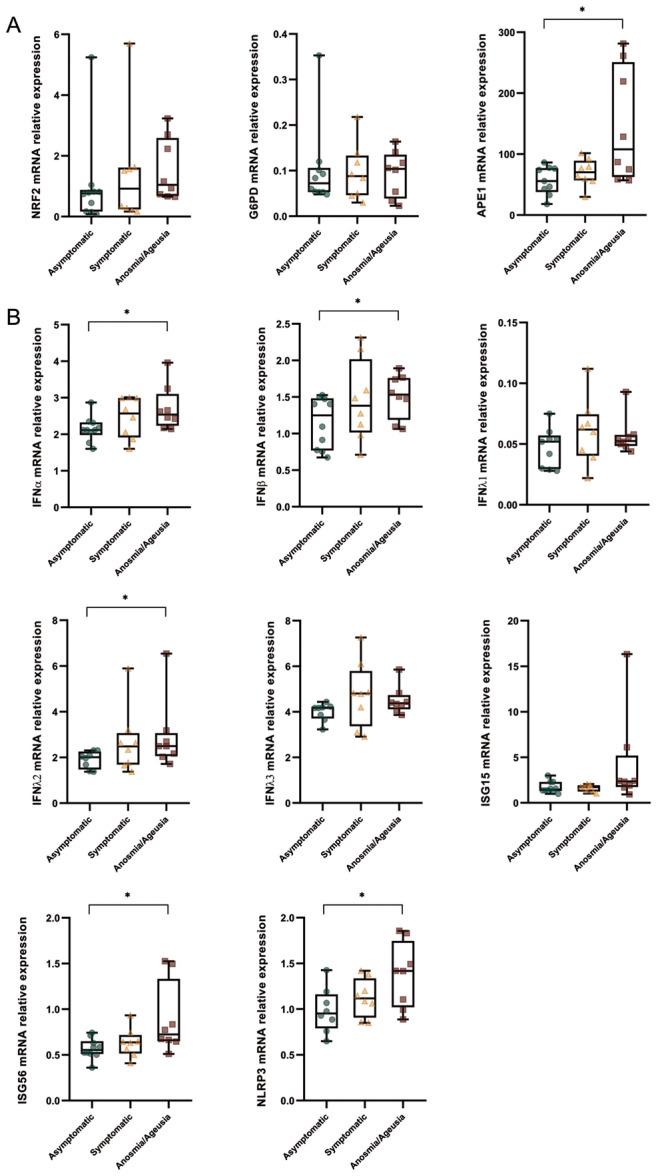
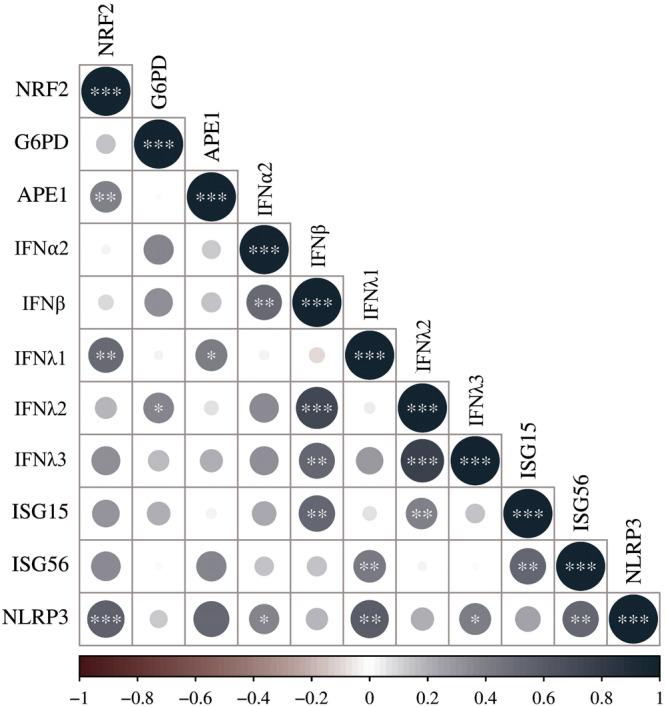
We found that NRF2 expression was markedly diminished in positive patients compared to negative. Moreover, it correlated with higher expression of IFNα2 and IFNλ3, as well as ISG15 and ISG56. Interestingly, symptomatic patients with anosmia/ageusia showed pronounced expression of apurinic/apyrimidinic endonuclease1/redox factor 1 (APE1), together with Type I IFNs, ISG56, and the inflammasome component NLRP3.
CONCLUSION
The results indicate an interdependence between NRF2 antioxidant pathway and IFN-mediated response during SARS-CoV-2 infection in young subjects.
背景
包括严重急性呼吸综合征冠状病毒2(SARS-CoV-2)在内的几种呼吸道病毒会抑制核因子E2相关因子2(NRF2)的抗氧化反应,从而产生有利于自身的氧化应激条件。据报道,NRF2还可通过抑制干扰素(IFN)途径来调节先天免疫反应。然而,其在年轻个体中的调节作用及其与IFN反应的相关性仍有待阐明。
方法
对在儿科医院进行SARS-CoV-2分子检测的儿童鼻咽拭子中的NRF2和氧化还原相关基因表达进行检测。根据SARS-CoV-2阳性、年龄或症状的存在对人群进行分层,分析表达水平。结果与I型和III型IFN基因以及IFN刺激基因(ISG)进行相关性分析。
结果
我们发现,与阴性患者相比,阳性患者的NRF2表达明显降低。此外,它与IFNα2和IFNλ3以及ISG15和ISG56的高表达相关。有趣的是,患有嗅觉减退/味觉减退的有症状患者显示出脱嘌呤/脱嘧啶内切酶1/氧化还原因子1(APE1)以及I型IFN、ISG56和炎性小体成分NLRP3的明显表达。
结论
结果表明,在年轻受试者感染SARS-CoV-2期间,NRF2抗氧化途径与IFN介导的反应之间存在相互依存关系。

 Zotero 插件