
揭示微纳米塑料的毒性:对环境和健康影响理解的系统探索。
Unveiling the toxicity of micro-nanoplastics: A systematic exploration of understanding environmental and health implications.
作者信息
Shukla Saurabh, Khanna Sakshum, Khanna Kushagra
机构信息
School of Forensic Sciences, Centurion University of Technology and Management, Bhubaneswar Campus, Bhubaneswar, Odisha 752050, India.
School of Technology, Pandit Deendayal Energy University, Gandhinagar, Gujarat 382007, India.
出版信息
Toxicol Rep. 2024 Dec 12;14:101844. doi: 10.1016/j.toxrep.2024.101844. eCollection 2025 Jun.
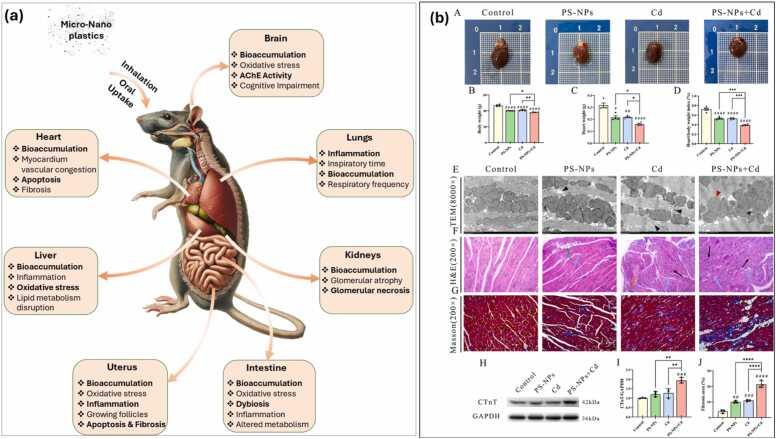
The surge in plastic production has spurred a global crisis as plastic pollution intensifies, with microplastics and nanoplastics emerging as notable environmental threats. Due to their miniature size, these particles are ubiquitous across ecosystems and pose severe hazards as they are ingested and bioaccumulate within organisms. Although global plastic production has reached an alarming 400.3 MTs, recycling efforts remain limited, with only 18.5 MTs being recycled. Currently, out of the total plastic waste, 49.6 % is converted into energy, 27 % is recycled, and 23.5 % is recovered as material, indicating a need for better waste management practices to combat the escalating pollution levels. Research studies on micro-nanoplastics have primarily concentrated on their environmental presence and laboratory-based toxicity studies. This review critically examines the sources and detection methods for micro-nanoplastics, emphasising their toxicological effects and ecological impacts. Organisms like zebrafish and rats serve as key models for studying these particle's bioaccumulative potential, showcasing adverse effects that extend to DNA damage, oxidative stress, and cellular apoptosis. Studies reveal that micro-nanoplastics can permeate biological barriers, including the blood-brain barrier, neurological imbalance, cardiac, respiratory, and dermatological disorders. These health risks, particularly relevant for humans, underscore the urgency for broader, real-world studies beyond controlled laboratory conditions. Additionally, the review discusses innovative energy-harvesting technologies as sustainable alternatives for plastic waste utilisation, particularly valuable for energy-deficient regions. These strategies aim to simultaneously address energy demands and mitigate plastic waste. This approach aligns with global sustainability goals, providing a promising avenue for both pollution reduction and energy generation. The review calls for further research to enhance detection techniques, assess long-term environmental impacts, and explore sustainable solutions that integrate energy recovery with pollution mitigation, especially in regions most affected by both energy shortages and increased plastic waste.
随着塑料污染加剧,塑料产量的激增引发了一场全球危机,微塑料和纳米塑料成为显著的环境威胁。由于其微小的尺寸,这些颗粒在整个生态系统中无处不在,并且在被生物体摄入并生物累积时会造成严重危害。尽管全球塑料产量已达到惊人的400.3亿吨,但回收利用的努力仍然有限,仅有1850万吨被回收。目前,在总的塑料垃圾中,49.6%被转化为能源,27%被回收利用,23.5%被作为材料回收,这表明需要更好的废物管理措施来应对不断升级的污染水平。关于微纳米塑料的研究主要集中在它们在环境中的存在以及基于实验室的毒性研究。本综述批判性地审视了微纳米塑料的来源和检测方法,强调了它们的毒理学效应和生态影响。斑马鱼和大鼠等生物体是研究这些颗粒生物累积潜力的关键模型,展示了包括DNA损伤、氧化应激和细胞凋亡在内的不良影响。研究表明,微纳米塑料可以穿透生物屏障,包括血脑屏障,导致神经失衡、心脏、呼吸和皮肤疾病。这些健康风险对人类尤为相关,凸显了在受控实验室条件之外进行更广泛的实际研究的紧迫性。此外,综述讨论了创新的能量收集技术,作为塑料废物利用的可持续替代方案,对能源匮乏地区尤其有价值。这些策略旨在同时满足能源需求并减少塑料废物。这种方法符合全球可持续发展目标,为减少污染和产生能源提供了一条有前景的途径。综述呼吁进一步开展研究,以改进检测技术、评估长期环境影响,并探索将能量回收与污染缓解相结合的可持续解决方案,特别是在受能源短缺和塑料废物增加影响最大的地区。



 Zotero 插件