
新辅助阿替利珠单抗联合双重HER2阻断加表柔比星治疗早期HER2阳性乳腺癌女性:随机2期ABCSG-52/ATHENE试验
Neoadjuvant atezolizumab in combination with dual HER2 blockade plus epirubicin in women with early HER2-positive breast cancer: the randomized phase 2 ABCSG-52/ATHENE trial.
作者信息
Rinnerthaler Gabriel, Egle Daniel, Bartsch Rupert, Schmitt Clemens A, Petzer Andreas, Balic Marija, Petru Edgar, Denison Ursula, Singer Christian F, Bjelic-Radisic Vesna, Gampenrieder Simon Peter, Knauer Michael, Sotlar Karl, Brunner Christine, Posch Florian, Hlauschek Dominik, Sölkner Lidija, Bago-Horvath Zsuzsanna, Filipits Martin, Gili Manuela, Ritter Magdalena, Wieser Verena, Albertini Carmen, Zaborsky Nadja, Weiss Lukas, Marhold Maximilian, Schneeweiss Bruno, Pusch Renate, Gnant Michael, Greil Richard
机构信息
Division of Oncology, Department of Internal Medicine, Medical University of Graz, Graz, Austria.
Department of Internal Medicine III with Hematology, Medical Oncology, Hemostaseology, Infectiology and Rheumatology, Oncologic Center, Paracelsus Medical University Salzburg, Salzburg Cancer Research Institute, Center for Clinical Cancer and Immunology Trials (SCRI-CCCIT), Cancer Cluster Salzburg, Salzburg, Austria.
出版信息
Nat Cancer. 2025 Jan;6(1):41-50. doi: 10.1038/s43018-024-00890-2. Epub 2025 Jan 16.
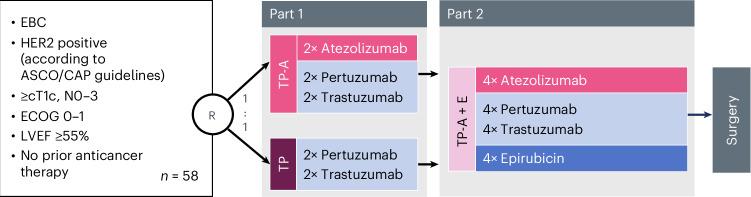
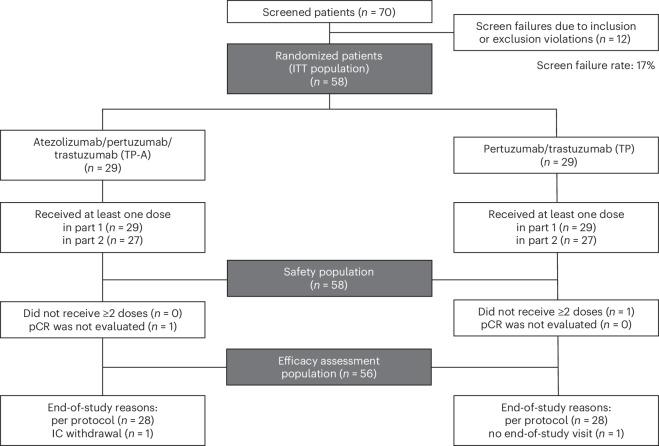
The role of anthracyclines in the treatment of early breast cancer (EBC) is increasingly being challenged, especially in de-escalation strategies. However, owing to their immunogenic effects, anthracyclines are promising combination partners with immunotherapies. In the randomized phase 2 trial ABCSG-52 (EudraCT no. 2019-002364-27), we investigated epirubicin plus immunotherapy in women with human epidermal growth factor receptor 2 (HER2)-positive EBC. A total of 58 patients were randomized 1:1 to two cycles of a chemotherapy-free induction phase (part 1) of dual HER2 blockade with trastuzumab and pertuzumab (TP) plus the anti-programmed death ligand 1 antibody atezolizumab (TP-A) or TP alone. Thereafter, all patients received four cycles of TP-A in combination with epirubicin (part 2). The primary endpoint, pathological complete response (pCR), was met in 35 patients (60.3%; 95% confidence interval (CI) 47.5% to 71.9%), 19 patients (65.5%) in the TP-A group and 16 patients (55.2%) in the TP group. The residual cancer burden 0/I rate and objective response rate (secondary endpoints) in all patients with evaluable data were 80.0% (n = 44/55; 95% CI 67.6% to 88.4%) and 89.3% (n = 50/56; 95% CI 78.5% to 95.0%), respectively. Grade ≥3 adverse events were reported in 17 patients (29.3%). Based on our findings, we conclude that a neoadjuvant chemotherapy de-escalation immunotherapy regimen with trastuzumab, pertuzumab, atezolizumab and epirubicin is effective and safe in patients with HER2-positive EBC.
蒽环类药物在早期乳腺癌(EBC)治疗中的作用日益受到挑战,尤其是在降阶梯治疗策略中。然而,由于其免疫原性效应,蒽环类药物有望成为免疫治疗的联合伙伴。在随机2期试验ABCSG-52(欧洲药品管理局临床试验编号2019-002364-27)中,我们研究了表柔比星联合免疫疗法用于治疗人表皮生长因子受体2(HER2)阳性EBC女性患者的疗效。共有58例患者按1:1随机分为两组,分别接受为期两个周期的无化疗诱导期(第1部分),即使用曲妥珠单抗和帕妥珠单抗(TP)进行双重HER2阻断联合抗程序性死亡配体1抗体阿特珠单抗(TP-A),或仅接受TP治疗。此后,所有患者接受四个周期的TP-A联合表柔比星治疗(第2部分)。35例患者(60.3%;95%置信区间(CI)47.5%至71.9%)达到主要终点,即病理完全缓解(pCR),其中TP-A组有19例患者(65.5%),TP组有16例患者(55.2%)。所有具有可评估数据的患者的残余癌负担0/I率和客观缓解率(次要终点)分别为80.0%(n = 44/55;95% CI 67.6%至88.4%)和89.3%(n = 50/56;95% CI 78.5%至95.0%)。17例患者(29.3%)报告了≥3级不良事件。基于我们的研究结果,我们得出结论,对于HER2阳性EBC患者,曲妥珠单抗、帕妥珠单抗、阿特珠单抗和表柔比星组成的新辅助化疗降阶梯免疫治疗方案是有效且安全的。
 Zotero 插件