
胰腺腺癌中KRAS密码子12特定变体的独特分子和临床特征
Distinct Molecular and Clinical Features of Specific Variants of KRAS Codon 12 in Pancreatic Adenocarcinoma.
作者信息
Ardalan Bach, Ciner Aaron, Baca Yasmine, Hinton Andrew, Darabi Sourat, Kasi Anup, Lou Emil, Azqueta Jose Ignacio, Xiu Joanne, Datta Jashodeep, Shields Anthony F, Aguirre Andrew, Singh Harshabad, Shroff Rachna T, Pishvaian Michael J, Goel Sanjay
机构信息
Sylvester Comprehensive Cancer Center, Miami, Florida.
University of Maryland, Baltimore, Maryland.
出版信息
Clin Cancer Res. 2025 Mar 17;31(6):1082-1090. doi: 10.1158/1078-0432.CCR-24-3149.
PURPOSE
Oncogenic mutations in KRAS have been identified in >85% of pancreatic ductal adenocarcinoma (PDAC) cases, with G12D, G12V, and G12R being the most frequent variants. Using large clinical and genomic databases, this study characterizes prognostic and molecular differences between KRAS variants, focusing on KRASG12D and KRASG12R.
EXPERIMENTAL DESIGN
PDAC samples were tested using DNA and RNA sequencing. The MAPK activation score and tumor microenvironment were analyzed from RNA expression data. Real-world overall survival (OS) obtained from insurance claims data was calculated from tissue collection to last contact. Significance was determined by χ2 and Fisher exact tests.
RESULTS
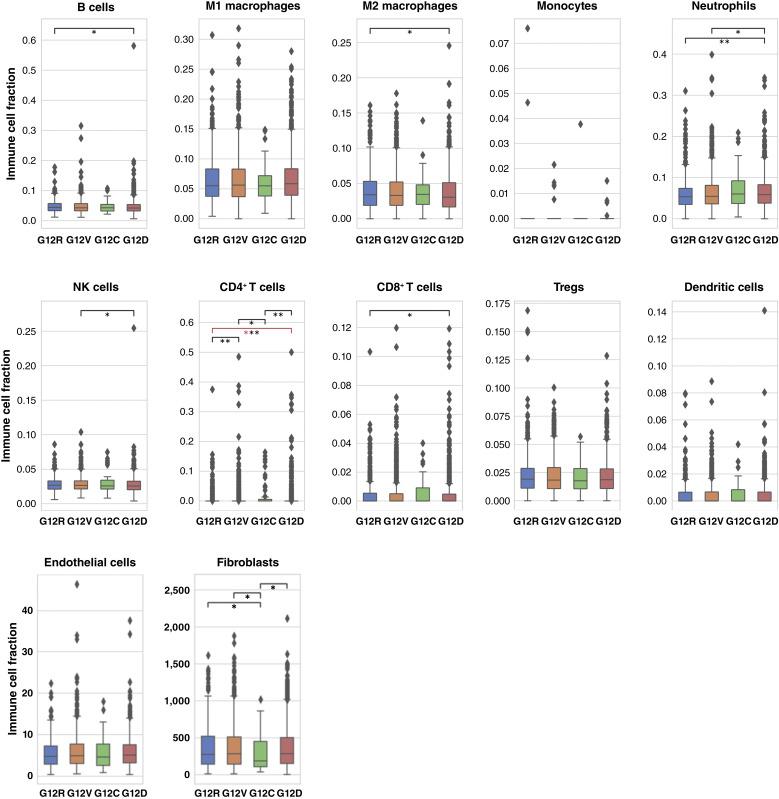
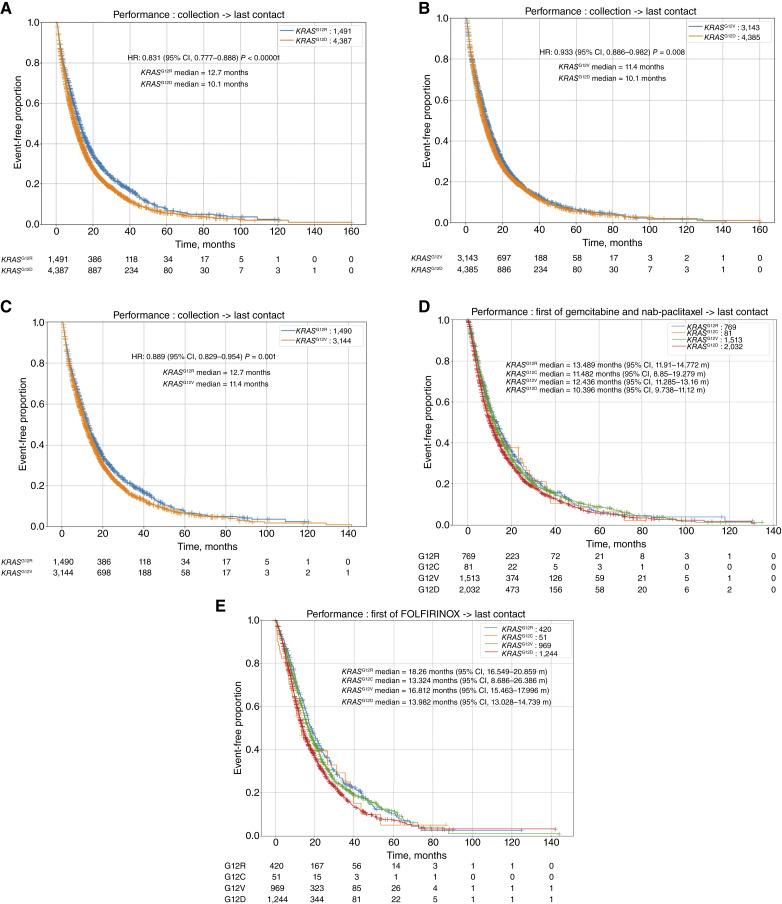
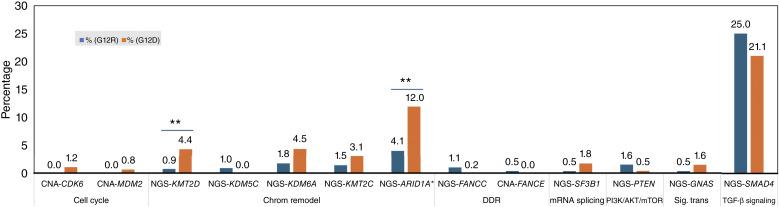
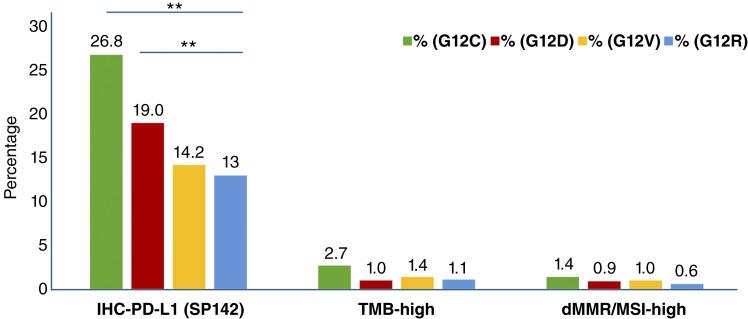
A total of 3,755 patients with PDAC harboring KRASG12D (n = 1,766), KRASG12V (n = 1,294), KRASG12R (n = 621), or KRASG12C (n = 74) variants were identified. Patients with G12R mutations had longer OS compared with those with G12D overall (12.7 vs. 10.1 months; P value = 0.0001), with similar trends in patients treated with gemcitabine/nab-paclitaxel (13.5 vs. 10.4 months; P value = 0.0002) or FOLFIRINOX (18.3 vs. 14.0 months; P value<0.001). ARID1A and KMT2D mutations were more frequent in the G12D subgroup. Several genes involved in glucose and glutamine metabolism were less expressed in G12R compared with G12D. PD-L1 expression was lower in G12R compared with G12D (13% vs. 19%).
CONCLUSIONS
KRAS G12D tumors exhibited a distinct molecular profile compared with G12R tumors, including genes involved in the MAPK pathway, immune activation, and glucose and glutamine metabolism. Patients with G12D mutations had lower OS compared with those with G12R. Based on these data, future studies should address the KRAS mutation status and explore distinct therapeutic vulnerabilities.
目的
在超过85%的胰腺导管腺癌(PDAC)病例中已鉴定出KRAS致癌突变,其中G12D、G12V和G12R是最常见的变体。本研究利用大型临床和基因组数据库,对KRAS变体之间的预后和分子差异进行了表征,重点关注KRASG12D和KRASG12R。
实验设计
使用DNA和RNA测序对PDAC样本进行检测。从RNA表达数据中分析MAPK激活评分和肿瘤微环境。根据保险理赔数据获得的真实世界总生存期(OS),从组织采集计算至最后一次联系。通过χ2检验和Fisher精确检验确定显著性。
结果
共鉴定出3755例携带KRASG12D(n = 1766)、KRASG12V(n = 1294)、KRASG12R(n = 621)或KRASG12C(n = 74)变体的PDAC患者。与总体G12D患者相比,G12R突变患者的OS更长(12.7个月对10.1个月;P值 = 0.0001),在接受吉西他滨/纳米紫杉醇治疗的患者中也有类似趋势(13.5个月对10.4个月;P值 = 0.0002)或FOLFIRINOX(18.3个月对14.0个月;P值<0.001)。ARID1A和KMT2D突变在G12D亚组中更常见。与G12D相比,G12R中一些参与葡萄糖和谷氨酰胺代谢的基因表达较低。与G12D相比,G12R中的PD-L1表达较低(13%对19%)。
结论
与G12R肿瘤相比,KRAS G12D肿瘤表现出独特的分子特征,包括参与MAPK途径、免疫激活以及葡萄糖和谷氨酰胺代谢的基因。与G12R患者相比,G12D突变患者的OS较低。基于这些数据,未来的研究应关注KRAS突变状态,并探索不同的治疗弱点。
 Zotero 插件