
昼夜节律调节因子PERs在氧化应激、免疫及癌症发展中的作用。
The role of circadian rhythm regulator PERs in oxidative stress, immunity, and cancer development.
作者信息
Zhao Baimei, Nepovimova Eugenie, Wu Qinghua
机构信息
College of Life Science, Yangtze University, Jingzhou, 434025, China.
Department of Chemistry, Faculty of Science, University of Hradec Králové, Hradec Králové , 500 03, Czech Republic.
出版信息
Cell Commun Signal. 2025 Jan 16;23(1):30. doi: 10.1186/s12964-025-02040-2.
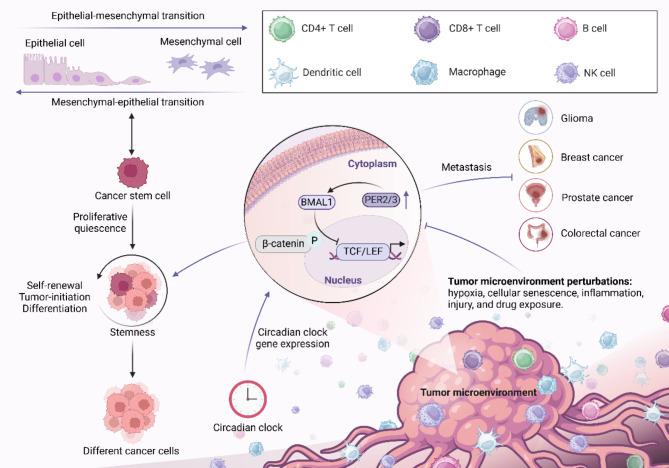
The complex interaction between circadian rhythms and physiological functions is essential for maintaining human health. At the heart of this interaction lies the PERIOD proteins (PERs), pivotal to the circadian clock, influencing the timing of physiological and behavioral processes and impacting oxidative stress, immune functionality, and tumorigenesis. PER1 orchestrates the cooperation of the enzyme GPX1, modulating mitochondrial dynamics in sync with daily rhythms and oxidative stress, thus regulating the mechanisms managing energy substrates. PERs in innate immune cells modulate the temporal patterns of NF-κB and TNF-α activities, as well as the response to LPS-induced toxic shock, initiating inflammatory responses that escalate into chronic inflammatory conditions. Crucially, PERs modulate cancer cell behaviors including proliferation, apoptosis, and migration by influencing the levels of cell cycle proteins and stimulating the expression of oncogenes c-Myc and MDM2. PER2/3, as antagonists in cancer stem cell biology, play important roles in differentiating cancer stem cells and in maintaining their stemness. Importantly, the expression of Pers serve as a significant factor for early cancer diagnosis and prognosis. This review delves into the link between circadian rhythm regulator PERs, disruptions in circadian rhythm, and oncogenesis. We examine the evidence that highlights how dysfunctions in PERs activities initiate cancer development, aid tumor growth, and modify cancer cell metabolism through pathways involved in oxidative stress and immune system. Comprehending these connections opens new pathways for the development of circadian rhythm-based therapeutic strategies, with the aims of boosting immune responses and enhancing cancer treatments.
昼夜节律与生理功能之间的复杂相互作用对于维持人类健康至关重要。这种相互作用的核心是周期蛋白(PERs),它是生物钟的关键,影响生理和行为过程的时间安排,并影响氧化应激、免疫功能和肿瘤发生。PER1协调酶GPX1的协同作用,与日常节律和氧化应激同步调节线粒体动力学,从而调节能量底物的管理机制。固有免疫细胞中的PERs调节NF-κB和TNF-α活性的时间模式,以及对脂多糖诱导的中毒性休克的反应,引发炎症反应并升级为慢性炎症状态。至关重要的是,PERs通过影响细胞周期蛋白水平并刺激癌基因c-Myc和MDM2的表达来调节癌细胞的行为,包括增殖、凋亡和迁移。PER2/3作为癌症干细胞生物学中的拮抗剂,在分化癌症干细胞及其干性维持中发挥重要作用。重要的是,PERs的表达是癌症早期诊断和预后的重要因素。本综述深入探讨了昼夜节律调节因子PERs、昼夜节律紊乱与肿瘤发生之间的联系。我们研究了相关证据,这些证据突出了PERs活性功能障碍如何通过氧化应激和免疫系统相关途径引发癌症发展、促进肿瘤生长并改变癌细胞代谢。理解这些联系为开发基于昼夜节律的治疗策略开辟了新途径,旨在增强免疫反应并改善癌症治疗效果。


 Zotero 插件