
年龄相关性黄斑变性中人工智能的进化模式与研究前沿:一项文献计量分析
Evolutionary patterns and research frontiers of artificial intelligence in age-related macular degeneration: a bibliometric analysis.
作者信息
Yang Zuyi, Tian Dianzhe, Zhao Xinyu, Zhang Lei, Xu Yiyao, Lu Xin, Chen Youxin
机构信息
Eight-year Medical Doctor Program, Chinese Academy of Medical Sciences and Peking Union Medical College, Beijing, China.
Department of Ophthalmology, Key Lab of Ocular Fundus Diseases, Peking Union Medical College Hospital, Chinese Academy of Medical Sciences and Peking Union Medical College, Beijing, China.
出版信息
Quant Imaging Med Surg. 2025 Jan 2;15(1):813-830. doi: 10.21037/qims-24-1406. Epub 2024 Dec 30.
BACKGROUND
Age-related macular degeneration (AMD) represents a significant clinical concern, particularly in aging populations, and recent advancements in artificial intelligence (AI) have catalyzed substantial research interest in this domain. Despite the growing body of literature, there remains a need for a comprehensive, quantitative analysis to delineate key trends and emerging areas in the field of AI applications in AMD. This bibliometric analysis sought to systematically evaluate the landscape of AI-focused research on AMD to illuminate publication patterns, influential contributors, and focal research trends.
METHODS
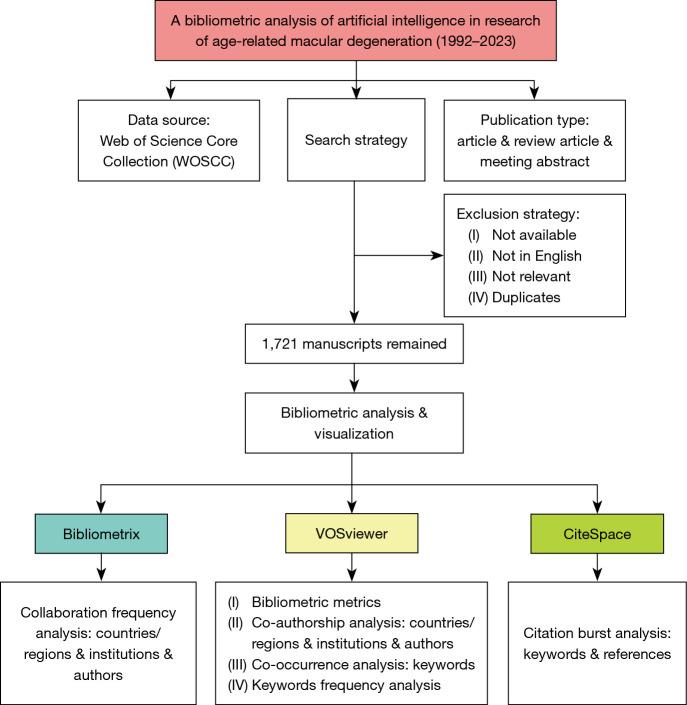
Using the Web of Science Core Collection (WoSCC), a search was conducted to retrieve relevant publications from 1992 to 2023. This analysis involved an array of bibliometric indicators to map the evolution of AI research in AMD, assessing parameters such as publication volume, national/regional and institutional contributions, journal impact, author influence, and emerging research hotspots. Visualization tools, including Bibliometrix, CiteSpace and VOSviewer, were employed to generate comprehensive assessments of the data.
RESULTS
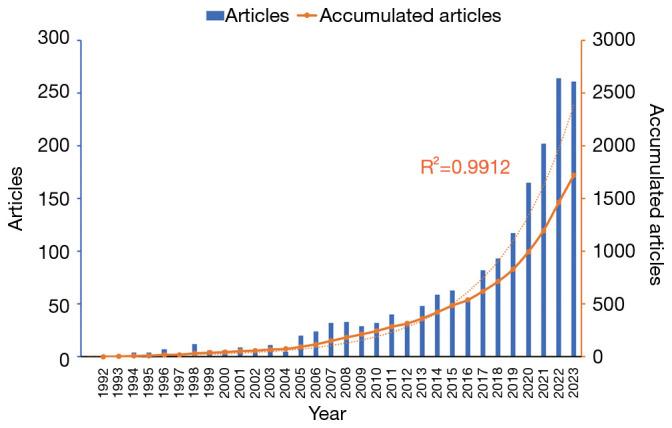
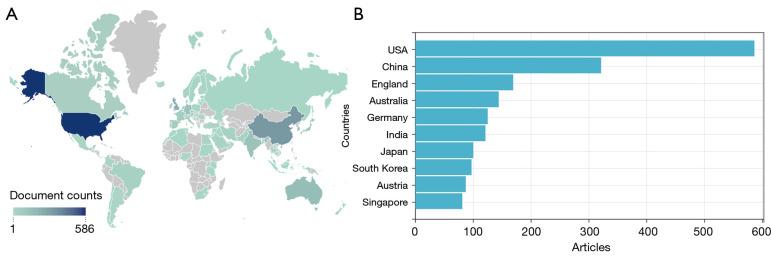
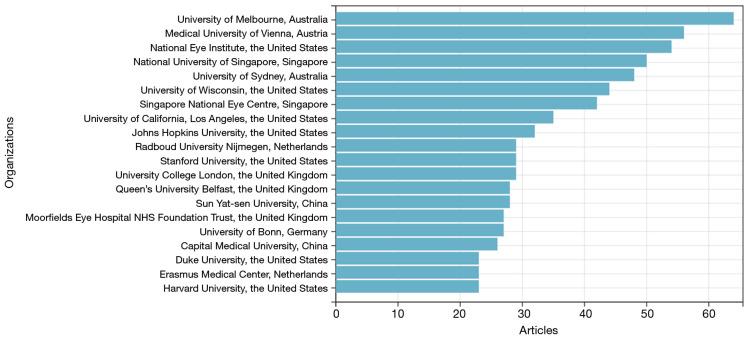
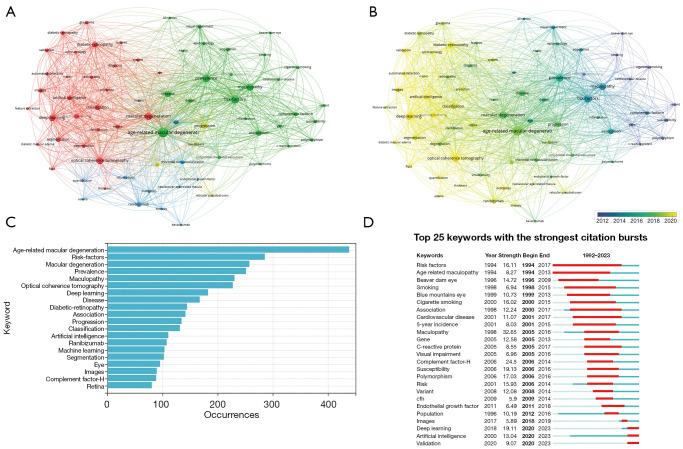
A total of 1,721 publications were identified, with the USA leading in publication output and the University of Melbourne as the most prolific institution. The journal published the highest number of articles, and Schmidt-Eerfurth emerged as the most active author. Keyword and clustering analyses, along with citation burst detection, revealed three distinct research stages within the field from 1992 to 2023. Presently, research efforts are concentrated on developing deep learning (DL) models for AMD diagnosis and progression prediction. Prominent emerging themes include early detection, risk stratification, and treatment efficacy prediction. The integration of large language models (LLMs) and vision-language models (VLMs) for enhanced image processing also represents a novel research frontier.
CONCLUSIONS
This bibliometric analysis provides a structured overview of prevailing research trends and emerging directions in AI applications for AMD. These findings furnish valuable insights to guide future research and foster collaborative advancements in this evolving field.
背景
年龄相关性黄斑变性(AMD)是一个重大的临床问题,在老龄化人群中尤为突出,而人工智能(AI)的最新进展激发了该领域大量的研究兴趣。尽管文献数量不断增加,但仍需要进行全面的定量分析,以勾勒出AMD领域人工智能应用的关键趋势和新兴领域。这项文献计量分析旨在系统地评估以人工智能为重点的AMD研究格局,以阐明出版模式、有影响力的贡献者和重点研究趋势。
方法
利用科学网核心合集(WoSCC)进行检索,以获取1992年至2023年的相关出版物。该分析涉及一系列文献计量指标,以描绘AMD领域人工智能研究的演变,评估诸如出版量、国家/地区和机构贡献、期刊影响力、作者影响力以及新兴研究热点等参数。使用包括Bibliometrix、CiteSpace和VOSviewer在内的可视化工具对数据进行全面评估。
结果
共确定了1721篇出版物,美国在出版量方面领先,墨尔本大学是最多产的机构。该期刊发表的文章数量最多,施密特 - 厄尔富特是最活跃的作者。关键词和聚类分析以及引文突发检测揭示了1992年至2023年该领域内三个不同的研究阶段。目前,研究工作集中在为AMD诊断和病情进展预测开发深度学习(DL)模型。突出的新兴主题包括早期检测、风险分层和治疗效果预测。整合大语言模型(LLMs)和视觉语言模型(VLMs)以增强图像处理也代表了一个新的研究前沿。
结论
这项文献计量分析提供了AMD人工智能应用中当前研究趋势和新兴方向的结构化概述。这些发现为指导未来研究和促进这一不断发展领域的合作进展提供了有价值的见解。

 Zotero 插件