
1990年至2021年全球、区域和国家青年慢性阻塞性肺疾病负担及到2050年的预测:全球疾病负担研究2021的系统分析
Global, regional, and national burden of young COPD, 1990-2021, with forecasts to 2050: a systematic analysis for the global burden of disease study 2021.
作者信息
Zhu Yi, Shen Tao, Guo Ruixin, Liu Ke, Cao Xiyu, Yang Xiuli, Zhang Chuantao
机构信息
Department of Respiratory Medicine, Hospital of Chengdu University of Traditional Chinese Medicine, Chengdu, China.
出版信息
BMC Public Health. 2025 Jan 22;25(1):276. doi: 10.1186/s12889-025-21414-2.
BACKGROUND
Young chronic obstructive pulmonary disease (COPD) refers to people with COPD between the ages of 20 and 50 years. Current epidemiological studies focus on local geography, and there is a lack of global-level analysis. This study provides in-depth analyses of the disease burden of young COPD at global, regional, and national levels.
METHODS
This study used the Global Burden of Disease Study 2021 (GBD). The age-standardised prevalence rate (ASPR), age-standardised incidence rate (ASIR), age-standardised death rate (ASDR), and age-standardised disability-adjusted life years (DALYs) rate were used to describe the disease burden. The estimated annual percentage change (EAPC) during the study period was calculated. Joinpoint regression analysis examined the time trend from 1990 to 2021. Annual percentage change (APC) and average annual percentage change (AAPC) were calculated. Risk factors were reported by region and sex.
RESULTS
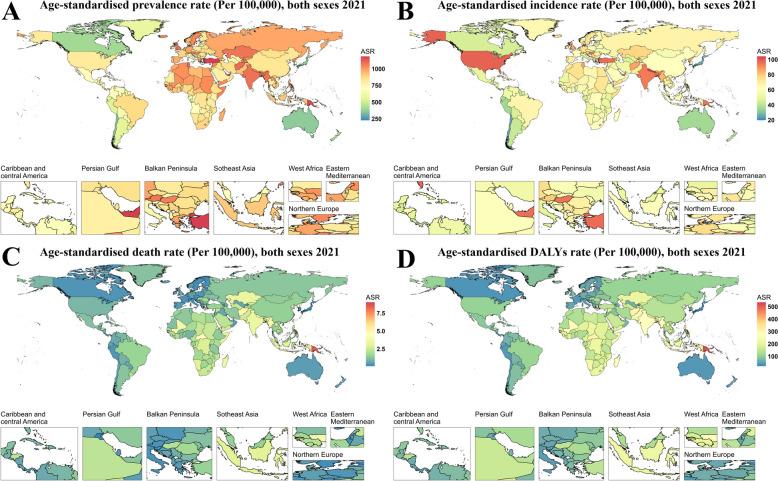
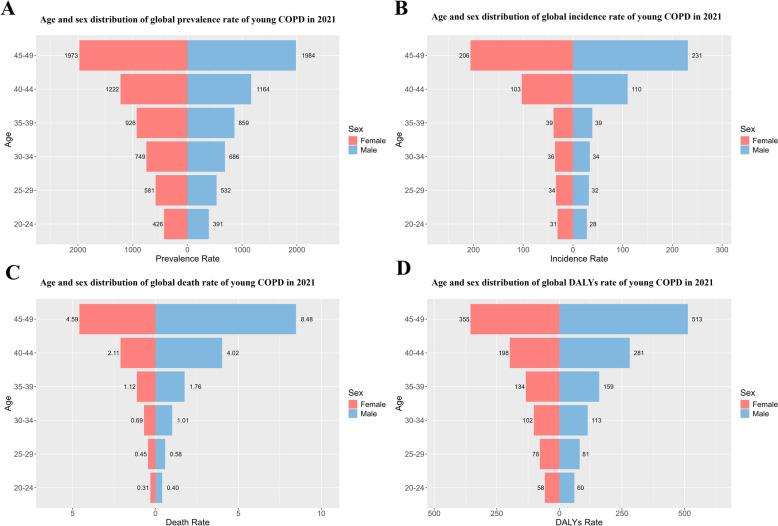
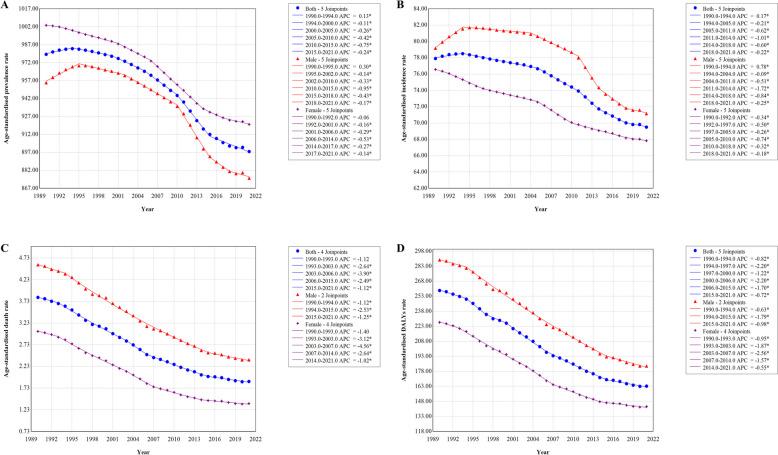
In 2021, the global number of young COPD cases was 30,384,539, and the ASPR, ASIR, ASDR, and age-standardised DALYs rates fell slightly. Oceania reported the highest ASPR, ASDR, and age-standardised DALYs rate. High-income North America has the highest ASIR. In 2021, the prevalence, incidence, death, and DALYs rates exhibited similar trends, increasing with age. From 1990 to 2021, both the prevalence and death rates showed a consistent downward trend across all age groups. Joinpoint regression analysis indicated a slight increase in both the ASPR (APC: 0.13; 95% CI: 0.06 to 0.19) and the ASIR (APC: 0.17; 95% CI: 0.10 to 0.24) during the period from 1990 to 1994. The leading DALYs attributable to risk factors for young COPD are household air pollution from solid fuels (20.4%), ambient particulate matter pollution (17.9%), and smoking (13.5%).
CONCLUSIONS
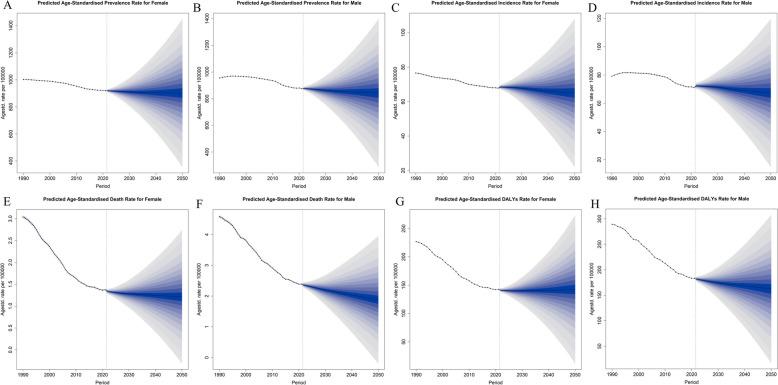
The global burden of ASPR, ASIR, ASDR, and age-standardised DALYs rates in young COPD has decreased, however, the absolute number of patients has increased. The global burden shows noticeable regional differences, with particularly high burdens observed in Oceania. Improving air quality, promoting smoking cessation, and increasing access to lung function tests, raising awareness of young COPD are key strategies for alleviating the burden of young COPD.
背景
青年慢性阻塞性肺疾病(COPD)是指年龄在20至50岁之间的COPD患者。当前的流行病学研究集中在局部地区,缺乏全球层面的分析。本研究对全球、区域和国家层面的青年COPD疾病负担进行了深入分析。
方法
本研究使用了2021年全球疾病负担研究(GBD)。采用年龄标准化患病率(ASPR)、年龄标准化发病率(ASIR)、年龄标准化死亡率(ASDR)和年龄标准化伤残调整生命年(DALYs)率来描述疾病负担。计算了研究期间的估计年变化百分比(EAPC)。Joinpoint回归分析考察了1990年至2021年的时间趋势。计算了年变化百分比(APC)和平均年变化百分比(AAPC)。按地区和性别报告了危险因素。
结果
2021年,全球青年COPD病例数为30384539例,ASPR、ASIR、ASDR和年龄标准化DALYs率略有下降。大洋洲报告的ASPR、ASDR和年龄标准化DALYs率最高。高收入的北美地区ASIR最高。2021年,患病率、发病率、死亡率和DALYs率呈现相似趋势,随年龄增长而增加。1990年至2021年,所有年龄组的患病率和死亡率均呈持续下降趋势。Joinpoint回归分析表明,1990年至1994年期间,ASPR(APC:0.13;95%CI:0.06至0.19)和ASIR(APC:0.17;95%CI:0.10至0.24)均略有上升。导致青年COPD危险因素的主要DALYs是固体燃料造成的家庭空气污染(20.4%)、环境颗粒物污染(17.9%)和吸烟(13.5%)。
结论
青年COPD的全球ASPR、ASIR、ASDR和年龄标准化DALYs率负担有所下降,但患者绝对数量有所增加。全球负担存在明显的地区差异,大洋洲负担尤其高。改善空气质量、促进戒烟、增加肺功能检测的可及性、提高对青年COPD的认识是减轻青年COPD负担的关键策略。


 Zotero 插件