
北京新冠疫情非药物干预措施实施前、期间及之后婴儿呼吸道病原体的变化
Changes in infant respiratory pathogens pre-, during, and post-COVID-19 non-pharmacological interventions in Beijing.
作者信息
Han Tongying, Wang Yajuan, Zhang Di, Li Ying, Zhang Li, Yan Jin, Li Chi, Yang Shengnan, Guo Litao, Yan Huijuan
机构信息
Department of Neonatology, Children's Hospital, Capital Institute of Pediatrics, Beijing, 100020, China.
出版信息
Ital J Pediatr. 2025 Jan 22;51(1):8. doi: 10.1186/s13052-025-01848-5.
BACKGROUND
To explore the effect of non-pharmacological interventions (NPIs) on respiratory pathogen profiles among hospitalized infants aged 0-3 months in Beijing during the coronavirus disease 2019 (COVID-19) pandemic.
METHODS
Respiratory specimens were collected from 1,184 infants aged 0-3 months who were hospitalized for acute respiratory infection at the Children's Hospital affiliated with the Capital Institute of Pediatrics from January 2018 to December 2023. The data were divided into three groups-the pre-epidemic (January 2018 to December 2019), epidemic prevention and control (January 2020 to December 2022), and post-epidemic (January 2023 to December 2023) groups-based on the outbreak of COVID-19 and the implementation and termination of NPIs. The specimens were tested for 14 respiratory pathogens, including influenza virus A (Flu A), influenza virus B, respiratory syncytial virus, parainfluenza virus (PIV), adenovirus (ADV), human metapneumovirus (HMPV), human bocavirus, human rhinovirus (HRV), coronavirus, Chlamydia trachomatis, Chlamydia pneumoniae (C.pn), Mycoplasma pneumoniae, Bordetella pertussis, and severe acute respiratory syndrome coronavirus 2 (SARS-CoV-2).
RESULTS
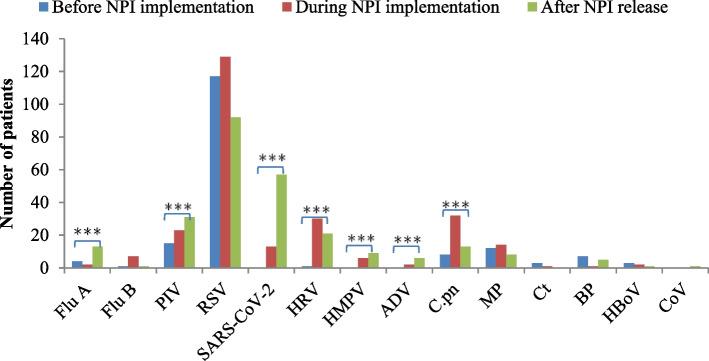
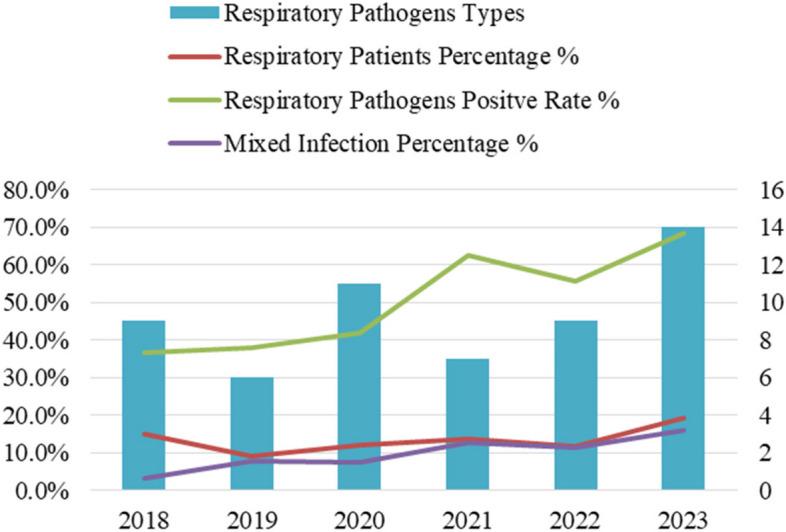
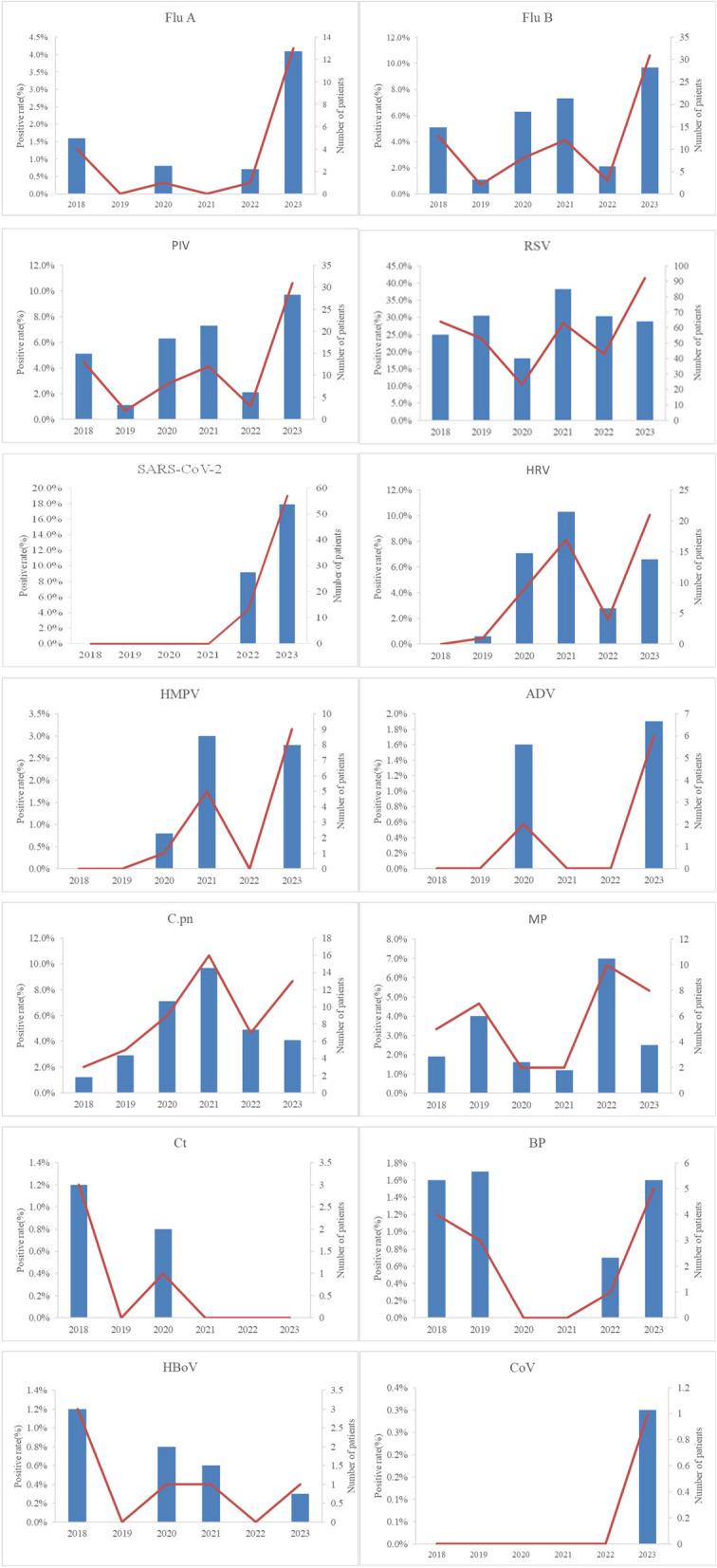
A total of 1,184 infants, including 649 males and 535 females, with acute respiratory infections were admitted. The positive detection rate for respiratory pathogens was 51.77% (n = 613). In 2023, the proportion of infants with respiratory infections after the epidemic was 19.4% (319/1646), the positive detection rate of respiratory pathogens was 68.3% (218/319), and the mixed infection detection rate of respiratory pathogens was 16.1% (35/218). Prior to the epidemic, these rates were 11.9% (431/3611), 37.1% (160/431), and 5.0% (8/160), respectively. During the epidemic prevention and control period, these rates significantly increased to 12.4% (434/3486), 54.1% (235/434), and 11.1% (26/235) (P < 0.05), respectively. Post-epidemic, the proportion of newborns testing positive for respiratory pathogens decreased, while the number of infants aged 29-90 days significantly increased. The proportion of admission weight and contact history with respiratory patients increased significantly compared to before and during the epidemic, with statistical significance (P < 0.05). After the epidemic, a total of 13 respiratory pathogens were detected throughout the year. There were statistically significant differences in the detection rates of Flu A, PIV, SARS-CoV-2, HRV, HMPV, ADV, and C.pn before, during, and after implementation of the NPIs during the COVID-19 epidemic (P < 0.05). Post-epidemic, the detection rates of Flu A, PIV, and SARS-CoV-2 were significantly higher than those before and during the epidemic (P < 0.017). The detection rates of HRV, HMPV, and ADV significantly increased after the epidemic compared to those before the epidemic (P < 0.017). Before the epidemic, the positivity rate of respiratory pathogens was high in the first and fourth quarters. After the termination of NPIs, the positive detection rate decreased in the first quarter but increased in the second, third, and fourth quarters, with a statistically significant difference (P < 0.05).
CONCLUSION
The implementation and lifting of COVID-19 NPIs have caused significant changes in the detection and seasonal distribution of respiratory pathogens in infants aged 0-3 months in Beijing. NPIs temporarily reduced the detection rate of respiratory pathogens in infants during the prevalence of COVID-19. Understanding the prevalence of respiratory pathogens before and after the epidemic is particularly important for the prevention and control of respiratory diseases in infants.
背景
探讨2019年冠状病毒病(COVID-19)大流行期间非药物干预措施(NPIs)对北京0至3个月住院婴儿呼吸道病原体谱的影响。
方法
收集2018年1月至2023年12月在首都儿科研究所附属儿童医院因急性呼吸道感染住院的1184例0至3个月婴儿的呼吸道标本。根据COVID-19疫情爆发以及NPIs的实施和终止情况,将数据分为三组:疫情前(2018年1月至2019年12月)、疫情防控期(2020年1月至2022年12月)和疫情后(2023年1月至2023年12月)。对标本进行14种呼吸道病原体检测,包括甲型流感病毒(Flu A)、乙型流感病毒、呼吸道合胞病毒、副流感病毒(PIV)、腺病毒(ADV)、人偏肺病毒(HMPV)、人博卡病毒、人鼻病毒(HRV)、冠状病毒、沙眼衣原体、肺炎衣原体(C.pn)、肺炎支原体、百日咳博德特氏菌和严重急性呼吸综合征冠状病毒2(SARS-CoV-2)。
结果
共收治1184例急性呼吸道感染婴儿,其中男649例,女535例。呼吸道病原体阳性检出率为51.77%(n = 613)。2023年,疫情后呼吸道感染婴儿比例为19.4%(319/1646),呼吸道病原体阳性检出率为68.3%(218/319),呼吸道病原体混合感染检出率为16.1%(35/218)。疫情前,这些比率分别为11.9%(431/3611)、37.1%(160/431)和5.0%(8/160)。在疫情防控期间,这些比率分别显著增至12.4%(434/3486)、54.1%(235/434)和11.1%(26/235)(P < 0.05)。疫情后,呼吸道病原体检测呈阳性的新生儿比例下降,而29至90天龄婴儿数量显著增加。与疫情前和疫情期间相比,入院体重和与呼吸道疾病患者接触史的比例显著增加,具有统计学意义(P < 0.05)。疫情后,全年共检测到13种呼吸道病原体。在COVID-19疫情期间实施NPIs之前、期间和之后,Flu A、PIV、SARS-CoV-2、HRV、HMPV、ADV和C.pn的检出率存在统计学显著差异(P < 0.05)。疫情后,Flu A、PIV和SARS-CoV-2的检出率显著高于疫情前和疫情期间(P < 0.017)。与疫情前相比,疫情后HRV、HMPV和ADV的检出率显著增加(P < 0.017)。疫情前,呼吸道病原体阳性率在第一和第四季度较高。NPIs终止后,第一季度阳性检出率下降,但第二、第三和第四季度上升,差异有统计学意义(P < 0.05)。
结论
COVID-19 NPIs的实施和解除导致北京0至3个月婴儿呼吸道病原体的检测和季节分布发生了显著变化。NPIs在COVID-19流行期间暂时降低了婴儿呼吸道病原体的检出率。了解疫情前后呼吸道病原体的流行情况对于婴儿呼吸道疾病的防控尤为重要。


 Zotero 插件