
农村和城市退伍军人健康管理局患者中用于阿片类药物使用障碍的药物接收情况。
Receipt of medications for opioid use disorder among rural and urban veterans health administration patients.
作者信息
Reynolds Olivia C, Carlson Kathleen F, Gordon Adam J, Handley Robert L, Morasco Benjamin J, Korthuis Todd P, Lovejoy Travis I, Wyse Jessica J
机构信息
Center to Improve Veteran Involvement in Care, VA Portland Health Care System, 3710 SW US Veterans Hospital Rd, Portland, OR 97239, United States.
School of Public Health, Oregon Health & Science University, 840 SW Gaines St, Portland, OR 97239, United States.
出版信息
Drug Alcohol Depend Rep. 2024 Dec 14;14:100311. doi: 10.1016/j.dadr.2024.100311. eCollection 2025 Mar.
AIM
We examined differences in medications for opioid use disorder (MOUD) receipt between rural and urban veteran patients following initiatives within the US Department of Veterans Affairs (VA) to expand access to MOUD.
METHODS
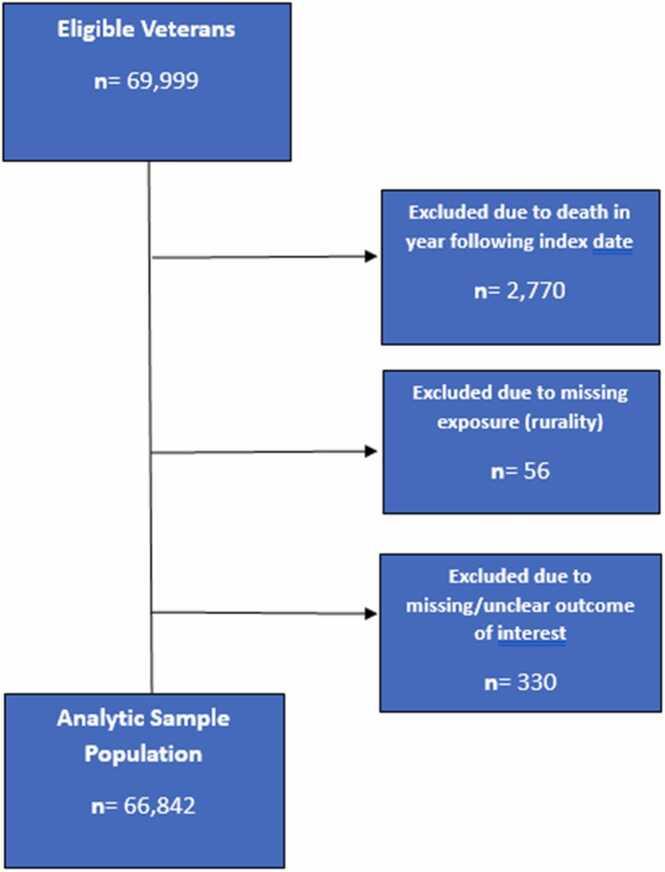
Data for this retrospective cohort study were obtained from the VA Corporate Data Warehouse, which contains national electronic health record data for all VA patients. The analytic sample included all patients diagnosed with OUD from 10/1/2018-9/30/20. Rurality was identified by the Rural Urban Commuting Area (RUCA) code of patients' home address. Associations between rurality and MOUD receipt, as well as type of MOUD received, were examined using logistic regression.
RESULTS
Among 66,842 patients with OUD, 27.4 % were rural residents. Compared to urban patients, rural patients were slightly younger (50.1 vs. 52.5 years), more often white (87.7 % vs. 70.3 %) and less often received MOUD (42.6 % vs 45.5 %). Multivariable models confirmed that rural patients had a lower likelihood of accessing any form of MOUD (aOR= 0.84, 95 % CI: 0.81-0.87) relative to urban VA patients. Medication-specific analyses identified a lower likelihood of receiving methadone (aOR= 0.36, 95 % CI: 0.33-0.39) and naltrexone (aOR= 0.89, 95 % CI: 0.80-0.99) among rural patients, but higher likelihood of receiving buprenorphine (aOR= 1.05, 95 % CI: 1.01-1.09).
CONCLUSION
Rural VA patients have a lower likelihood of receiving methadone and naltrexone for OUD treatment relative to urban patients, but greater likelihood of receiving buprenorphine. Continued work is needed to ensure that rural Veterans have equitable access to the most appropriate medication for their health care needs.
目的
在美国退伍军人事务部(VA)采取举措扩大阿片类药物使用障碍(MOUD)治疗药物获取途径之后,我们研究了农村和城市退伍军人患者在接受MOUD治疗药物方面的差异。
方法
这项回顾性队列研究的数据来自VA企业数据仓库,其中包含所有VA患者的全国电子健康记录数据。分析样本包括2018年10月1日至2020年9月30日期间所有被诊断为阿片类药物使用障碍(OUD)的患者。根据患者家庭住址的城乡通勤区(RUCA)代码确定其居住地区是农村还是城市。使用逻辑回归分析研究居住地区与接受MOUD治疗药物之间的关联,以及所接受的MOUD治疗药物类型。
结果
在66,842例患有阿片类药物使用障碍(OUD)的患者中,27.4%为农村居民。与城市患者相比,农村患者年龄稍小(50.1岁对52.5岁),白人比例更高(87.7%对70.3%),接受MOUD治疗药物的比例更低(42.6%对45.5%)。多变量模型证实,相对于城市VA患者,农村患者获得任何形式MOUD治疗药物的可能性较低(调整后比值比[aOR]=0.84,95%置信区间[CI]:0.81 - 0.87)。针对具体药物的分析发现,农村患者接受美沙酮治疗的可能性较低(aOR=0.36,95%CI:0.33 - 0.39),接受纳曲酮治疗的可能性也较低(aOR=0.89,95%CI:0.80 - 0.99),但接受丁丙诺啡治疗的可能性较高(aOR=1.05,95%CI:1.01 - 1.09)。
结论
相对于城市患者,农村VA患者接受美沙酮和纳曲酮进行阿片类药物使用障碍(OUD)治疗的可能性较低,但接受丁丙诺啡治疗的可能性较高。需要继续努力确保农村退伍军人能够公平地获得最适合其医疗保健需求的药物。
 Zotero 插件