
1990年至2021年职业性颗粒物、气体和烟雾所致尘肺病的全球负担及未来趋势预测:一项基于人群的研究。
Global burden of pneumoconiosis attributable to occupational particulate matter, gasses, and fumes from 1990~2021 and forecasting the future trends: a population-based study.
作者信息
Qingsong Mao, Xiao Ruijie, Yang Wenqi, Wang Xinyi, Kong Yu-Zhe
机构信息
Hepatobiliary Pancreatic Surgery, Banan Hospital Affiliated of Chongqing Medical University, Chongqing, China.
Xiangya School of Medicine, Central South University, Changsha, China.
出版信息
Front Public Health. 2025 Jan 8;12:1494942. doi: 10.3389/fpubh.2024.1494942. eCollection 2024.
BACKGROUND
This study aimed to quantify the global impact of pneumoconiosis resulting from occupational exposure to particulate matter, gasses, and fumes from 1990 to 2021, utilizing data from the Global Burden of Disease Study 2021.
METHOD
The analysis evaluated the global, regional, and national burden of pneumoconiosis attributable to workplace exposure to particulate matter, gasses, and fumes. It explored variations in disease impact across different demographics, including age and gender, and analyzed the relationship between disease burden and the Socio-Demographic Index (SDI). Furthermore, an ARIMA model was employed to forecast future trends of pneumoconiosis up to 2050.
RESULT
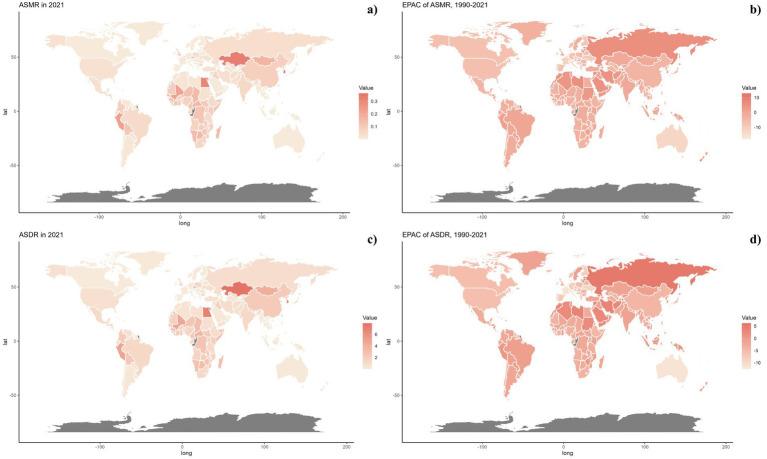
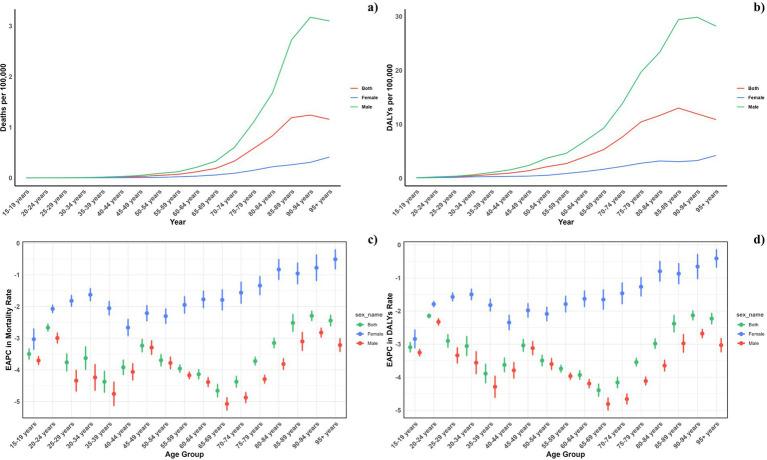
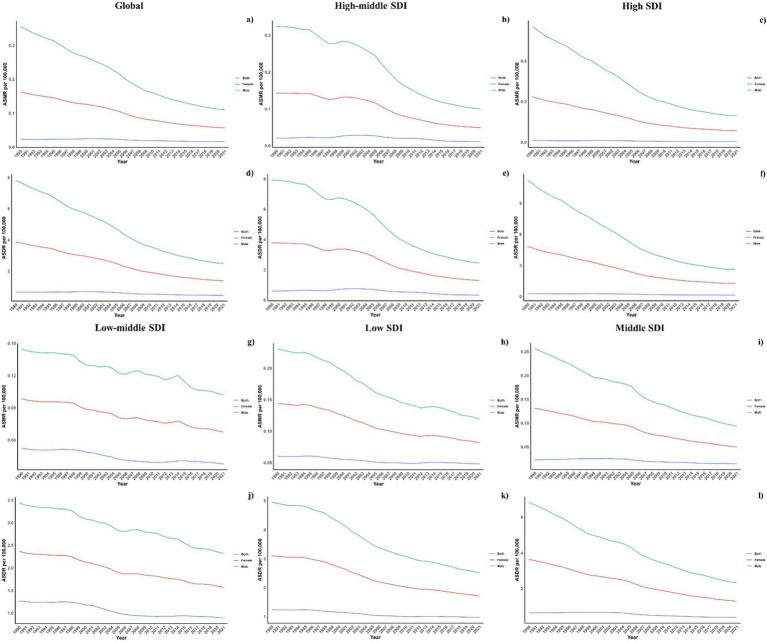
The year 2021 saw pneumoconiosis from occupational particulate matter, gasses, and fumes account for roughly 4,775 deaths and 117.80 thousand disability-adjusted life years (DALYs). Over the past three decades, there was a notable decline in the disease's burden. The condition predominantly affected males and those aged above 60. Future projections suggest a decrease in mortality rates in low to middle SDI regions, while high SDI regions may experience an increase in ASMR. Additionally, both ASMR and ASDR are anticipated to rise globally. Nationally, the Czech Republic, France, and the United States are expected to show relatively higher mortality rates in 2030 and 2050. Countries like Kazakhstan, Egypt, Mongolia, and Peru are projected to experience elevated levels of ASMR, DALY rates, and ASDR.
CONCLUSION
The findings underscore the urgent need for policymakers to create and improve targeted preventive strategies to reduce the incidence of pneumoconiosis among specific populations.
背景
本研究旨在利用《2021年全球疾病负担研究》的数据,量化1990年至2021年职业接触颗粒物、气体和烟雾导致的尘肺病的全球影响。
方法
该分析评估了因工作场所接触颗粒物、气体和烟雾导致的尘肺病的全球、区域和国家负担。探讨了不同人口统计学特征(包括年龄和性别)下疾病影响的差异,并分析了疾病负担与社会人口指数(SDI)之间的关系。此外,采用自回归整合移动平均模型(ARIMA)预测到2050年尘肺病的未来趋势。
结果
2021年,职业性颗粒物、气体和烟雾导致的尘肺病约造成4775人死亡和11.78万个伤残调整生命年(DALY)。在过去三十年中,该疾病的负担显著下降。这种疾病主要影响男性和60岁以上的人群。未来预测表明,低至中等SDI地区的死亡率将下降,而高SDI地区的年龄标准化死亡率(ASMR)可能会上升。此外,预计全球的ASMR和年龄标准化残疾率(ASDR)都将上升。在国家层面,预计捷克共和国、法国和美国在2030年和2050年的死亡率相对较高。预计哈萨克斯坦、埃及、蒙古和秘鲁等国的ASMR、DALY率和ASDR将升高。
结论
研究结果强调政策制定者迫切需要制定和改进有针对性的预防策略,以降低特定人群中尘肺病的发病率。




 Zotero 插件