
认证:新冠病毒疾病(COVID-19)住院期间病情进展临床评分的验证
ACCREDIT: Validation of clinical score for progression of COVID-19 while hospitalized.
作者信息
Melo Vinicius Lins Costa Ok, do Brasil Pedro Emmanuel Alvarenga Americano
机构信息
Instituto Nacional de Infectologia Evandro Chagas, Fundação Oswaldo Cruz, Brazil.
出版信息
Glob Epidemiol. 2024 Dec 28;9:100181. doi: 10.1016/j.gloepi.2024.100181. eCollection 2025 Jun.
UNLABELLED
COVID-19 is no longer a global health emergency, but it remains challenging to predict its prognosis.
OBJECTIVE
To develop and validate an instrument to predict COVID-19 progression for critically ill hospitalized patients in a Brazilian population.
METHODOLOGY
Observational study with retrospective follow-up. Participants were consecutively enrolled for treatment in non-critical units between January 1, 2021, to February 28, 2022. They were included if they were adults, with a positive RT-PCR result, history of exposure, or clinical or radiological image findings compatible with COVID-19. The outcome was characterized as either transfer to critical care or death. Predictors such as demographic, clinical, comorbidities, laboratory, and imaging data were collected at hospitalization. A logistic model with lasso or elastic net regularization, a random forest classification model, and a random forest regression model were developed and validated to estimate the risk of disease progression.
RESULTS
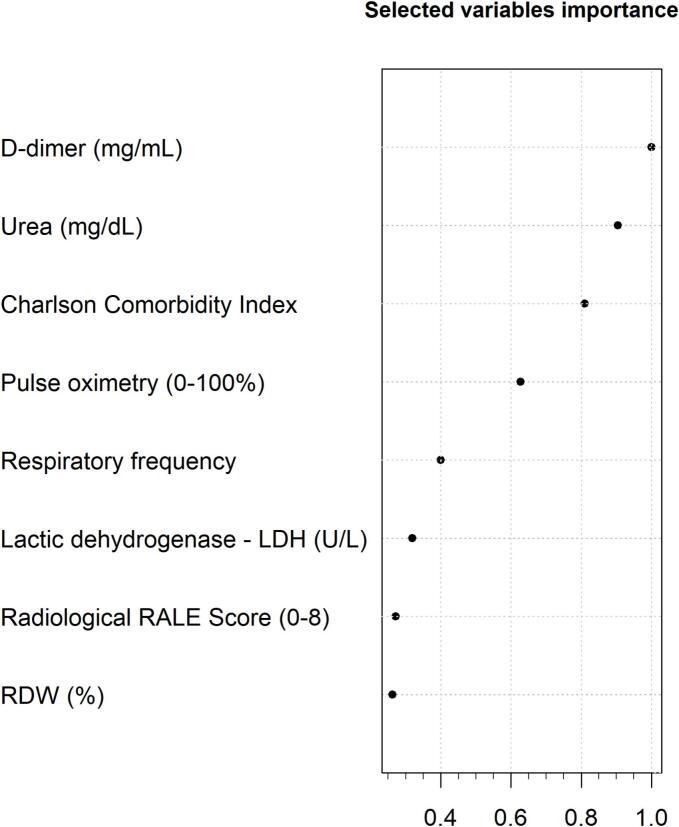
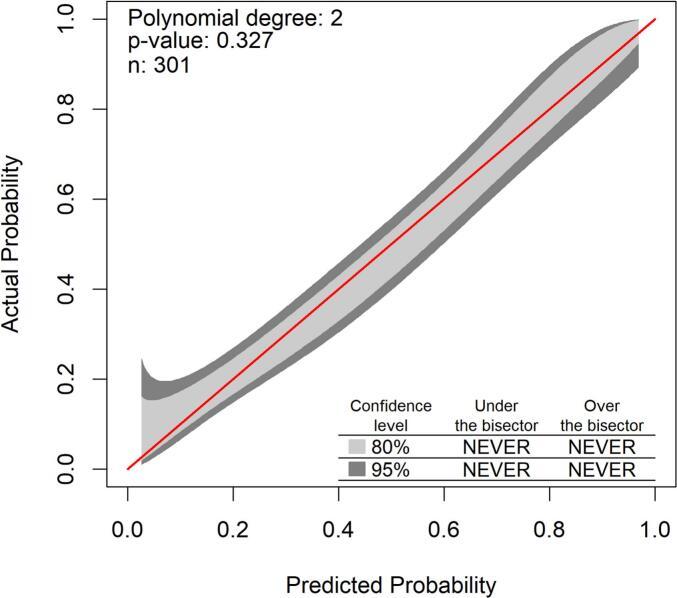
Out of 301 individuals, the outcome was 41.8 %. The majority of the patients in the study lacked a COVID-19 vaccination. Diabetes mellitus and systemic arterial hypertension were the most common comorbidities. After model development and cross-validation, the Random Forest regression was considered the best approach, and the following eight predictors were retained: D-dimer, Urea, Charlson comorbidity index, pulse oximetry, respiratory frequency, Lactic Dehydrogenase, RDW, and Radiologic RALE score. The model's bias-corrected intercept and slope were - 0.0004 and 1.079 respectively, the average prediction error was 0.028. The ROC AUC curve was 0.795, and the variance explained was 0.289.
CONCLUSION
The prognostic model was considered good enough to be recommended for clinical use in patients during hospitalization (https://pedrobrasil.shinyapps.io/INDWELL/). The clinical benefit and the performance in different scenarios are yet to be known.
未标注
新冠病毒病(COVID-19)不再是全球卫生紧急事件,但预测其预后仍然具有挑战性。
目的
开发并验证一种工具,用于预测巴西人群中重症住院患者的COVID-19病情进展。
方法
采用回顾性随访的观察性研究。2021年1月1日至2022年2月28日期间,连续纳入在非重症病房接受治疗的参与者。纳入标准为成年、逆转录聚合酶链反应(RT-PCR)结果呈阳性、有接触史、或临床或影像学检查结果符合COVID-19。结局定义为转入重症监护或死亡。在住院时收集人口统计学、临床、合并症、实验室及影像学数据等预测因素。开发并验证了具有套索或弹性网络正则化的逻辑模型、随机森林分类模型和随机森林回归模型,以估计疾病进展风险。
结果
301名个体中,结局发生率为41.8%。研究中的大多数患者未接种COVID-19疫苗。糖尿病和系统性动脉高血压是最常见的合并症。经过模型开发和交叉验证,随机森林回归被认为是最佳方法,并保留了以下八个预测因素:D-二聚体、尿素、查尔森合并症指数、脉搏血氧饱和度、呼吸频率、乳酸脱氢酶、红细胞分布宽度(RDW)和放射学啰音评分。该模型经偏差校正后的截距和斜率分别为-0.0004和1.079,平均预测误差为0.028。受试者工作特征曲线下面积(ROC AUC)为0.795,解释的方差为0.289。
结论
该预后模型被认为足够好,可推荐在患者住院期间用于临床(https://pedrobrasil.shinyapps.io/INDWELL/)。其临床益处及在不同场景下的表现尚待明确。


 Zotero 插件