
血小板生成素受体激动剂对儿童免疫性血小板减少症病理生理学的影响。
Impact of Thrombopoietin Receptor Agonists on Pathophysiology of Pediatric Immune Thrombocytopenia.
作者信息
Evangelidis Paschalis, Tragiannidis Konstantinos, Gavriilaki Eleni, Tragiannidis Athanasios
机构信息
2nd Propedeutic Department of Internal Medicine, Hippocration Hospital, Aristotle University of Thessaloniki, 54642 Thessaloniki, Greece.
Children & Adolescent Hematology-Oncology Unit, Second Department of Pediatrics, School of Medicine, Aristotle University of Thessaloniki, 54124 Thessaloniki, Greece.
出版信息
Curr Issues Mol Biol. 2025 Jan 18;47(1):65. doi: 10.3390/cimb47010065.
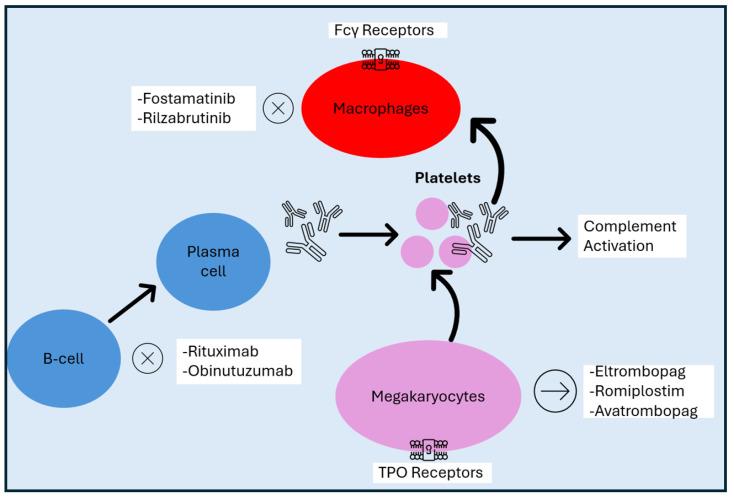
Immune thrombocytopenia (ITP) in pediatric patients is a common cause of isolated thrombocytopenia. Various pathophysiological mechanisms are implicated in ITP pathogenesis, including the production of autoantibodies against components of platelets (PLTs) by B-cells, the activation of the complement system, phagocytosis by macrophages mediated by Fcγ receptors, the dysregulation of T cells, and reduced bone marrow megakaryopoiesis. ITP is commonly manifested with skin and mucosal bleeding, and it is a diagnosis of exclusion. In some ITP cases, the disease is self-limiting, and treatment is not required, but chronic-persistent disease can also be developed. In these cases, anti-CD20 monoclonal antibodies, such as rituximab and thrombopoietin (TPO) receptor agonists, can be used. TPO agonists have become standard of care today. It has been reported in the published literature that the efficacy of TPO-RAs can be up to 80% in the achievement of several end goals, such as PLT counts. In the current literature review, the data regarding the impact of TPO agonists in the pathogenesis of ITP and treatment outcomes of the patients are examined. In the era of precision medicine, targeted and individualized therapies are crucial to achieving better outcomes for pediatric patients with ITP, especially when chronic refractory disease is developed.
儿童免疫性血小板减少症(ITP)是孤立性血小板减少症的常见病因。ITP发病机制涉及多种病理生理机制,包括B细胞产生针对血小板(PLT)成分的自身抗体、补体系统激活、Fcγ受体介导的巨噬细胞吞噬作用、T细胞失调以及骨髓巨核细胞生成减少。ITP通常表现为皮肤和黏膜出血,且是一种排除性诊断。在某些ITP病例中,疾病具有自限性,无需治疗,但也可能发展为慢性持续性疾病。在这些情况下,可使用抗CD20单克隆抗体,如利妥昔单抗和血小板生成素(TPO)受体激动剂。如今,TPO激动剂已成为标准治疗方法。已发表的文献报道,TPO受体激动剂在实现多个终点目标(如血小板计数)方面的疗效可达80%。在本次文献综述中,研究了TPO激动剂对ITP发病机制的影响以及患者的治疗结果。在精准医学时代,靶向和个体化治疗对于改善ITP患儿的治疗效果至关重要,尤其是在发展为慢性难治性疾病时。

 Zotero 插件